Berry Parul, Dhanakshirur Rohan Raju, Khanna Sahil
Division of Gastroenterology and Hepatology, Mayo Clinic, Rochester, MN, USA.
Indian Institute of Technology, New Delhi, India.
Therap Adv Gastroenterol. 2025 Apr 1;18:17562848251328577. doi: 10.1177/17562848251328577. eCollection 2025.
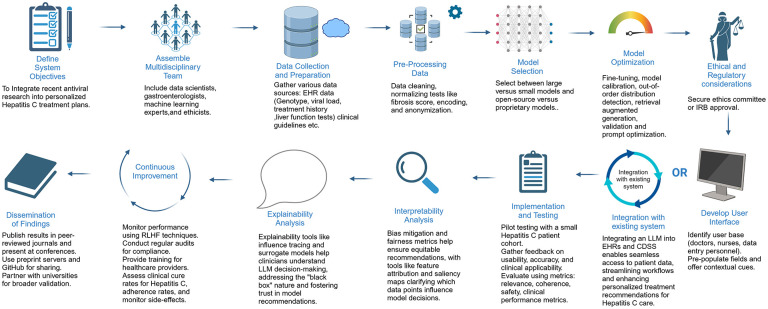
Large language models (LLMs) transform healthcare by assisting clinicians with decision-making, research, and patient management. In gastroenterology, LLMs have shown potential in clinical decision support, data extraction, and patient education. However, challenges such as bias, hallucinations, integration with clinical workflows, and regulatory compliance must be addressed for safe and effective implementation. This manuscript presents a structured framework for integrating LLMs into gastroenterology, using Hepatitis C treatment as a real-world application. The framework outlines key steps to ensure accuracy, safety, and clinical relevance while mitigating risks associated with artificial intelligence (AI)-driven healthcare tools. The framework includes defining clinical goals, assembling a multidisciplinary team, data collection and preparation, model selection, fine-tuning, calibration, hallucination mitigation, user interface development, integration with electronic health records, real-world validation, and continuous improvement. Retrieval-augmented generation and fine-tuning approaches are evaluated for optimizing model adaptability. Bias detection, reinforcement learning from human feedback, and structured prompt engineering are incorporated to enhance reliability. Ethical and regulatory considerations, including the Health Insurance Portability and Accountability Act, General Data Protection Regulation, and AI-specific guidelines (DECIDE-AI, SPIRIT-AI, CONSORT-AI), are addressed to ensure responsible AI deployment. LLMs have the potential to enhance decision-making, research efficiency, and patient care in gastroenterology, but responsible deployment requires bias mitigation, transparency, and ongoing validation. Future research should focus on multi-institutional validation and AI-assisted clinical trials to establish LLMs as reliable tools in gastroenterology.
大型语言模型(LLMs)通过协助临床医生进行决策、研究和患者管理来改变医疗保健。在胃肠病学领域,大型语言模型在临床决策支持、数据提取和患者教育方面已显示出潜力。然而,为了安全有效地实施,必须解决诸如偏差、幻觉、与临床工作流程的整合以及法规合规等挑战。本手稿提出了一个将大型语言模型整合到胃肠病学中的结构化框架,并将丙型肝炎治疗作为一个实际应用案例。该框架概述了关键步骤,以确保准确性、安全性和临床相关性,同时降低与人工智能驱动的医疗工具相关的风险。该框架包括定义临床目标、组建多学科团队、数据收集与准备、模型选择、微调、校准、幻觉缓解、用户界面开发、与电子健康记录整合、实际验证以及持续改进。对检索增强生成和微调方法进行了评估,以优化模型的适应性。纳入偏差检测、从人类反馈中进行强化学习以及结构化提示工程以提高可靠性。讨论了伦理和法规方面的考虑因素,包括《健康保险流通与责任法案》、《通用数据保护条例》以及特定于人工智能的指南(DECIDE - AI、SPIRIT - AI、CONSORT - AI),以确保负责任地部署人工智能。大型语言模型有潜力提高胃肠病学中的决策、研究效率和患者护理水平,但负责任的部署需要减轻偏差、保持透明度并持续进行验证。未来的研究应侧重于多机构验证和人工智能辅助临床试验,以使大型语言模型成为胃肠病学中可靠的工具。