
加纳半干旱地区木本和草本物种多样性对环境变量的响应不同。
Woody and Herbaceous Species Diversity Respond Differently to Environmental Variables in Semiarid Areas in Ghana.
作者信息
Guuroh Reginald T, Nero Bertrand F, Folega Fousseni, Oduro Kwame A, Kalanzi Fred, Adeyiga Gloria K, Asamoah Adu-Gyamfi, Appiah Mark, Obeng Miracle, Amponsah E
机构信息
CSIR-Forestry Research Institute of Ghana Kumasi Ghana.
Biodiversity Research/Systematic Botany University of Potsdam Potsdam Germany.
出版信息
Ecol Evol. 2025 Apr 15;15(4):e71253. doi: 10.1002/ece3.71253. eCollection 2025 Apr.
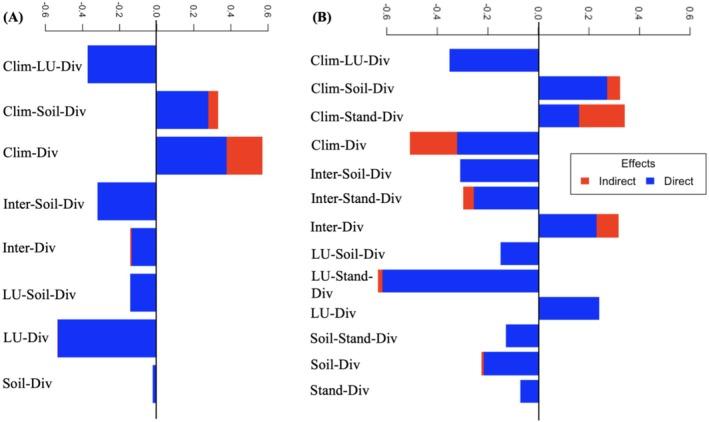
In the semiarid areas of Ghana, the interactive effects of various environmental drivers, their relative importance, and their direct and indirect effects on plant species composition and diversity are still poorly understood, hence affecting effective ecosystem management. Using a combined gradient approach, the study investigated the predictors of species diversity of both the woody and the herbaceous layers of a steep land-use and climatic gradient from the forest-savanna transition to the Sudan savanna of Ghana. Species richness and the Shannon-Weiner Index are the response variables. Two-way ANOVA was performed to test the interaction effects of climate and land-use on species diversity; linear mixed-effect models were used to test the relationships between multiple environmental variables, and structural equation modelling was used to determine the direct and indirect effects of climate and land-use on species diversity. We found significant effects of climate and land use, and their interactions on species diversity for both vegetation layers. We also found differential responses of the herbaceous and woody layers to environmental drivers. Land use (Grazing pressure) was the most important predictor of the woody layer while climatic aridity was the most important for the herbaceous layer. Climatic aridity and fire were only directly important for herbaceous vegetation but not the woody layer, although their indirect effects cannot be discounted. For soil properties, organic matter was important for both vegetation layers. The marked differences in species composition for various land uses along the climatic gradient imply that climate change will indeed affect vegetation. The observed importance of grazing for all response variables implies that land use could override climate effects and that appropriate land management strategies could mitigate potential negative effects of climate change.
在加纳的半干旱地区,各种环境驱动因素的交互作用、它们的相对重要性以及它们对植物物种组成和多样性的直接和间接影响仍未得到充分了解,从而影响了有效的生态系统管理。本研究采用综合梯度方法,调查了加纳从森林 - 稀树草原过渡到苏丹稀树草原的陡峭土地利用和气候梯度上木本层和草本层物种多样性的预测因子。物种丰富度和香农 - 维纳指数为响应变量。进行双向方差分析以检验气候和土地利用对物种多样性的交互作用;使用线性混合效应模型检验多个环境变量之间的关系,并使用结构方程模型确定气候和土地利用对物种多样性的直接和间接影响。我们发现气候和土地利用及其交互作用对两个植被层的物种多样性均有显著影响。我们还发现草本层和木本层对环境驱动因素的响应存在差异。土地利用(放牧压力)是木本层最重要的预测因子,而气候干旱对草本层最为重要。气候干旱和火灾仅对草本植被有直接重要性,对木本层则不然,尽管它们的间接影响不可忽视。对于土壤性质,有机质对两个植被层都很重要。沿气候梯度不同土地利用方式下物种组成的显著差异表明气候变化确实会影响植被。观察到的放牧对所有响应变量的重要性意味着土地利用可能会超过气候影响,并且适当的土地管理策略可以减轻气候变化的潜在负面影响。


 Zotero 插件