Meier Caroline S, Pagni Marco, Richard Sophie, Mühlethaler Konrad, Hauser Philippe M
Institute of Microbiology, Lausanne University Hospital and University of Lausanne, Lausanne, Switzerland.
Vital-IT Group, SIB Swiss Institute of Bioinformatics, Lausanne, Switzerland.
mBio. 2025 May 14;16(5):e0069225. doi: 10.1128/mbio.00692-25. Epub 2025 Apr 17.
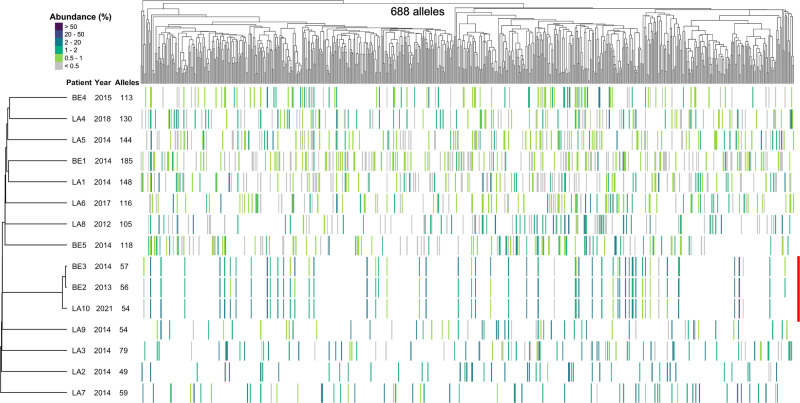
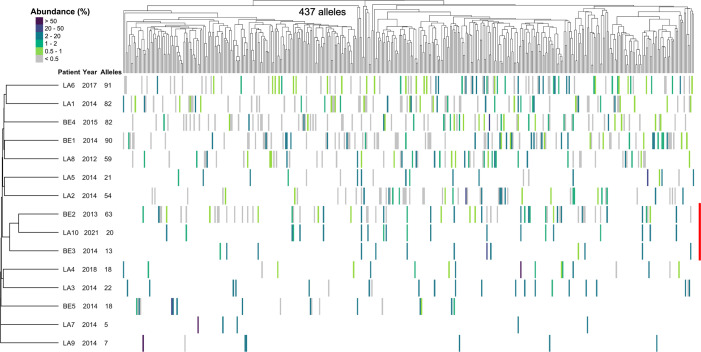
The fungus causes severe pneumonia in immunocompromised individuals. It harbors a system of surface antigenic variation involving six families of major surface glycoproteins (Msg). We determined the repertoires of genes of the most abundant family-I present in 15 Swiss patients with pneumonia (PCP) enrolled randomly. The highly repetitive -I genes were sequenced using generic PCRs followed by circular consensus sequencing with long reads. In contrast to the other 12 patients, three renal transplant recipients (RTRs) harbored the same repertoire of -I genes. Multilocus genotyping showed that these RTRs were infected by the same genotype that differed from those present in the other 12 patients. These observations suggested that these RTRs were involved in an outbreak of PCP due to interhuman transmission or a common source of the fungus. Although they harbored the same repertoire of -I genes, the sets of -I genes that were expressed differed between the three patients. This suggested that selective expression of surface antigens might have played a role in the pathogenesis of PCP by allowing escape from the immune response specific to each patient. Although expected for a family of genes, this is the first time that selective expression of antigens is observed in . The previously described adaptation of to infect solid organ transplant (SOT) recipients through resistance to the immunosuppressant mycophenolate probably also favored the suspected outbreak. Moreover, our study supports the idea that various genotypes can adapt to infect SOT recipients.IMPORTANCEThe fungus causes severe pneumonia in patients with weakened immune systems. It possesses a genetic system to vary the antigens at the surface of its cells that are presented to the immune system of the patient. We report for the first time that this system may have been implicated in the infections of renal transplant recipients involved in a suspected outbreak. Our observations suggest that the antigens presented might be selected to avoid the elimination of the fungus by the immune response specific to each patient. The resistance of the fungus to the immunosuppressant mycophenolate administered to these patients to prevent organ rejection probably also played a role in the infections during the suspected outbreak.
这种真菌会在免疫功能低下的个体中引发严重肺炎。它拥有一个表面抗原变异系统,涉及六个主要表面糖蛋白(Msg)家族。我们确定了随机招募的15名瑞士肺炎患者(肺孢子菌肺炎,PCP)中最丰富的I家族基因库。使用通用聚合酶链反应(PCR)对高度重复的I基因进行测序,随后进行长读长的环形一致测序。与其他12名患者不同,三名肾移植受者(RTR)拥有相同的I基因库。多位点基因分型显示,这些RTR感染的是同一基因型,与其他12名患者的基因型不同。这些观察结果表明,这些RTR因人际传播或真菌的共同来源而卷入了一次PCP暴发。尽管这三名患者拥有相同的I基因库,但他们所表达的I基因集却有所不同。这表明表面抗原的选择性表达可能通过逃避针对每个患者的免疫反应,在PCP的发病机制中发挥了作用。虽然对于一个基因家族来说这是预期的,但这是首次在该真菌中观察到抗原的选择性表达。先前描述的该真菌通过对免疫抑制剂霉酚酸的抗性来感染实体器官移植(SOT)受者的适应性变化,可能也促成了这次疑似暴发。此外,我们的研究支持了各种基因型的该真菌都能适应感染SOT受者这一观点。
这种真菌会在免疫系统较弱的患者中引发严重肺炎。它拥有一个遗传系统,可改变其细胞表面呈现给患者免疫系统的抗原。我们首次报告,这个系统可能与一次疑似暴发中肾移植受者的感染有关。我们的观察结果表明,所呈现的抗原可能经过选择,以避免被每个患者的特异性免疫反应清除。该真菌对这些患者为预防器官排斥而施用的免疫抑制剂霉酚酸的抗性,可能在这次疑似暴发期间的感染中也起到了作用。