Vera Cristian, Rueda Zulma Vanessa
Grupo de Investigación en Salud Pública, Research Department, Facultad de Medicina, Universidad Pontificia Bolivariana, Medellín 050031, Colombia.
Department of Medical Microbiology and Infectious Diseases, University of Manitoba, Winnipeg RT3, Colombia.
J Fungi (Basel). 2021 Nov 18;7(11):979. doi: 10.3390/jof7110979.
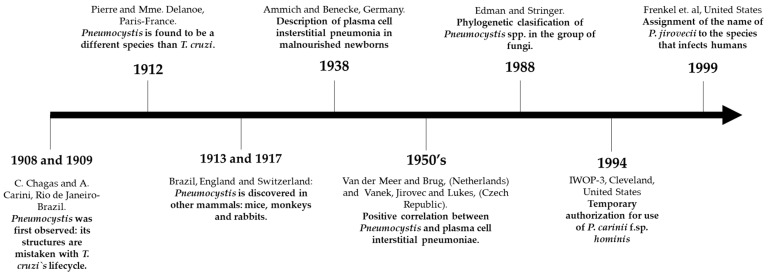
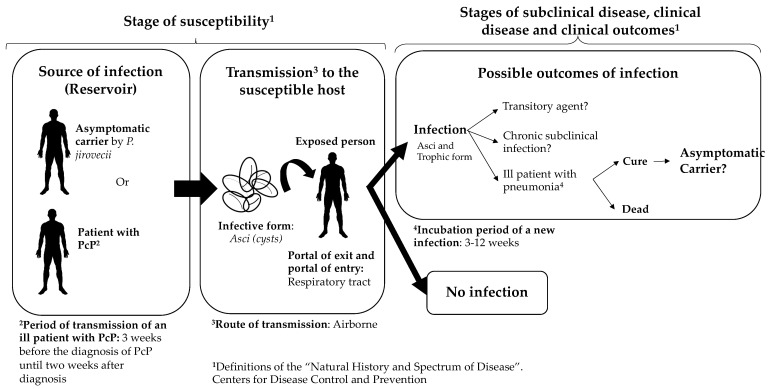
spp. was discovered in 1909 and was classified as a fungus in 1988. The species that infects humans is called and important characteristics of its genome have recently been discovered. Important advances have been made to understand , including aspects of its biology, evolution, lifecycle, and pathogenesis; it is now considered that the main route of transmission is airborne and that the infectious form is the asci (cyst), but it is unclear whether there is transmission by direct contact or droplet spread. On the other hand, has been detected in respiratory secretions of hosts without causing disease, which has been termed asymptomatic carrier status or colonization (frequency in immunocompetent patients: 0-65%, pregnancy: 15.5%, children: 0-100%, HIV-positive patients: 20-69%, cystic fibrosis: 1-22%, and COPD: 16-55%). This article briefly describes the history of its discovery and the nomenclature of spp., recently uncovered characteristics of its genome, and what research has been done on the transmission and colonization of . Based on the literature, the authors of this review propose a hypothetical natural history of infection in humans.
该菌种于1909年被发现,并于1988年被归类为真菌。感染人类的菌种被称为 ,其基因组的重要特征最近已被发现。在了解 方面已经取得了重要进展,包括其生物学、进化、生命周期和发病机制等方面;目前认为主要传播途径是空气传播,感染形式是子囊(囊肿),但尚不清楚是否存在通过直接接触或飞沫传播的情况。另一方面,在宿主的呼吸道分泌物中检测到了 但未引发疾病,这被称为无症状携带状态或定植(免疫功能正常患者中的频率:0 - 65%,孕妇:15.5%,儿童:0 - 100%,HIV阳性患者:20 - 69%,囊性纤维化患者:1 - 22%,慢性阻塞性肺疾病患者:16 - 55%)。本文简要介绍了其发现历史和 菌种的命名法,最近发现的其基因组特征,以及对 的传播和定植所做的研究。基于文献,本综述的作者提出了人类 感染的假设自然史。