Kushner J Keenan, Hoffman Paige B, Brzezinski Christine R, Svalina Matthew N, O'Neill Brent R, Hankinson Todd C, Wilkinson Charles C, Handler Michael H, Baca Serapio M, Huntsman Molly M, Alexander Allyson L
Neuroscience Graduate Program, University of Colorado | Anschutz Medical Campus, Aurora, Colorado 80045
Department of Pharmaceutical Sciences, Skaggs School of Pharmacy and Pharmaceutical Sciences, University of Colorado | Anschutz Medical Campus, Aurora, Colorado 80045.
eNeuro. 2025 May 8;12(5). doi: 10.1523/ENEURO.0247-24.2025. Print 2025 May.
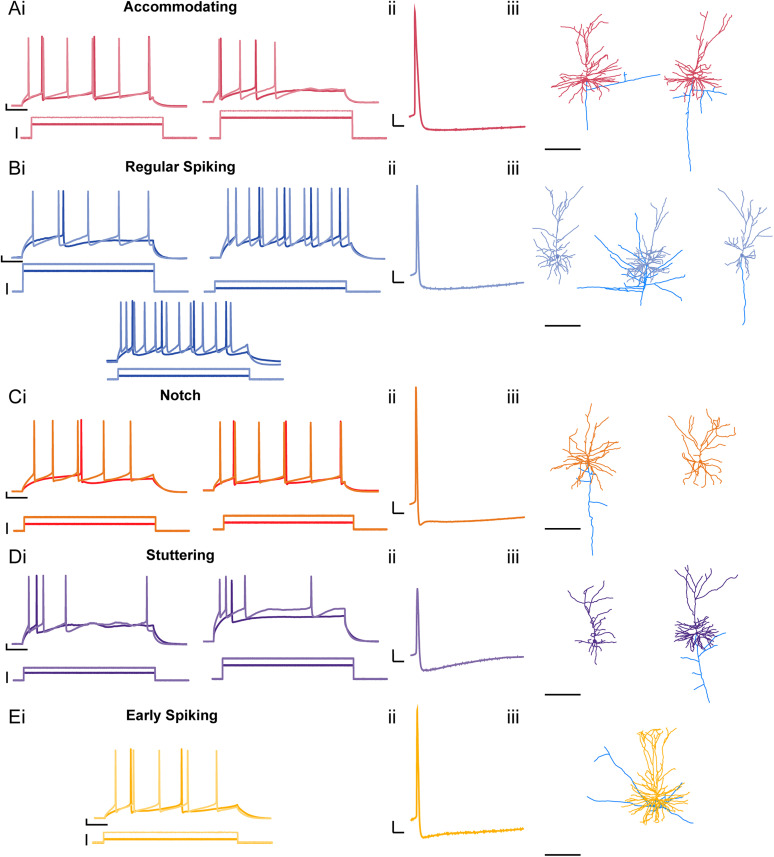
Childhood epilepsy is a common and devastating condition, for which many children still do not have adequate treatment. Some children with drug-resistant epilepsy require surgical excision of epileptogenic brain tissue for seizure control, affording the opportunity to study this tissue ex vivo to interrogate human epileptic neurons for potentially hyperexcitable perturbations in intrinsic electrophysiological properties. In this study, we characterized the diversity of layer L2/3 (L2/3) pyramidal neurons (PNs) in ex vivo brain slices from pediatric patients with epilepsy. We found a remarkable diversity in the firing properties of epileptic L2/3 PNs: five distinct subpopulations were identified. Additionally, we investigated whether the etiology of epilepsy influenced the intrinsic neuronal properties of L2/3 PNs when comparing tissue from patients with epilepsy due to malformations of cortical development (MCDs), other forms of epilepsy (OEs), or with deep-seated tumors. When comparing epileptic with control L2/3 PNs, we observed a decrease in voltage sag and lower maximum firing rates. Moreover, we found that MCD and OE L2/3 PNs were mostly similar indicating that epilepsy etiology may not outweigh the influences of epileptiform activity on L2/3 PN physiology. Lastly, we show that the proconvulsant drug, 4-aminopyridine (4-AP), leads to increased AP half-width, reduced firing rate accommodation, and slower AHPs. These changes imply that 4-AP induces an increase in [K] and a resultant increase in AP duration, leading to the release of more excitatory neurotransmitters per action potential, thereby promoting network hyperexcitability.
儿童癫痫是一种常见且严重的疾病,许多儿童仍未得到充分治疗。一些耐药性癫痫患儿需要手术切除致痫脑组织以控制癫痫发作,这为离体研究该组织提供了机会,以便探究人类癫痫神经元内在电生理特性中可能存在的过度兴奋扰动。在本研究中,我们对癫痫患儿离体脑片中的第2/3层(L2/3)锥体神经元(PNs)的多样性进行了表征。我们发现癫痫性L2/3 PNs的放电特性存在显著差异:确定了五个不同的亚群。此外,在比较皮质发育畸形(MCDs)所致癫痫、其他形式癫痫(OEs)或深部肿瘤患者的组织时,我们研究了癫痫病因是否会影响L2/3 PNs的内在神经元特性。在将癫痫性L2/3 PNs与对照L2/3 PNs进行比较时,我们观察到电压凹陷减少和最大放电率降低。此外,我们发现MCD和OE的L2/3 PNs大多相似,这表明癫痫病因对L2/3 PN生理学的影响可能不超过癫痫样活动的影响。最后,我们表明惊厥药物4-氨基吡啶(4-AP)会导致动作电位半宽度增加、放电率适应性降低和后超极化减慢。这些变化意味着4-AP会导致[K]增加,进而使动作电位持续时间增加,导致每个动作电位释放更多兴奋性神经递质,从而促进网络过度兴奋。