Wang Jingfu, Ding Mingchao, Chang Xin, Zhang Hongyun, Liu Yan, Qu Shuang, Ma Qin
State Key Laboratory of Oral & Maxillofacial Reconstruction and Regeneration, National Clinical Research Center for Oral Diseases, Shaanxi Clinical Research Center for Oral Diseases, Department of Oral and Maxillofacial Surgery, School of Stomatology, The Fourth Military Medical University, 145 West Changle Road, Xi'an, 710032, PR China.
Department of Stomatology, General Hospital of Northern Theater Command, 83 Wenhua Road, Shenyang, China.
BMC Oral Health. 2025 Apr 17;25(1):582. doi: 10.1186/s12903-025-05971-x.
Oral and maxillofacial space infections (OMSIs) are a serious emergency disease in oral and maxillofacial departments; untreated or undertreated OMSI can lead to serious complications and can be life-threatening. This study aimed to comprehensively analyse the epidemiological characteristics of OMSI, identify the associated etiological and risk factors, and develop a machine learning-based predictive model for factors influencing hospitalisation.
Medical records of 217 patients hospitalised with OMSI were retrospectively analysed. Demographic data, clinical characteristics, treatment histories, microbiological profiles, and drug sensitivity test results were reviewed. A risk prediction model for hospitalisation length was established using machine learning.
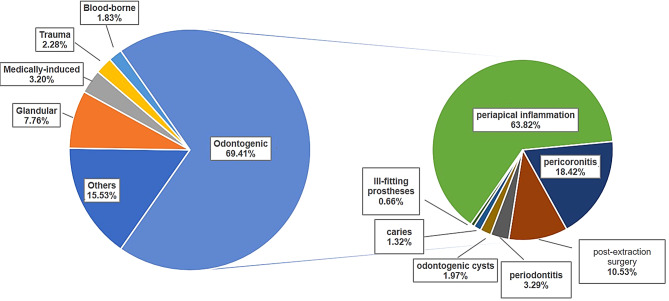
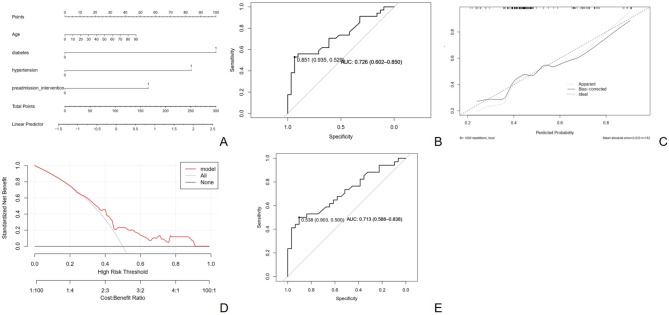
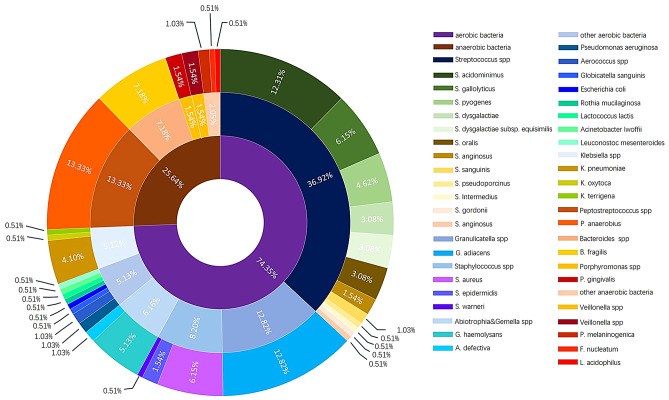
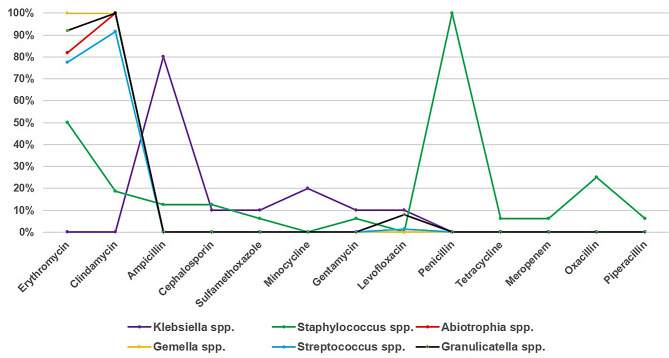
Odontogenic infections (69.41%) were the most common etiological factors for OMSI, with periapical periodontitis being the most prevalent. Streptococcus spp. was the most frequently cultured aerobic bacteria, whereas Peptostreptococcus anaerobius was the predominant anaerobe. Drug sensitivity tests indicated high resistance rates to clindamycin and erythromycin among aerobic bacteria. The risk prediction model exhibited an area under the curve of 0.726 and was validated by an internal area under the curve of 0.712. Factors such as hypertension, diabetes, pre-admission interventions, and age were significantly associated with prolonged hospitalisation.
Periapical periodontitis remains a primary cause of OMSI; however, the rising incidence of infections due to cosmetic injections and implant surgeries warrants attention. Penicillin, clindamycin, and erythromycin are not recommended as empirical first-choice drugs. The predictive model effectively identified risk factors for extended hospitalisation. Hypertension, diabetes, pre-admission interventions, and age are risk factors for lengthened hospitalisation. Efforts should be made to promote oral hygiene education and healthcare system reforms in regions with similar demographic and socioeconomic conditions.
口腔颌面部间隙感染(OMSIs)是口腔颌面科一种严重的急症疾病;未经治疗或治疗不充分的OMSIs可导致严重并发症并可能危及生命。本研究旨在全面分析OMSIs的流行病学特征,确定相关的病因和危险因素,并建立基于机器学习的影响住院因素的预测模型。
回顾性分析217例因OMSIs住院患者的病历。审查了人口统计学数据、临床特征、治疗史、微生物学特征和药敏试验结果。使用机器学习建立住院时间的风险预测模型。
牙源性感染(69.41%)是OMSIs最常见的病因,根尖周炎最为普遍。链球菌属是最常培养出的需氧菌,而厌氧消化链球菌是主要的厌氧菌。药敏试验表明需氧菌对克林霉素和红霉素的耐药率较高。风险预测模型的曲线下面积为0.726,并通过内部曲线下面积0.712进行了验证。高血压、糖尿病、入院前干预和年龄等因素与住院时间延长显著相关。
根尖周炎仍然是OMSIs的主要原因;然而,由于美容注射和种植手术导致的感染发病率上升值得关注。不推荐将青霉素、克林霉素和红霉素作为经验性首选药物。该预测模型有效地识别了延长住院时间的危险因素。高血压、糖尿病、入院前干预和年龄是住院时间延长的危险因素。应努力在具有相似人口统计学和社会经济条件的地区推广口腔卫生教育和医疗体系改革。