BaiQuan Yang, Meng Cao, Congqing Zhu, XiaoDong Wang
Sports College of Shenzhen University, 3688 Nan Hai Road, Nan Shan District, Shenzhen, 518061, China.
School of Physical Education, Shanghai Normal University, Shanghai, 200234, China.
Sci Rep. 2025 Apr 21;15(1):13770. doi: 10.1038/s41598-025-98590-z.
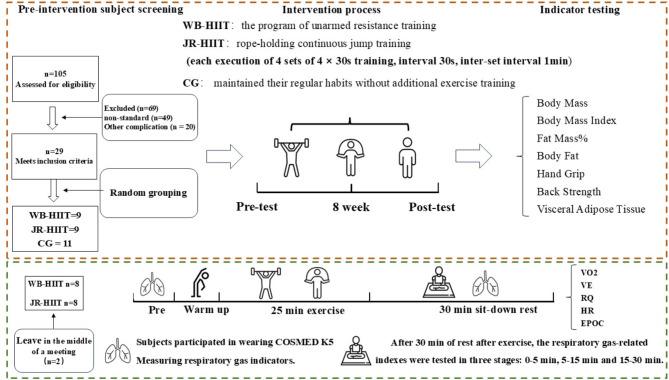
This study aimed to compare the effects of two high-intensity interval training modalities on body composition and muscular fitness in obese young adults and examined the characteristics of energy expenditure (EE) after training. Thirty-six obese young adults (eleven female, age: 22.1 ± 2.3 years, BMI: 25.1 ± 1.2 kg/m) were to Whole-body high-intensity interval training group (WB-HIIT) (n = 12), jump rope high-intensity interval training group (JR-HIIT) (n = 12), or non-training control group (CG) (n = 12). WB-HIIT and JR-HIIT groups performed an 8-week HIIT protocol. WB-HIIT, according to the program of unarmed resistance training, JR-HIIT use rope-holding continuous jump training, each execution of 4 sets of 4 × 30 s training, interval 30 s, inter-set interval 1min, and the control group maintained their regular habits without additional exercise training. Body composition and muscular strength were assessed before and after 8 weeks. Repeated measures analysis of variance and clinical effect analysis using Cohen's effect size were used, with a significance level of p < 0.05. In comparison with the CG group in both experimental groups, Body Mass and BMI significantly reduced (p < 0.05), and Muscular strength significantly improved (p < 0.05).WB-HIIT versus JR-HIIT: Fat Mass (- 1.5 ± 1.6; p = 0.02 vs - 2.3 ± 1.2; p < 0.01) and % Body Fat (- 1.3 ± 1.7; p = 0.05 vs - 1.9 ± 1.9; p < 0.01) the effect is more pronounced in the JR-HIIT group; Muscle Mass (1.5 ± 0.7; p < 0.01 vs - 0.8 ± 1.1; p = 0.07) the effect is more pronounced in the WB-HIIT group. Estimated daily energy intake (122 ± 459 vs 157 ± 313; p > 0.05). Compared to the CG, body composition was significantly improved in both intervention groups. All three groups had no significant changes in visceral adipose tissue (p > 0.05). Significant differences in Lipid and Carbohydrate oxidation and energy output were observed between the two groups, as well as substantial differences in WB-HIIT and JR-HIIT VO, ventilation, and energy consumption minute during the 0-5 min post-exercise period (p > 0.05). WB-HIIT and JR-HIIT interventions effectively improve the body composition of young adults with obesity, while WB-HIIT additionally improves muscular fitness. After exercise, WB-HIIT produces higher excess post-exercise oxygen consumption and associated lipid and carbohydrate metabolism than JR-HIIT.
本研究旨在比较两种高强度间歇训练方式对肥胖青年成年人身体成分和肌肉适能的影响,并研究训练后能量消耗(EE)的特征。36名肥胖青年成年人(11名女性,年龄:22.1±2.3岁,BMI:25.1±1.2kg/m²)被分为全身高强度间歇训练组(WB-HIIT)(n = 12)、跳绳高强度间歇训练组(JR-HIIT)(n = 12)或非训练对照组(CG)(n = 12)。WB-HIIT组和JR-HIIT组进行为期8周的HIIT方案。WB-HIIT按照徒手抗阻训练方案进行,JR-HIIT采用持绳连续跳跃训练,每次进行4组,每组4×30秒训练,间歇30秒,组间间歇1分钟,对照组保持常规习惯,不进行额外运动训练。在8周前后评估身体成分和肌肉力量。采用重复测量方差分析和使用科恩效应量的临床效果分析,显著性水平为p < 0.05。与CG组相比,两个实验组的体重和BMI均显著降低(p < 0.05),肌肉力量显著提高(p < 0.05)。WB-HIIT组与JR-HIIT组比较:脂肪量(-1.5±1.6;p = 0.02 vs -2.3±1.2;p < 0.01)和体脂百分比(-1.3±1.7;p = 0.05 vs -1.9±1.9;p < 0.01)在JR-HIIT组效果更明显;肌肉量(1.5±0.7;p < 0.01 vs -0.8±1.1;p = 0.07)在WB-HIIT组效果更明显。估计每日能量摄入量(122±459 vs 157±313;p > 0.05)。与CG组相比,两个干预组的身体成分均显著改善。三组的内脏脂肪组织均无显著变化(p > 0.05)。两组之间在脂质和碳水化合物氧化及能量输出方面存在显著差异,以及在运动后0 - 5分钟期间WB-HIIT和JR-HIIT的VO₂、通气和能量消耗分钟数方面存在显著差异(p > 0.05)。WB-HIIT和JR-HIIT干预有效改善肥胖青年成年人的身体成分,而WB-HIIT还额外改善肌肉适能。运动后,WB-HIIT比JR-HIIT产生更高的运动后过量氧耗以及相关的脂质和碳水化合物代谢。