Sergi Domenico, Angelini Sharon, Spaggiari Riccardo, Castaldo Fabiola, Zuliani Giovanni, Sanz Juana Maria, Passaro Angelina
Department of Translational Medicine, University of Ferrara, 44121, Ferrara, Italy.
Department of Chemical, Pharmaceutical and Agricultural Sciences, University of Ferrara, 44121, Ferrara, Italy.
Eur J Nutr. 2025 Apr 22;64(4):162. doi: 10.1007/s00394-025-03672-3.
Dietary advanced glycation end products (AGEs) have been implicated in promoting insulin resistance. However, their impact on insulin resistance in a mixed population made up of males and females remains controversial. The aim of this study was to evaluate whether the relationship between dietary AGEs and insulin resistance may be sex-dependent.
195 males and 239 females were included in this cross-sectional study. Study participants underwent anthropometric and metabolic assessments. AGE intake was estimated using food frequency questionnaires and databases reporting AGE content in individual food items. The relationship between AGE intake and insulin resistance, estimated using HOMA-IR, was assessed using Pearson correlation test. The predictive power of dietary AGEs towards HOMA-IR was investigated using stepwise linear regression.
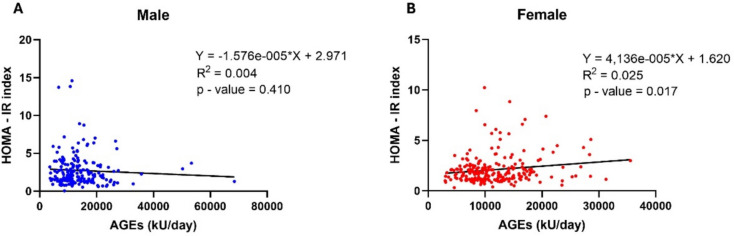
AGE intake correlated positively with HOMA-IR in females (p < 0.01) but not in male study participants (p > 0.05). Moreover, AGE intake was able to increase the predictive power of BMI towards insulin resistance in females but not males. Instead, anthropometric variables were the only discriminants able to predict insulin resistance in males.
Dietary AGEs exert a sex-dependent effect on insulin resistance as their intake is associated with and able to predict HOMA-IR in females but not males. This suggests that females may be more susceptible to the deleterious impact of these glycotoxins on insulin sensitivity. Nevertheless, considering this study not involving a nutritional intervention to directly elucidate whether the effect of AGEs on insulin resistance is sex-dependent, further studies are warranted to confirm the present findings.
膳食晚期糖基化终产物(AGEs)被认为与促进胰岛素抵抗有关。然而,它们对由男性和女性组成的混合人群中胰岛素抵抗的影响仍存在争议。本研究的目的是评估膳食AGEs与胰岛素抵抗之间的关系是否可能存在性别差异。
本横断面研究纳入了195名男性和239名女性。研究参与者接受了人体测量和代谢评估。使用食物频率问卷和报告单个食物中AGE含量的数据库来估计AGE摄入量。使用Pearson相关检验评估AGE摄入量与使用HOMA-IR估计的胰岛素抵抗之间的关系。使用逐步线性回归研究膳食AGEs对HOMA-IR的预测能力。
在女性中,AGE摄入量与HOMA-IR呈正相关(p < 0.01),而在男性研究参与者中则无相关性(p > 0.05)。此外,AGE摄入量能够增加BMI对女性胰岛素抵抗的预测能力,但对男性则不然。相反,人体测量变量是能够预测男性胰岛素抵抗的唯一判别因素。
膳食AGEs对胰岛素抵抗具有性别依赖性影响,因为它们的摄入量与女性的HOMA-IR相关且能够预测女性的HOMA-IR,但对男性则不然。这表明女性可能更容易受到这些糖毒素对胰岛素敏感性的有害影响。然而,考虑到本研究未涉及营养干预以直接阐明AGEs对胰岛素抵抗的影响是否存在性别差异,有必要进行进一步研究以证实本研究结果。