Kahleova Hana, Znayenko-Miller Tatiana, Uribarri Jaime, Holubkov Richard, Barnard Neal D
Physicians Committee for Responsible Medicine Washington District of Columbia USA.
Icahn School of Medicine at Mount Sinai New York New York USA.
Obes Sci Pract. 2022 Oct 21;9(3):235-242. doi: 10.1002/osp4.646. eCollection 2023 Jun.
Evidence suggests that changes in advanced glycation end-products (AGEs) may influence body weight. Previous studies have focused on cooking methods as the primary way how to reduce the dietary AGEs but little is known about the effects of a change in diet composition.
The aim of this study was to assess the effects of a low-fat plant-based diet on dietary AGEs and test the association with body weight, body composition, and insulin sensitivity.
Participants who were overweight ( = 244) were randomly assigned to an intervention (low-fat plant-based) ( = 122) or control group ( = 122) for 16 weeks. Before and after the intervention period, body composition was measured by dual X-ray absorptiometry. Insulin sensitivity was assessed with the predicted insulin sensitivity index (PREDIM). Three-day diet records were analyzed using the Nutrition Data System for Research software and dietary AGEs were estimated, using a database. Repeated measure ANOVA was used for statistical analysis.
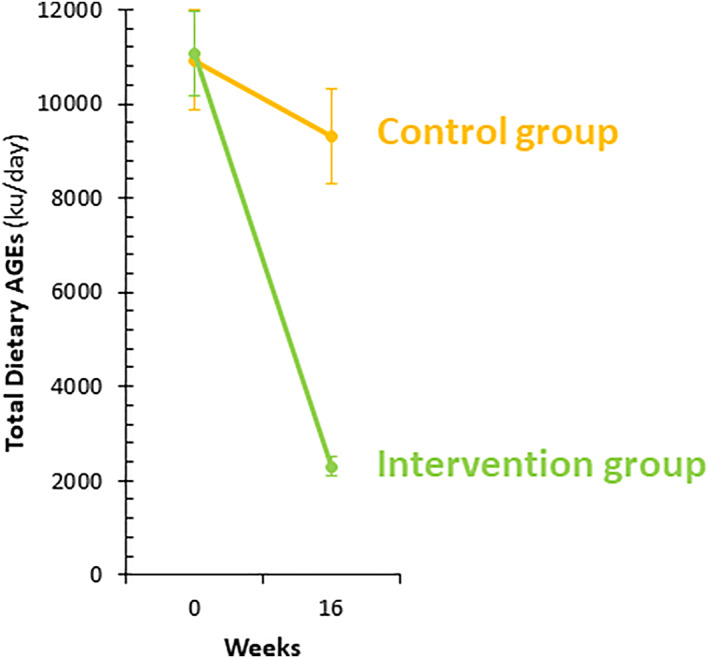
Dietary AGEs decreased in the intervention group by 8768 ku/day on average (95% -9611 to -7925; < 0.001), compared with the control group (-1608; 95% CI -2709 to -506; = 0.005; treatment effect -7161 ku/day [95% CI -8540 to -5781]; Gxt, < 0.001). Body weight decreased by 6.4 kg in the intervention group, compared with 0.5 kg in the control group (treatment effect -5.9 kg [95% CI -6.8 to -5.0]; Gxt, < 0.001), largely due to a reduction in fat mass, notably visceral fat. PREDIM increased in the intervention group (treatment effect +0.9 [95% CI + 0.5 to +1.2]; < 0.001). Changes in dietary AGEs correlated with changes in body weight ( = +0.41; < 0.001), fat mass ( = +0.38; < 0.001), visceral fat ( = +0.23; < 0.001), and PREDIM ( = -0.28; < 0.001), and remained significant even after adjustment for changes in energy intake ( = +0.35; < 0.001 for body weight; = +0.34; < 0.001 for fat mass; = +0.15; = 0.03 for visceral fat; and = -0.24; < 0.001 for PREDIM).
Dietary AGEs decreased on a low-fat plant-based diet, and this decrease was associated with changes in body weight, body composition, and insulin sensitivity, independent of energy intake. These findings demonstrate positive effects of qualitative dietary changes on dietary AGEs and cardiometabolic outcomes.
NCT02939638.
有证据表明,晚期糖基化终产物(AGEs)的变化可能会影响体重。以往的研究主要关注烹饪方法,将其作为减少膳食中AGEs的主要途径,但对于饮食成分变化的影响知之甚少。
本研究旨在评估低脂植物性饮食对膳食AGEs的影响,并测试其与体重、身体成分和胰岛素敏感性之间的关联。
将超重参与者(n = 244)随机分为干预组(低脂植物性饮食,n = 122)或对照组(n = 122),为期16周。在干预期前后,通过双能X线吸收法测量身体成分。使用预测胰岛素敏感性指数(PREDIM)评估胰岛素敏感性。使用营养数据系统研究软件分析三天的饮食记录,并使用数据库估算膳食AGEs。采用重复测量方差分析进行统计分析。
与对照组(-1608;95%CI -2709至-506;P = 0.005;治疗效果-7161 ku/天[95%CI -8540至-5781];P<0.001)相比,干预组的膳食AGEs平均每天减少8768 ku(95%CI -9611至-7925;P<0.001)。干预组体重下降6.4 kg,而对照组体重下降0.5 kg(治疗效果-5.9 kg[95%CI -6.8至-5.0];P<0.001),这主要归因于脂肪量的减少,尤其是内脏脂肪。干预组的PREDIM增加(治疗效果+0.9[95%CI +0.5至+1.2];P<0.001)。膳食AGEs的变化与体重变化(r = +0.41;P<0.001)、脂肪量变化(r = +0.38;P<0.001)、内脏脂肪变化(r = +0.23;P<0.001)和PREDIM变化(r = -0.28;P<0.001)相关,即使在调整能量摄入变化后仍具有显著性(体重r = +0.35;P<0.001;脂肪量r = +0.34;P<0.001;内脏脂肪r = +0.15;P = 0.03;PREDIM r = -0.24;P<0.001)。
低脂植物性饮食可降低膳食AGEs,这种降低与体重、身体成分和胰岛素敏感性的变化相关,且与能量摄入无关。这些发现表明,饮食质量的改变对膳食AGEs和心脏代谢结局具有积极影响。
NCT02939638。