
考虑新型电力系统影响的重力储能电站容量优化策略
Capacity optimization strategy for gravity energy storage stations considering the impact of new power systems.
作者信息
Lv Can, He Jun, Ma Jingjing, Yang Yukun, Liu Fan, Huang Wentao
机构信息
Hubei Collaborative Innovation Center for High-Efficiency Utilization of Solar Energy, Hubei University of Technology, Wuhan, China.
出版信息
PLoS One. 2025 Apr 23;20(4):e0320734. doi: 10.1371/journal.pone.0320734. eCollection 2025.
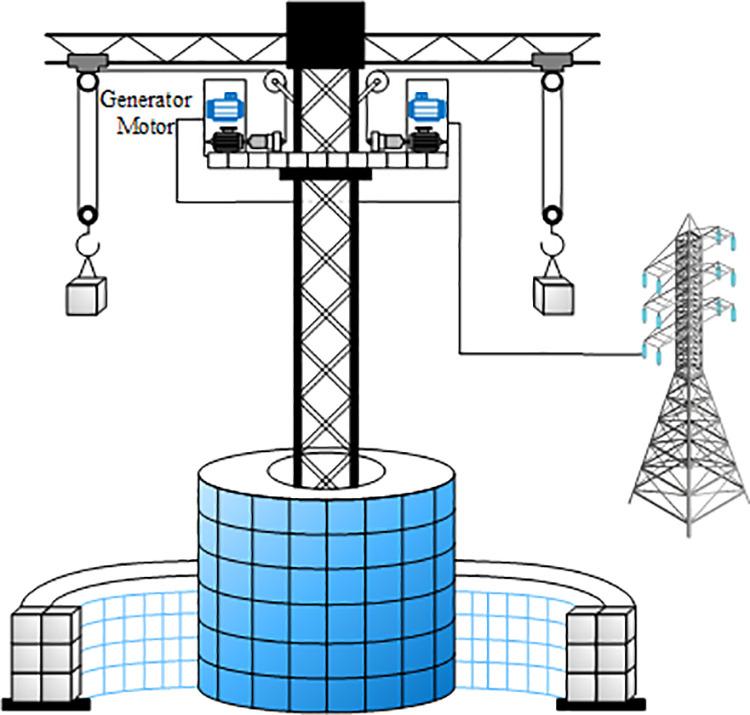
The integration of renewable energy sources, such as wind and solar power, into the grid is essential for achieving carbon peaking and neutrality goals. However, the inherent variability and unpredictability of these energy sources pose significant challenges to power system stability. Advanced energy storage systems (ESS) are critical for mitigating these challenges, with gravity energy storage systems (GESS) emerging as a promising solution due to their scalability, economic viability, and environmental benefits. This paper proposes a multi-objective economic capacity optimization model for GESS within a novel power system framework, considering the impacts on power network stability, environmental factors, and economic performance. The model is solved using an enhanced Grasshopper Optimization Algorithm (W-GOA) incorporating a whale spiral motion strategy to improve convergence and solution accuracy. Simulations on the IEEE 30-node system demonstrate that GESS reduces peak-to-valley load differences by 36.1% and curtailment rates by 42.3% (wind) and 18.7% (PV), with a 15% lower levelized cost than CAES. The results indicate that GESS effectively mitigates peak load pressures, stabilizes the grid, and provides a cost-effective solution for integrating high shares of renewable energy. This study highlights the potential of GESS as a key component in future low-carbon power systems, offering both technical and economic advantages over traditional energy storage technologies.
将风能和太阳能等可再生能源整合到电网中对于实现碳达峰和碳中和目标至关重要。然而,这些能源固有的波动性和不可预测性给电力系统稳定性带来了重大挑战。先进的储能系统(ESS)对于缓解这些挑战至关重要,重力储能系统(GESS)因其可扩展性、经济可行性和环境效益而成为一种有前途的解决方案。本文在一个新颖的电力系统框架内提出了一种用于GESS的多目标经济容量优化模型,考虑了对电网稳定性、环境因素和经济性能的影响。该模型使用一种结合了鲸鱼螺旋运动策略的增强型蚱蜢优化算法(W-GOA)求解,以提高收敛性和求解精度。在IEEE 30节点系统上的仿真表明,GESS将峰谷负荷差异降低了36.1%,削减率降低了42.3%(风能)和18.7%(光伏),其平准化成本比压缩空气储能(CAES)低15%。结果表明,GESS有效地缓解了峰值负荷压力,稳定了电网,并为整合高比例可再生能源提供了一种具有成本效益的解决方案。本研究突出了GESS作为未来低碳电力系统关键组件的潜力,与传统储能技术相比具有技术和经济优势。



 Zotero 插件