Servadio Michela, Belleudi Valeria, Poggi Francesca R, Perna Serena, Addis Antonio, Davoli Marina, Trotta Francesco, Fortinguerra Filomena
Department of Epidemiology, Lazio Regional Health Service, ASL Roma 1, Via Cristoforo Colombo, 112, 00147, Rome, Italy.
Italian Medicines Agency (AIFA), Rome, Italy.
BMC Pregnancy Childbirth. 2025 Apr 23;25(1):480. doi: 10.1186/s12884-025-07605-0.
Exposure to antibiotics during pregnancy is frequent, despite the limited evidence derived from clinical trials. Drug utilization studies could improve knowledge on utilization of these medications during this critical period. In this context, the present study aimed to describe antibiotic exposure during pregnancy in Italy at both national and regional levels.
This retrospective population-based study involved a cohort of women who gave birth from 2016 to 2018 and were residents of one of the following Italian regions: Lombardy, Veneto, Emilia-Romagna, Tuscany, Umbria, Lazio, Apulia or Sardinia. A series of sociodemographic and clinical characteristics were retrieved from regional healthcare databases. The prevalence of the use of antibiotics was estimated in nine trimesters, which were divided into three different periods: pre- pregnancy (-III, -II, -I) during pregnancy (I, II, III) and post-pregnancy (+ I, + II, + III). Analyses were stratified by region and by prenatal invasive diagnostic performed.
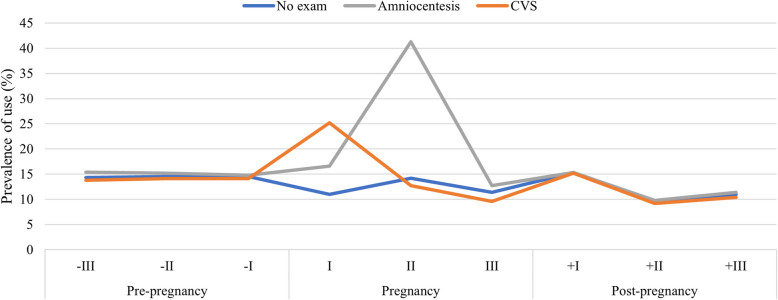
A total of 449,012 women were included in the study, of whom more than 37% were aged ≥ 35 years at birth. The overall prevalence rates of antibiotic use in the study cohort were 33.9% pre-pregnancy (per trimester: -III = 14.3%, -II = 14.5%, -I = 14.5%), 31.8% during pregnancy (per trimester: I = 12.0%, II = 16.0%, III = 11.4%) and 29.3% post-pregnancy (per trimester: + I = 15.3%, + II = 9.7%; + III = 11.0%). The regions with the lowest usage pre-, during and post-pregnancy were Lombardy (29.7%, 26.1%, 28.0%) and Veneto (28.8%, 26.4%, 25.5%), whereas Apulia reached the highest values (45.6%, 41.6%, 38.3%). The highest peaks during pregnancy were reached by Umbria (25.8%), Latium (24.1%) and Apulia (21.4%). Women who underwent chorionic villus sampling and those who underwent amniocentesis registered a peak during trimester I (25%) and trimester II (41%), respectively. These peaks were in line with the timing of the invasive prenatal diagnostic procedures.
The use of antibiotics during pregnancy in Italy was in line with other European countries, reflecting national and international guidelines. However, a certain level of misuse of specific antibiotics and different utilization rates across the regions were observed. Continuous monitoring of long- and short-term outcomes associated with exposure to antibiotics during pregnancy may contribute to reducing excessive utilization and improving the diffusion of more appropriate procedures and practices.
尽管临床试验证据有限,但孕期接触抗生素的情况仍很常见。药物利用研究有助于增进对这些药物在这一关键时期使用情况的了解。在此背景下,本研究旨在描述意大利全国和地区层面孕期抗生素暴露情况。
这项基于人群的回顾性研究纳入了2016年至2018年分娩的女性队列,她们居住在以下意大利地区之一:伦巴第、威尼托、艾米利亚 - 罗马涅、托斯卡纳、翁布里亚、拉齐奥、普利亚或撒丁岛。从地区医疗保健数据库中检索了一系列社会人口统计学和临床特征。在九个孕期阶段估计抗生素使用的患病率,这九个孕期阶段分为三个不同时期:孕前(-III、-II、-I)、孕期(I、II、III)和产后(+I、+II、+III)。分析按地区和产前侵入性诊断进行分层。
该研究共纳入449,012名女性,其中超过37%在分娩时年龄≥35岁。研究队列中抗生素使用的总体患病率在孕前为33.9%(每个孕期阶段:-III = 14.3%,-II = 14.5%,-I = 14.5%),孕期为31.8%(每个孕期阶段:I = 12.0%,II = 16.0%,III = 11.4%),产后为29.3%(每个孕期阶段:+I = 15.3%,+II = 9.7%;+III = 11.0%)。孕前、孕期和产后使用率最低的地区是伦巴第(29.7%、26.1%、28.0%)和威尼托(28.8%、26.4%、25.5%),而普利亚达到最高值(45.6%、41.6%、38.3%)。翁布里亚(25.8%)、拉齐奥(24.1%)和普利亚(21.4%)在孕期达到最高峰值。接受绒毛取样的女性和接受羊膜穿刺术的女性分别在孕期第一阶段(25%)和第二阶段(41%)出现峰值。这些峰值与侵入性产前诊断程序的时间一致。
意大利孕期抗生素的使用与其他欧洲国家一致,符合国家和国际指南。然而,观察到特定抗生素存在一定程度的滥用以及各地区使用率不同。持续监测孕期接触抗生素相关的长期和短期结果可能有助于减少过度使用,并促进更适当程序和做法的推广。