Jiang Zhibin, Hu Keli, Qu Jia, Bian Zekang, Yu Donghua, Zhou Jie
Department of Computer Science and Engineering, Shaoxing University, Shaoxing, China.
Institute of Artificial Intelligence, Shaoxing University, Shaoxing, China.
Front Neuroinform. 2025 Apr 9;19:1559335. doi: 10.3389/fninf.2025.1559335. eCollection 2025.
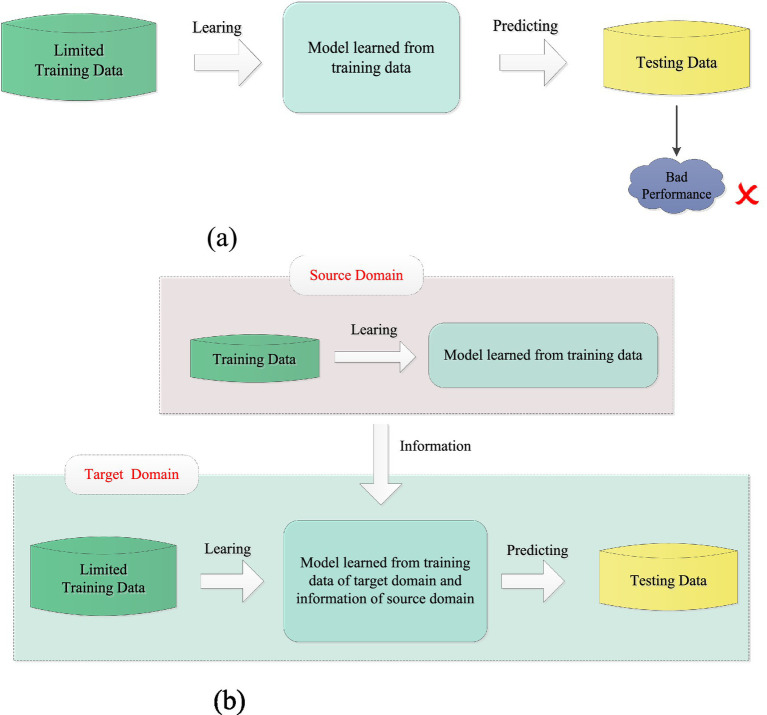
Motor imagery electroencephalographic (MI-EEG) signal recognition is used in various brain-computer interface (BCI) systems. In most existing BCI systems, this identification relies on classification algorithms. However, generally, a large amount of subject-specific labeled training data is required to reliably calibrate the classification algorithm for each new subject. To address this challenge, an effective strategy is to integrate transfer learning into the construction of intelligent models, allowing knowledge to be transferred from the source domain to enhance the performance of models trained in the target domain. Although transfer learning has been implemented in EEG signal recognition, many existing methods are designed specifically for certain intelligent models, limiting their application and generalization.
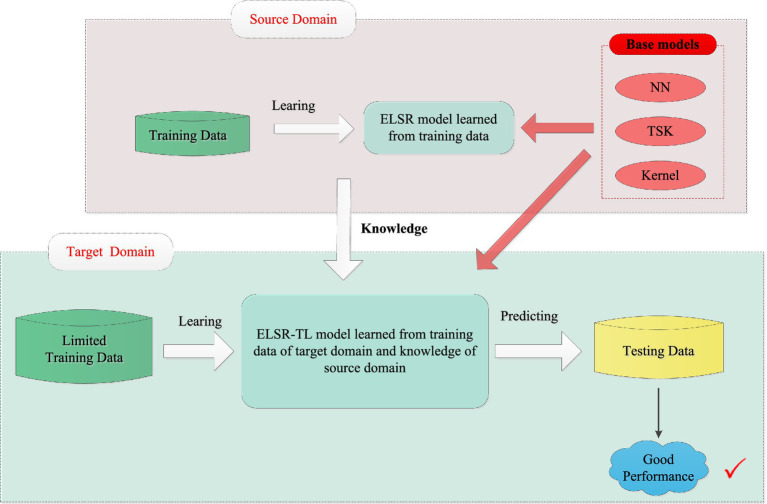
To broaden application and generalization, an extended-LSR-based inductive transfer learning method is proposed to facilitate transfer learning across various classical intelligent models, including neural networks, Takagi-SugenoKang (TSK) fuzzy systems, and kernel methods.
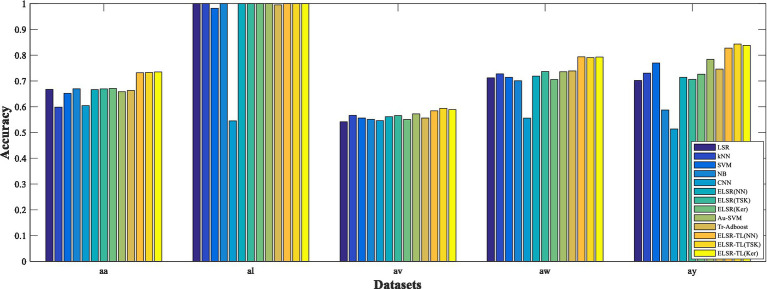
The proposed method not only promotes the transfer of valuable knowledge from the source domain to improve learning performance in the target domain when target domain training data are insufficient but also enhances application and generalization by incorporating multiple classic base models. The experimental results demonstrate the effectiveness of the proposed method in MI-EEG signal recognition.
运动想象脑电图(MI-EEG)信号识别应用于各种脑机接口(BCI)系统。在大多数现有的BCI系统中,这种识别依赖于分类算法。然而,一般来说,需要大量特定于个体的带标签训练数据来为每个新个体可靠地校准分类算法。为应对这一挑战,一种有效的策略是将迁移学习集成到智能模型的构建中,使知识能够从源域转移,以提高在目标域中训练的模型的性能。尽管迁移学习已在脑电信号识别中得到应用,但许多现有方法是专门为某些智能模型设计的,限制了它们的应用和通用性。
为了拓宽应用和通用性,提出了一种基于扩展LSR的归纳迁移学习方法,以促进跨各种经典智能模型(包括神经网络、高木-关野康(TSK)模糊系统和核方法)的迁移学习。
所提出的方法不仅在目标域训练数据不足时促进了源域有价值知识的转移,以提高目标域的学习性能,而且通过纳入多个经典基础模型增强了应用和通用性。实验结果证明了所提出的方法在MI-EEG信号识别中的有效性。