
利用动态对比增强磁共振成像(DCE-MRI)和扩散加权磁共振成像(DW-MRI)的稳健影像组学特征对腮腺肿瘤进行分类
Classification of Parotid Tumors with Robust Radiomic Features from DCE- and DW-MRI.
作者信息
Angelone Francesca, Tortora Silvia, Patella Francesca, Bonanno Maria Chiara, Contaldo Maria Teresa, Sansone Mario, Carrafiello Gianpaolo, Amato Francesco, Ponsiglione Alfonso Maria
机构信息
Department of Electrical Engineering and Information Technology, University of Naples Federico II, 80125 Naples, Italy.
Department of Radiology, San Paolo University Hospital, ASST Santi Paolo e Carlo, 20142 Milan, Italy.
出版信息
J Imaging. 2025 Apr 17;11(4):122. doi: 10.3390/jimaging11040122.
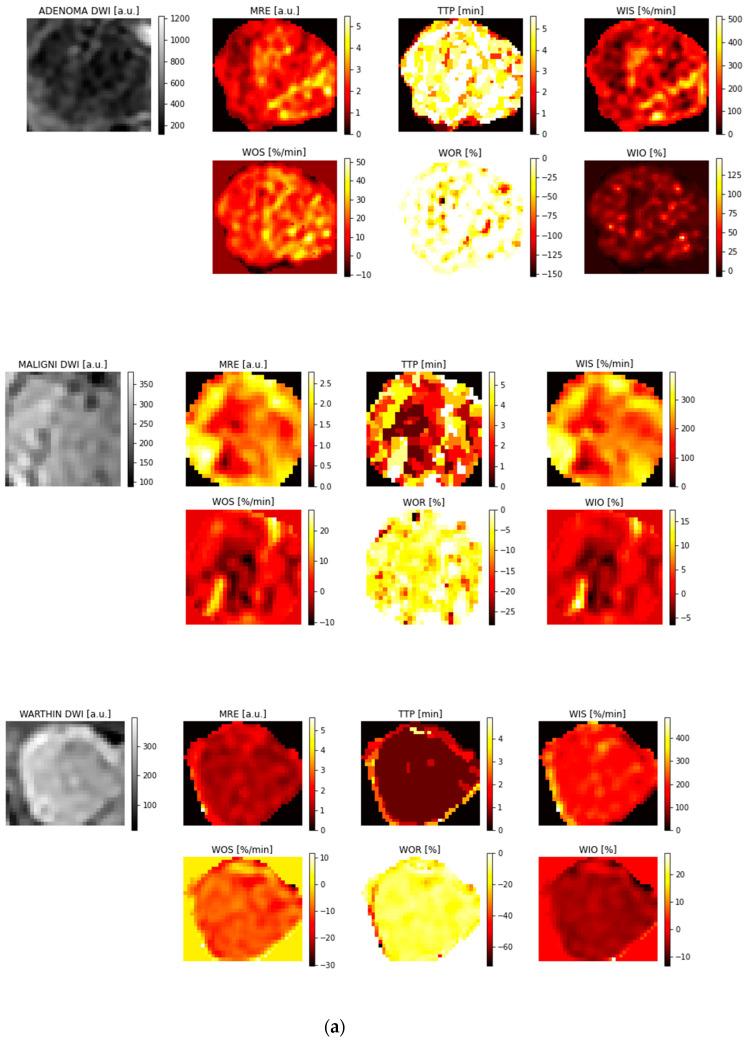
This study aims to evaluate the role of MRI-based radiomic analysis and machine learning using both DWI with multiple B-values and dynamic contrast-enhanced T1-weighted sequences to differentiate benign (B) and malignant (M) parotid tumors. Patients underwent DCE- and DW-MRI. An expert radiologist performed the manual selection of 3D ROIs. Classification of malignant vs. benign parotid tumors was based on radiomic features extracted from DCE-based and DW-based parametric maps. Care was taken in robustness evaluation and the no-bias selection of features. Several classifiers were employed. Sensitivity and specificity ranged from 0.6 to 0.8. The combination of LASSO + neural networks achieved the highest performance (0.76 sensitivity and 0.75 specificity). Our study identified a few robust DCE-based radiomic features with respect to ROI selection that can effectively be adopted in classifying malignant vs. benign parotid tumors.
本研究旨在评估基于MRI的放射组学分析和机器学习在使用具有多个B值的扩散加权成像(DWI)和动态对比增强T1加权序列来鉴别腮腺良性(B)和恶性(M)肿瘤中的作用。患者接受了动态对比增强和扩散加权MRI检查。一名放射科专家进行了三维感兴趣区(ROI)的手动选择。腮腺恶性肿瘤与良性肿瘤的分类基于从基于动态对比增强和基于扩散加权的参数图中提取的放射组学特征。在稳健性评估和特征的无偏选择方面都很谨慎。采用了几种分类器。敏感性和特异性范围为0.6至0.8。套索回归(LASSO)+神经网络的组合表现最佳(敏感性为0.76,特异性为0.75)。我们的研究确定了一些关于ROI选择的稳健的基于动态对比增强的放射组学特征,这些特征可有效地用于腮腺恶性肿瘤与良性肿瘤的分类。



 Zotero 插件