Qi Jinbo, Gao Ankang, Ma Xiaoyue, Song Yang, Zhao Guohua, Bai Jie, Gao Eryuan, Zhao Kai, Wen Baohong, Zhang Yong, Cheng Jingliang
Department of MRI, The First Affiliated Hospital of Zhengzhou University, Zhengzhou, China.
Magnetic Resonance Scientific Marketing, Siemens Healthineers Ltd., Shanghai, China.
Front Oncol. 2022 Jul 11;12:937050. doi: 10.3389/fonc.2022.937050. eCollection 2022.
We aimed to develop and validate radiomic nomograms to allow preoperative differentiation between benign- and malignant parotid gland tumors (BPGT and MPGT, respectively), as well as between pleomorphic adenomas (PAs) and Warthin tumors (WTs).
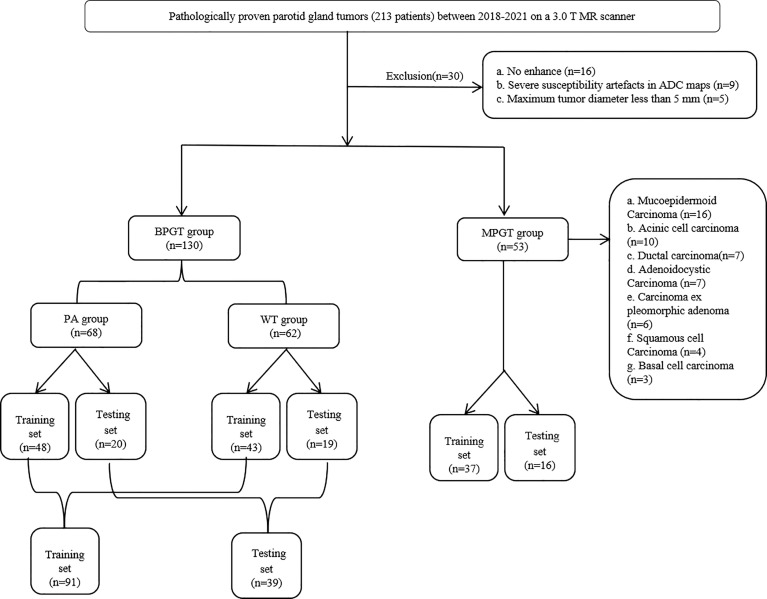
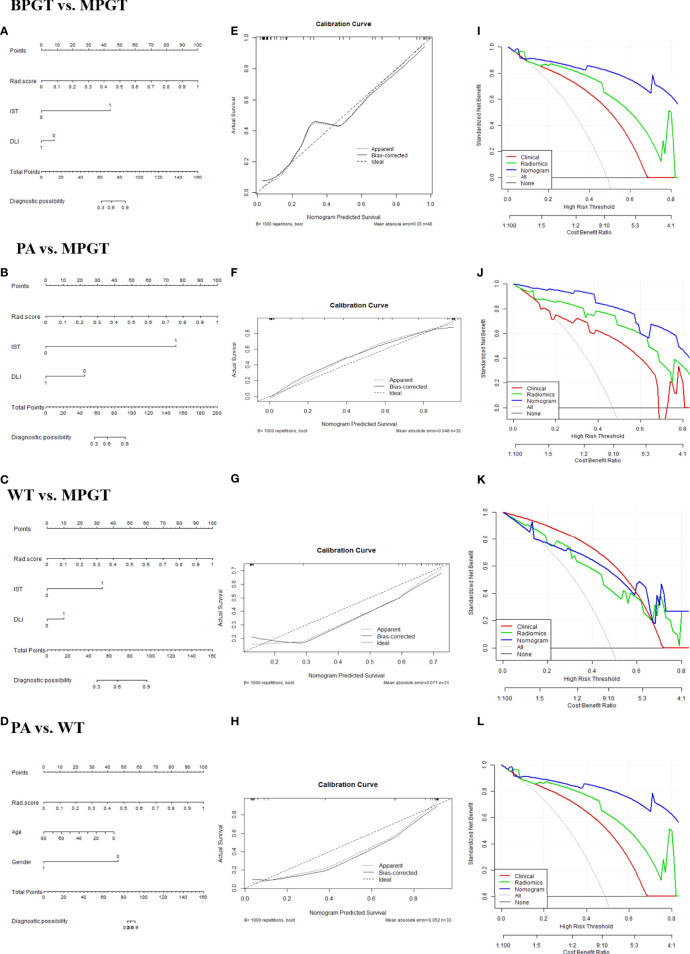
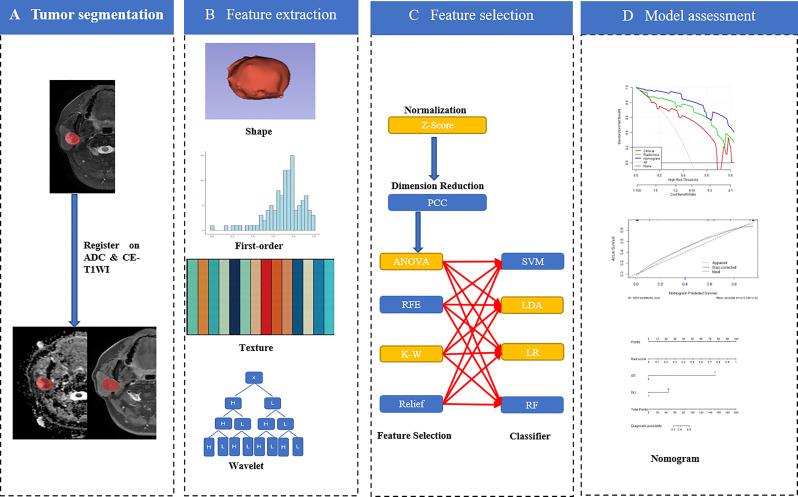
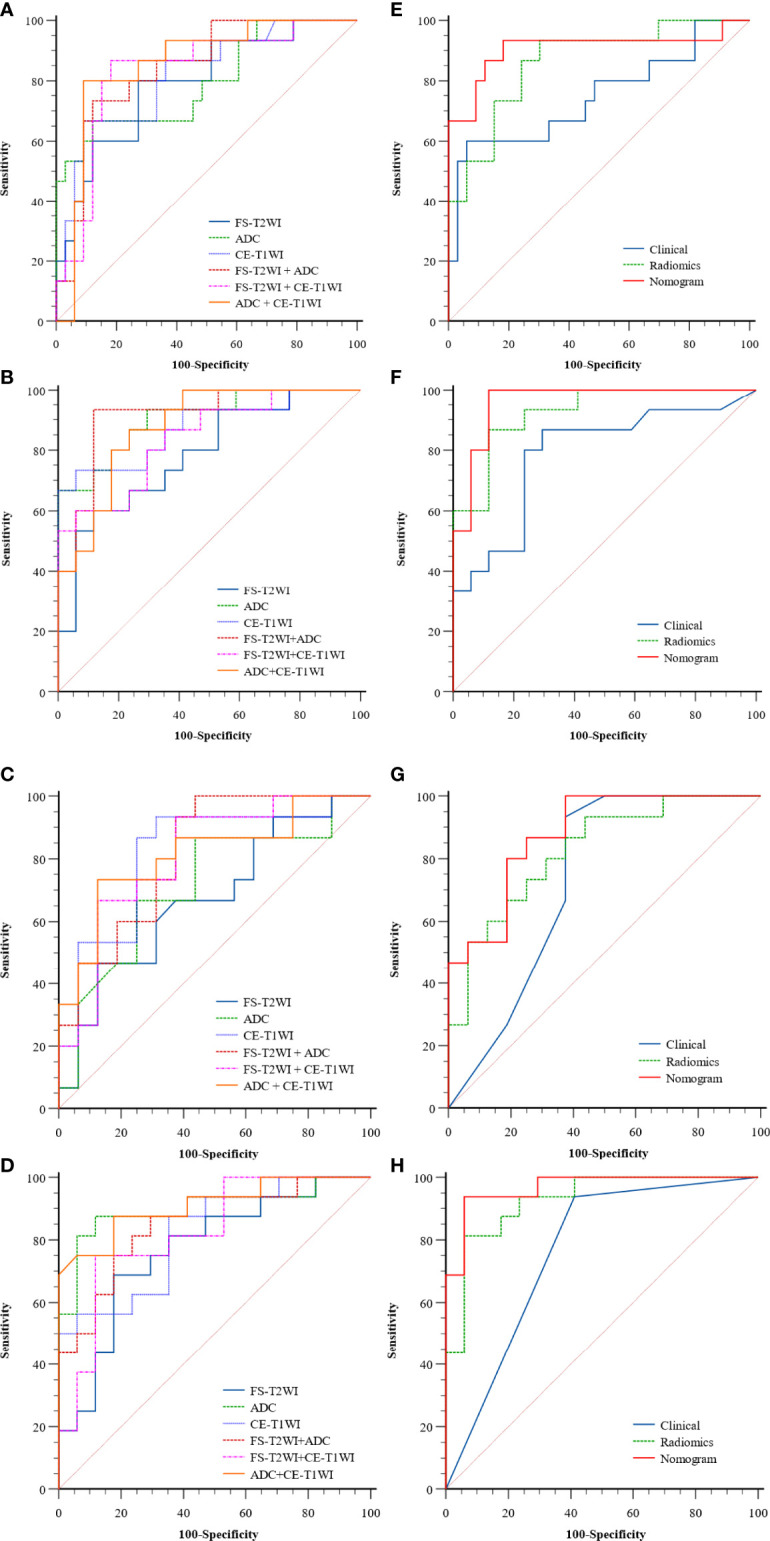
This retrospective study enrolled 183 parotid gland tumors (68 PAs, 62 WTs, and 53 MPGTs) and divided them into training (n = 128) and testing (n = 55) cohorts. In total, 2553 radiomics features were extracted from fat-saturated T2-weighted images, apparent diffusion coefficient maps, and contrast-enhanced T1-weighted images to construct single-, double-, and multi-sequence combined radiomics models, respectively. The radiomics score (Rad-score) was calculated using the best radiomics model and clinical features to develop the radiomics nomogram. The receiver operating characteristic curve and area under the curve (AUC) were used to assess these models, and their performances were compared using DeLong's test. Calibration curves and decision curve analysis were used to assess the clinical usefulness of these models.
The multi-sequence combined radiomics model exhibited better differentiation performance (BPGT . MPGT, AUC=0.863; PA . MPGT, AUC=0.929; WT . MPGT, AUC=0.825; PA . WT, AUC=0.927) than the single- and double sequence radiomics models. The nomogram based on the multi-sequence combined radiomics model and clinical features attained an improved classification performance (BPGT . MPGT, AUC=0.907; PA . MPGT, AUC=0.961; WT . MPGT, AUC=0.879; PA . WT, AUC=0.967).
Radiomics nomogram yielded excellent diagnostic performance in differentiating BPGT from MPGT, PA from MPGT, and PA from WT.
我们旨在开发并验证放射组学列线图,以实现术前鉴别腮腺良性肿瘤和恶性肿瘤(分别为BPGT和MPGT),以及鉴别多形性腺瘤(PA)和沃辛瘤(WT)。
这项回顾性研究纳入了183例腮腺肿瘤(68例PA、62例WT和53例MPGT),并将它们分为训练队列(n = 128)和测试队列(n = 55)。总共从脂肪饱和T2加权图像、表观扩散系数图和对比增强T1加权图像中提取了2553个放射组学特征,分别构建单序列、双序列和多序列联合放射组学模型。使用最佳放射组学模型和临床特征计算放射组学评分(Rad-score),以建立放射组学列线图。采用受试者操作特征曲线和曲线下面积(AUC)评估这些模型,并使用德龙检验比较它们的性能。校准曲线和决策曲线分析用于评估这些模型的临床实用性。
多序列联合放射组学模型表现出比单序列和双序列放射组学模型更好的鉴别性能(BPGT与MPGT相比,AUC = 0.863;PA与MPGT相比,AUC = 0.929;WT与MPGT相比,AUC = 0.825;PA与WT相比,AUC = 0.927)。基于多序列联合放射组学模型和临床特征的列线图获得了更好的分类性能(BPGT与MPGT相比,AUC = 0.907;PA与MPGT相比,AUC = 0.961;WT与MPGT相比,AUC = 0.879;PA与WT相比,AUC = 0.967)。
放射组学列线图在鉴别BPGT与MPGT、PA与MPGT以及PA与WT方面具有出色的诊断性能。