
在山羊母羊日粮中添加落地生根对肝脏和肾脏功能以及繁殖性能的影响。
Impact of Kalanchoe ) Supplementation in Goat Maternal Diet on Hepatic and Renal Function and Reproductive Performance.
作者信息
Vázquez-García Juan M, Ballesteros-Rodea Gilberto, Cuevas-Reyes Venancio, Hernández-Arteaga Luisa E S, Peña-Avelino Luz Y, López-Aguirre Samuel, Sims Reagan, Cavazos-Galindo Jaime M, Rosales-Nieto Cesar A
机构信息
Facultad de Agronomía y Veterinaria, Universidad Autónoma San Luis Potosí, San Luis Potosí 78321, Mexico.
Instituto Nacional de Investigaciones Forestales, Agrícolas y Pecuarias, Campo Experimental Valle de México, Texcoco 56250, Mexico.
出版信息
Biology (Basel). 2025 Apr 5;14(4):376. doi: 10.3390/biology14040376.
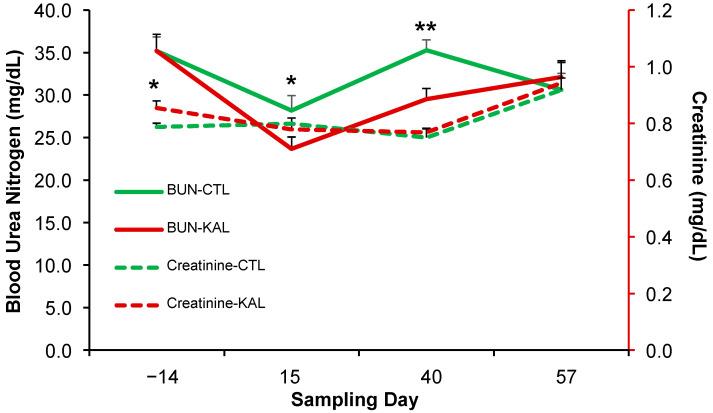
, a medicinal plant rich in bioactive compounds, has the potential to serve as a feed supplement, reducing reliance on conventional livestock medications while potentially enhancing productivity. This study evaluated the effects of supplementation over 52 days on kidney and liver function, metabolism, weight changes, and reproductive efficiency in multiparous Alpine goats during the breeding season. Fifty-five goats were assigned to either a control (CTL, n = 27; 47.6 ± 1.1 kg) or a -supplemented (KAL, n = 28; 47.6 ± 1.3 kg) diet. The KAL group received at a dry matter-based inclusion rate of 2 kg t of feed, while the CTL group received no supplementation. Blood samples were collected at four time points to assess the biochemical markers of kidney and liver function. Pregnancy was achieved through natural mating, and reproductive efficiency was evaluated. Overall, liver and kidney function did not differ significantly between treatments ( > 0.05). However, KAL supplementation was associated with increased creatinine ( < 0.05), ALP ( < 0.001), and bilirubin ( < 0.05) at specific time points, whereas CTL goats exhibited higher BUN ( < 0.001), AST ( < 0.05), albumin ( < 0.001), total protein ( ≤ 0.05), and phosphorus ( < 0.01) on specific dates. Other metabolic markers, weight gain, and reproductive efficiency did not differ between treatments ( > 0.05). Overall, supplementation had mild, transient effects on goat health without significantly impacting productivity. Further research is needed to explore its long-term effects and optimal dosage for livestock nutrition.
[一种富含生物活性化合物的药用植物]有潜力用作饲料添加剂,减少对传统家畜药物的依赖,同时可能提高生产力。本研究评估了在繁殖季节对多胎高山山羊补充[该植物]52天对肾脏和肝脏功能、新陈代谢、体重变化及繁殖效率的影响。55只山羊被分配到对照组(CTL,n = 27;体重47.6 ± 1.1千克)或补充[该植物]组(KAL,n = 28;体重47.6 ± 1.3千克)。KAL组以每2千克干物质饲料中添加1吨[该植物]的比例添加,而CTL组不添加。在四个时间点采集血样以评估肾脏和肝脏功能的生化指标。通过自然交配实现怀孕,并评估繁殖效率。总体而言,各处理组间肝脏和肾脏功能无显著差异(P > 0.05)。然而,在特定时间点,KAL组的肌酐(P < 0.05)、碱性磷酸酶(P < 0.001)和胆红素(P < 0.05)有所升高,而CTL组的山羊在特定日期的尿素氮(P < 0.001)、天冬氨酸转氨酶(P < 0.05)、白蛋白(P < 0.001)、总蛋白(P ≤ 0.05)和磷(P < 0.01)较高。其他代谢指标、体重增加和繁殖效率在各处理组间无差异(P > 0.05)。总体而言,补充[该植物]对山羊健康有轻微、短暂的影响,对生产力无显著影响。需要进一步研究以探索其对家畜营养的长期影响和最佳剂量。




 Zotero 插件