Cakmak Umit, Merhametsiz Ozgur, Ay Nurettin
Antalya Memorial Hospital, Nephrology Clinic, 07025 Antalya, Turkey.
Nephrology Department, Faculty of Medicine, Yeni Yüzyıl University, Private Gaziosmanpaşa Hospital, 34245 İstanbul, Turkey.
Medicina (Kaunas). 2025 Mar 25;61(4):580. doi: 10.3390/medicina61040580.
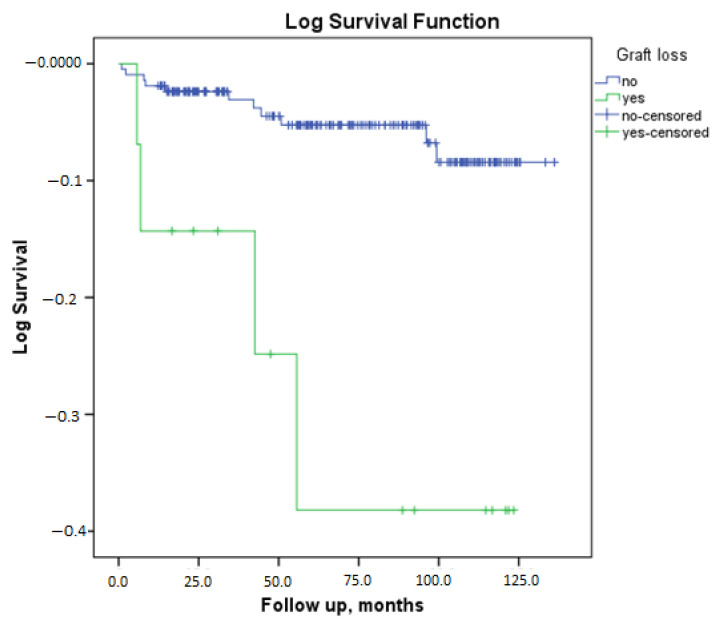
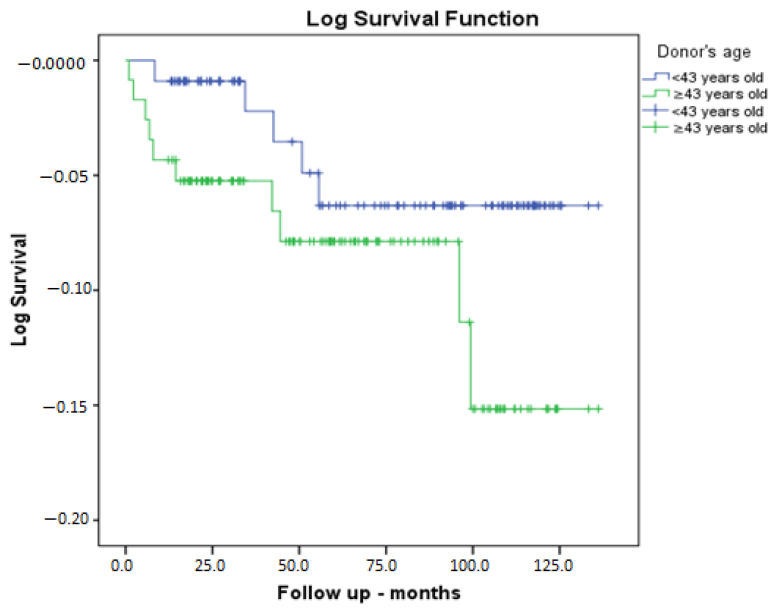
Kidney transplantation (KT) is the gold-standard treatment for end-stage renal disease (ESRD). An accurate evaluation of donor renal function is critical for living kidney transplantation. This study aimed to assess the impact of donor glomerular filtration rate (GFR) on long-term graft function and survival. A retrospective analysis was conducted on 229 donor-recipient pairs who underwent living kidney transplantation at our center. Data on recipient demographics, clinical characteristics, and donor GFR were collected. The outcomes of graft survival were compared based on donor and recipient characteristics. Logistic regression was used to identify the factors influencing graft loss. Mortality was significantly higher in the graft loss group (26% vs. 5.1%, = 0.001). Graft biopsy was associated with a 24.74-fold increased risk of graft loss (95% CI: 5.387-113.609, < 0.001). Each 1 mL/min/1.73 m increase in donor GFR reduced graft loss risk by 0.075% (95% CI: 0.870-0.983, = 0.013). Donor age, gender, and BMI showed no significant impact on graft survival. A higher donor GFR positively influenced graft survival. However, donor age, gender, and BMI did not significantly affect long-term outcomes. These findings emphasize the importance of thorough donor evaluation to optimize graft survival and recipient outcomes.
肾移植(KT)是终末期肾病(ESRD)的金标准治疗方法。准确评估供体肾功能对于活体肾移植至关重要。本研究旨在评估供体肾小球滤过率(GFR)对长期移植肾功能和存活的影响。对在本中心接受活体肾移植的229对供受体进行了回顾性分析。收集了受体的人口统计学数据、临床特征和供体GFR数据。根据供体和受体特征比较了移植存活结果。采用逻辑回归分析确定影响移植肾丢失的因素。移植肾丢失组的死亡率显著更高(26%对5.1%,P = 0.001)。移植肾活检与移植肾丢失风险增加24.74倍相关(95%CI:5.387 - 113.609,P < 0.001)。供体GFR每增加1 mL/min/1.73 m²,移植肾丢失风险降低0.075%(95%CI:0.870 - 0.983,P = 0.013)。供体年龄、性别和BMI对移植存活无显著影响。较高的供体GFR对移植存活有积极影响。然而,供体年龄、性别和BMI对长期结局无显著影响。这些发现强调了全面评估供体以优化移植存活和受体结局的重要性。