Stelzmueller Marie-Elisabeth, Zimpfer Daniel, Wisser Wilfried
Department of Cardiac and Thoracic Aortic Surgery, Medical University Vienna, 1090 Vienna, Austria.
J Clin Med. 2025 Apr 9;14(8):2581. doi: 10.3390/jcm14082581.
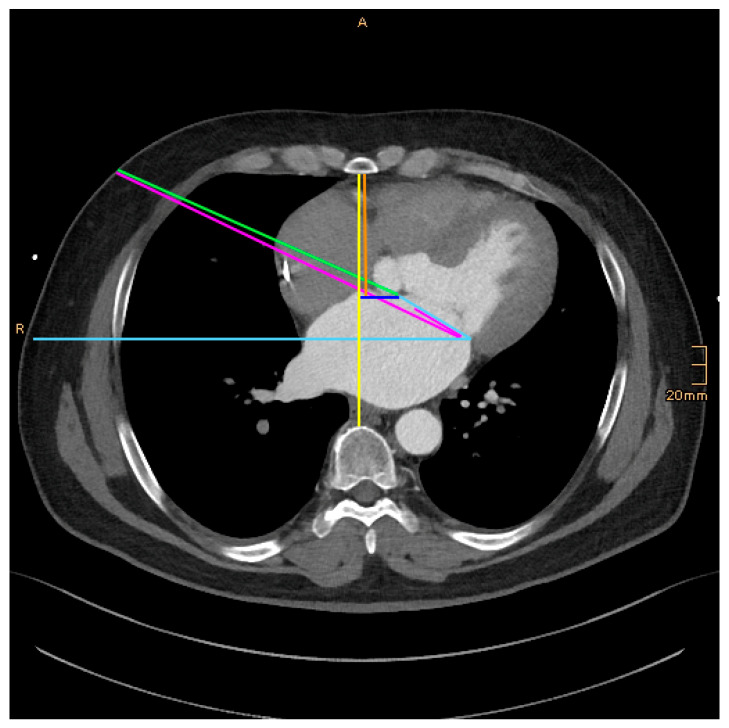
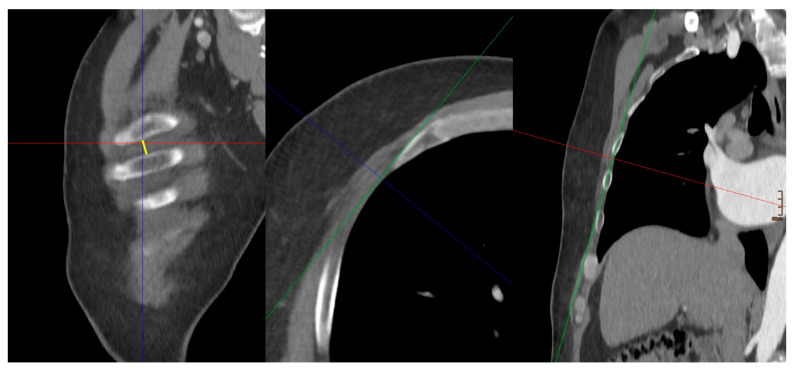
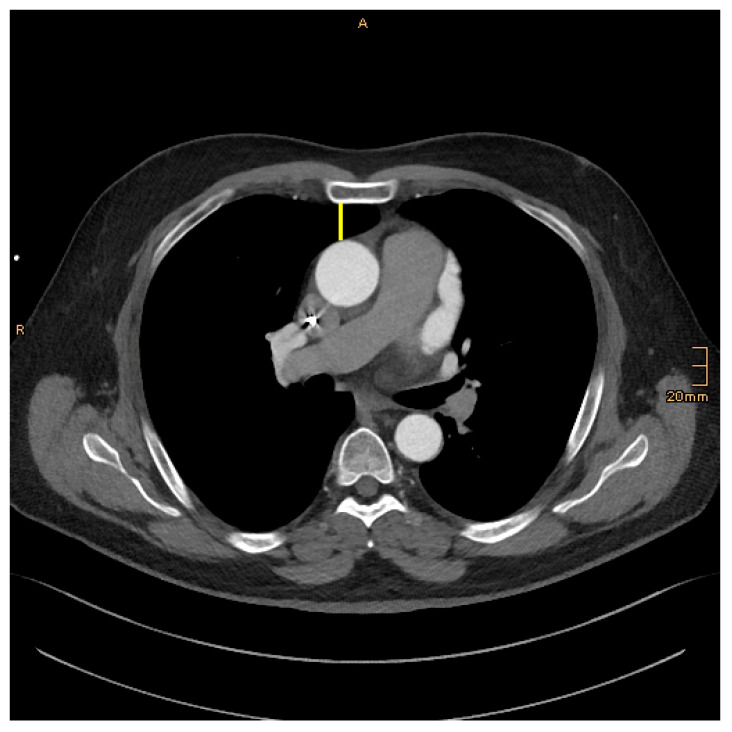
: The totally endoscopic approach is on the rise to become the new standard in mitral valve surgery. The aim of this study was to develop a morphometric measurement tool for educational purposes to predict operability with low conversion and high repair rates. : From January 2020 to March 2023, 64 patients underwent totally endoscopic mitral valve repair (TE-MVR). Of these, 15 patients were deemed to be unsuitable for TE-MVR due to narrow space and/or anticipated complex repair techniques and underwent repair through sternotomy (MVR-open). Angio-CT scanning was performed for preoperative planning and measurements of the following: the distance between the sternum and the spine (DSS), the distance between the skin incision and the anterior anulus of the mitral valve (DNM) and the intercostal space at the level of the skin incision (ICS). : The repair rate for all patients was 98.7%. In the TE-MVR group, the conversion rate to sternotomy was 3.1%. The 30-day survival was 100%. The DSS was 130.4 ± 18.8 mm and 108.1 ± 17.3 mm, and the DSM 70.7 ± 12.1 mm and 58.5 ± 13.6 mm in the TE-MVR and MVR-open, respectively ( < 0.001). Twenty-one TE-MVR patients were found to be technically demanding due to friction and less freedom to move the instruments. The composite morphometric parameter DSS plus 4xICS minus DNM was 53.3, 39.8 and 25.6 for TE-TMReasy, TE-TMRdemanding and MVR-open, respectively ( < 0.05 and < 0.01). : Surgical skills and a long history of expertise are mandatory to achieve excellent results with a low conversion and high repair rate. The composite morphometric parameter may be an easy tool for educational demands to predict the ease and feasibility of TE-MVR.
全内镜手术方法正逐渐兴起,成为二尖瓣手术的新标准。本研究的目的是开发一种用于教育目的的形态测量工具,以预测手术的可操作性,实现低中转率和高修复率。
2020年1月至2023年3月,64例患者接受了全内镜二尖瓣修复术(TE-MVR)。其中,15例患者因空间狭窄和/或预期的复杂修复技术被认为不适合TE-MVR,转而通过胸骨切开术进行修复(开放式二尖瓣修复术,MVR-open)。术前进行血管CT扫描以进行规划和测量以下指标:胸骨与脊柱之间的距离(DSS)、皮肤切口与二尖瓣前瓣环之间的距离(DNM)以及皮肤切口水平的肋间间隙(ICS)。
所有患者的修复率为98.7%。在TE-MVR组中,中转开胸手术的比例为3.1%。30天生存率为100%。TE-MVR组和MVR-open组的DSS分别为130.4±18.8mm和108.1±17.3mm,DNM分别为70.7±12.1mm和58.5±13.6mm(P<0.001)。21例TE-MVR患者因器械摩擦和操作空间受限,手术操作难度较大。TE-TMReasy组、TE-TMRdemanding组和MVR-open组的复合形态测量参数DSS加4×ICS减DNM分别为53.3、39.8和25.6(P<0.05和P<0.01)。
要实现低中转率和高修复率的优异手术效果,手术技能和丰富的专业经验是必不可少的。复合形态测量参数可能是一种简单的工具,可用于教育需求,以预测TE-MVR的难易程度和可行性。