Hernández-Vega Josué Daniel, Parola-Contreras Ixchel, Tovar-Pérez Erik Gustavo, Guevara-González Ramón Gerardo, Aguirre-Becerra Humberto, Feregrino-Pérez Ana Angélica, Contreras-Medina Luis Miguel, Guzmán-Cruz Rosario
Centro de Investigación Aplicada en Biosistemas (CIAB), Facultad de Ingeniería, Universidad Autónoma de Querétaro, Campus Amazcala, Carr. Chichimequillas-Amazcala Km 1 S/N, Amazcala, El Marques 76265, Querétaro, Mexico.
TecNM/Tecnológico de Estudios Superiores de Chimalhuacán, Ingeniería Industrial, Ingeniería de Procesos Sustentables ITESCHIM-CA-02, Chimalhuacán 56335, Estado de México, Mexico.
Plants (Basel). 2025 Apr 10;14(8):1173. doi: 10.3390/plants14081173.
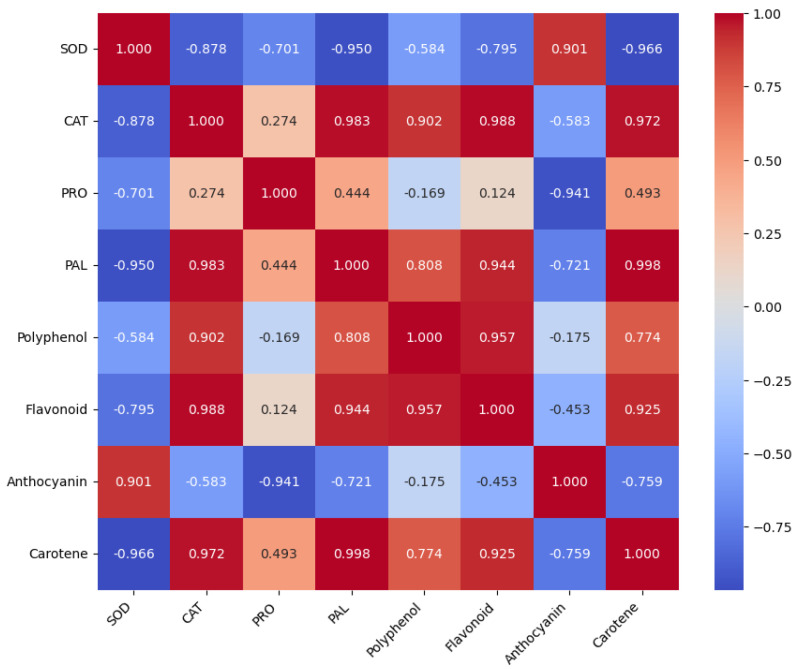
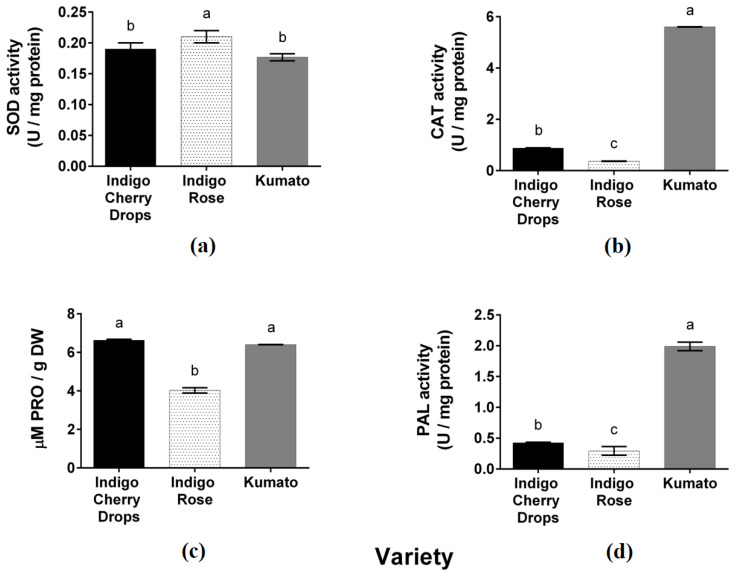
Given the importance of phenolic compounds and antioxidant capacity in plant defense and human health, this study aimed to evaluate black cherry tomatoes' polyphenol, flavonoid, anthocyanin, and carotenoid content and enzymatic activity under greenhouse conditions. Black cherry tomato varieties-Indigo Cherry Drops, Indigo Rose, and Kumato-were cultivated from seed to the third harvest. Total polyphenols, flavonoids, anthocyanins, β-carotenoids, antioxidant capacity 2,2-diphenyl-1-picrylhydrazyl (DPPH), 2,2'-azino-bis (3-ethylbenzothiazoline-6-sulfonic acid) (ABTS), and enzymatic activities, including superoxide dismutase (SOD), catalase (CAT), proline (PRO), and superoxide dismutase (PAL), were measured and compared. The Kumato variety exhibited significantly higher total polyphenols, flavonoids, and carotenoids, along with enhanced antioxidant activity (DPPH, ABTS) and enzymatic activity (CAT, PAL) compared to Indigo Rose and Indigo Cherry Drops, with free radical inhibition of 87.0% (DPPH) and 74.72% (ABTS). SOD activity was highest in Indigo Rose (0.21 U/mg protein), while proline levels were significantly higher in Kumato and Indigo Cherry Drops (6.40 and 6.63 U/mg protein). These findings highlight the antioxidant potential of black cherry tomatoes and their high potential nutritional value for consumers. Future research should explore how environmental factors influence their biochemical composition and potential applications in functional food.
鉴于酚类化合物和抗氧化能力在植物防御和人类健康中的重要性,本研究旨在评估温室条件下黑樱桃番茄的多酚、黄酮类化合物、花青素和类胡萝卜素含量以及酶活性。从种子开始种植黑樱桃番茄品种——靛蓝樱桃滴、靛蓝玫瑰和金玛托,直至第三次收获。测定并比较了总多酚、黄酮类化合物、花青素、β-胡萝卜素、抗氧化能力2,2-二苯基-1-苦基肼(DPPH)、2,2'-联氮-双-(3-乙基苯并噻唑啉-6-磺酸)(ABTS)以及包括超氧化物歧化酶(SOD)、过氧化氢酶(CAT)、脯氨酸(PRO)和苯丙氨酸解氨酶(PAL)在内的酶活性。与靛蓝玫瑰和靛蓝樱桃滴相比,金玛托品种的总多酚、黄酮类化合物和类胡萝卜素含量显著更高,同时抗氧化活性(DPPH、ABTS)和酶活性(CAT、PAL)增强,自由基抑制率分别为87.0%(DPPH)和74.72%(ABTS)。靛蓝玫瑰的SOD活性最高(0.21 U/mg蛋白质),而金玛托和靛蓝樱桃滴的脯氨酸水平显著更高(分别为每毫克蛋白质6.40和6.63 U)。这些发现突出了黑樱桃番茄的抗氧化潜力及其对消费者的高潜在营养价值。未来的研究应探索环境因素如何影响其生化组成以及在功能性食品中的潜在应用。