Academy of Agricultural and Forestry Sciences, Qinghai University, Xining 810016, China.
Tibetan Plateau Key Laboratory of Agric-Product Processing, Qinghai Academy of Agricultural and Forestry Sciences, Xining 810016, China.
Molecules. 2022 May 25;27(11):3411. doi: 10.3390/molecules27113411.
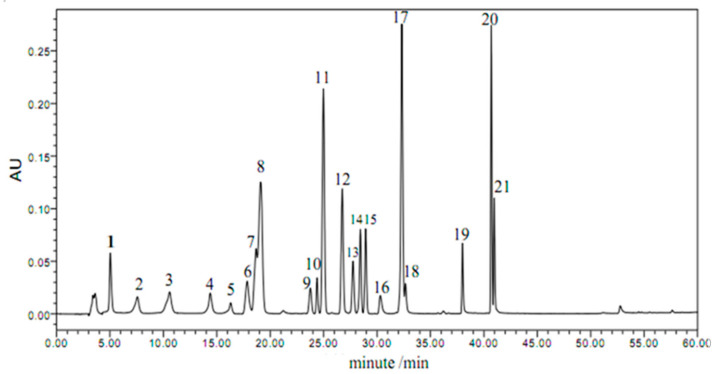
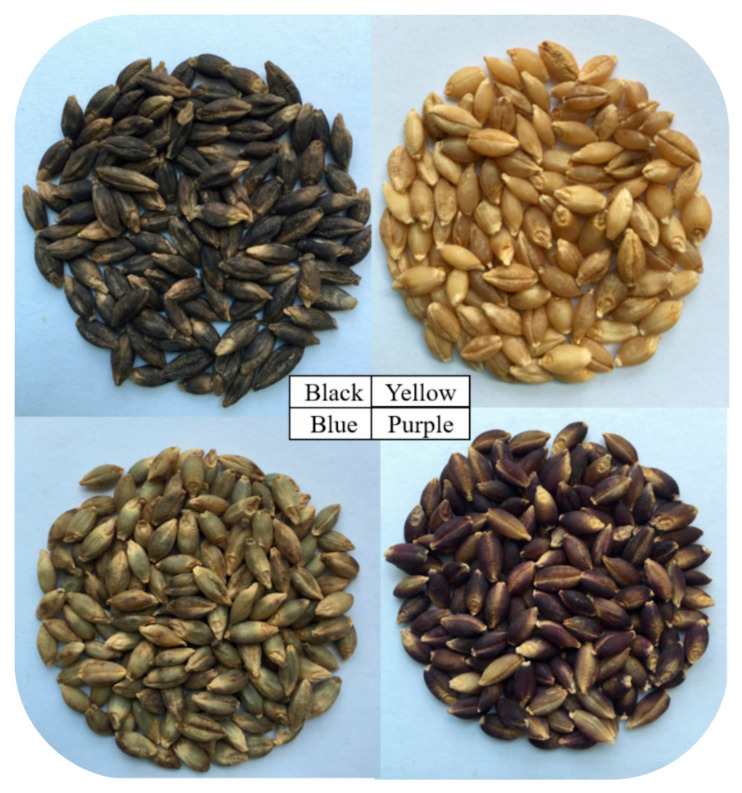
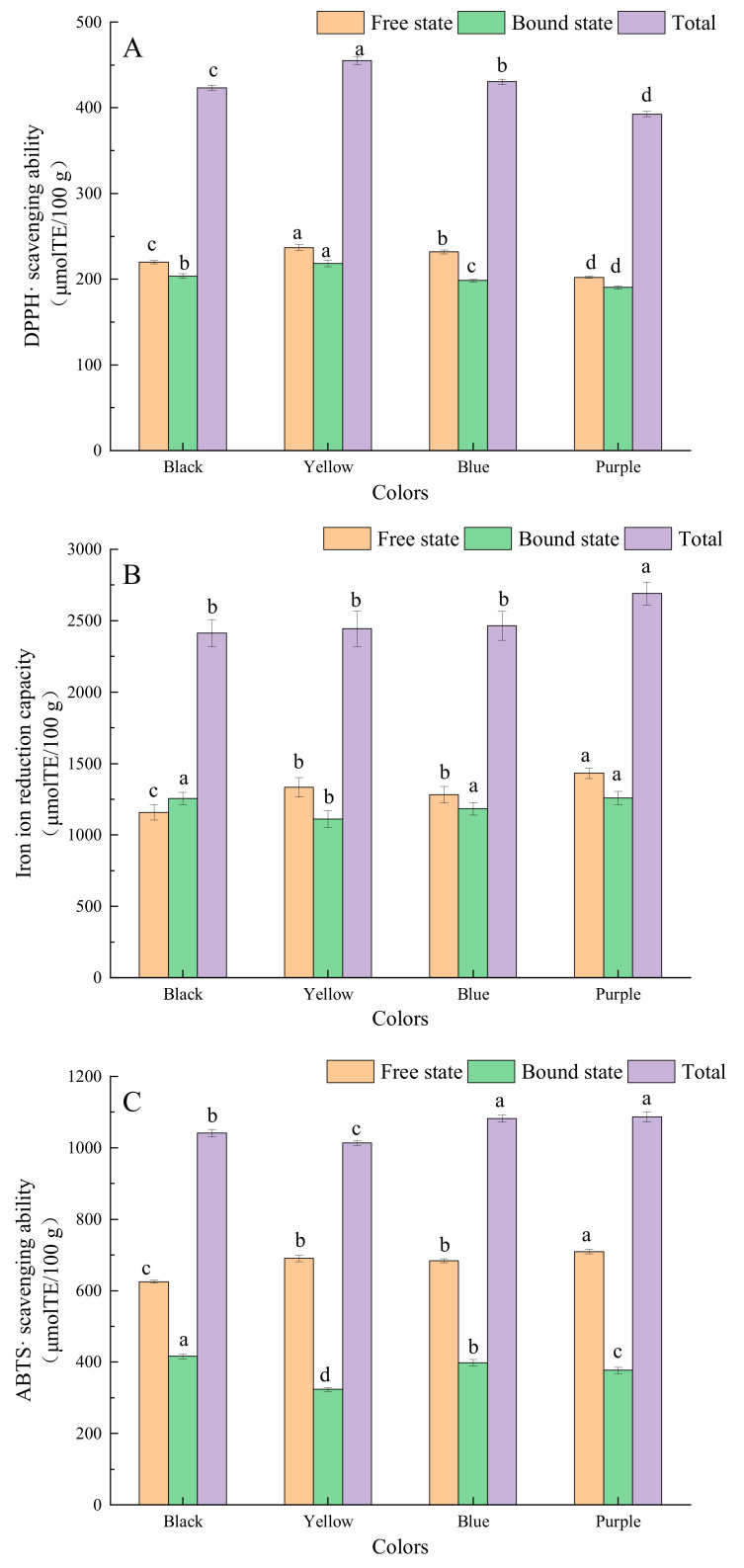
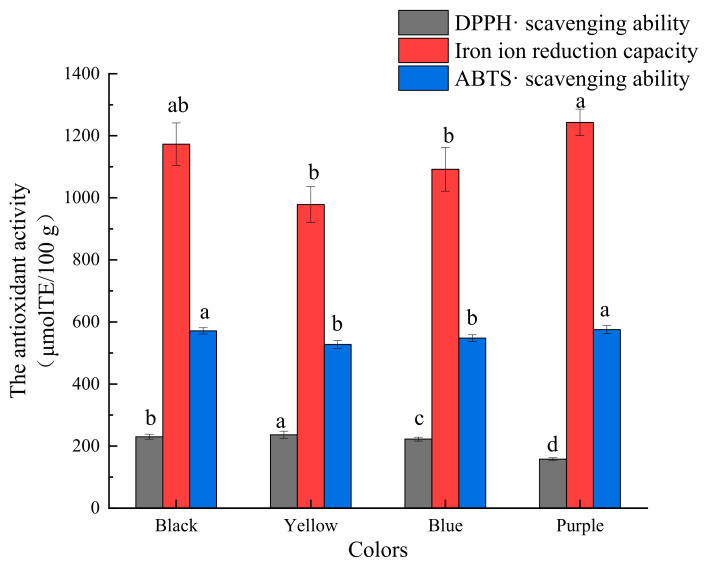
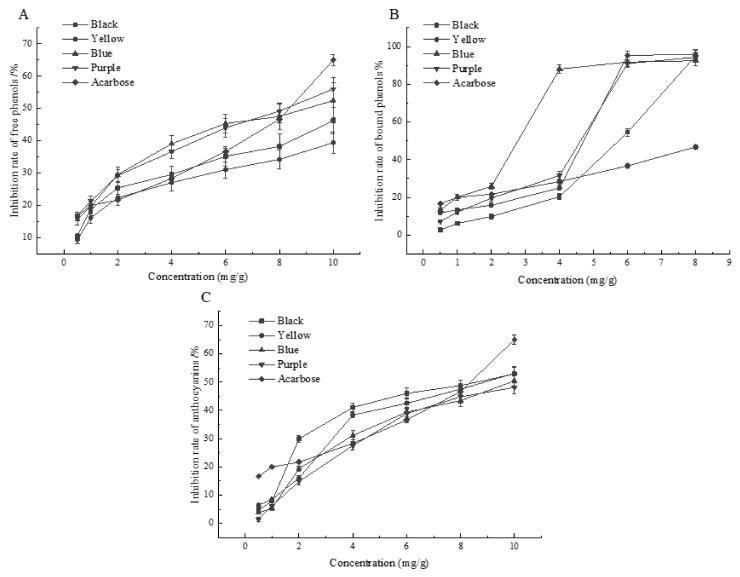
In this research, the composition of free phenols, bound phenols, and anthocyanins and their in vitro antioxidant activity and in vitro α-glucosidase inhibiting activity were observed in different barley colors. The outcomes revealed that the contents of total phenols (570.78 mg/100 gDW), total flavonoids (47.08 mg/100 gDW), and anthocyanins (48.07 mg/100 g) were the highest in purple barley. Furthermore, the structure, composition, and concentration of phenolics differed depending on the colors of barley. The types and contents of bound total phenolic acids and flavonoids were greater than those of free total phenolic acids and flavonoids. The main phenolic acids in blue barley were cinnamic acid polyphenols, whereas in black, yellow, and purple barley, benzoic acid polyphenols were the main phenolic acids, and the main types of flavonoids in black and blue barley were chalcones and flavanones, respectively, whereas flavonol was the main type of flavonoid in yellow and purple barley. Moreover, cornflower pigment-3-glucoside was the major anthocyanin in blue, yellow, and purple barley, whereas the main anthocyanin in black barley was delphinidin-3-glucoside. The dark color of barley indicated richness in the anthocyanins. In addition, the free polyphenol fractions had stronger DPPH and ABTS radical scavenging capacity as compared to the bound ones. In vitro α-glucosidase-inhibiting activity was greater in bound polyphenols than in free polyphenols, with differences between different varieties of barley. Purple barley phenolic fractions had the greatest ABTS radical scavenging and iron ion reduction capacities, as well as the highest α-glucosidase-inhibiting activity. The strongest DPPH radical scavenging capacity was found in yellow barley, while the strongest in vitro α-glucosidase-inhibiting activity was found in anthocyanins isolated from black barley. Furthermore, in different colors of barley, there was a strong association between the concentration of specific phenolic compounds and antioxidant and α-glucosidase-inhibiting activities. The outcomes of this study revealed that all colored barley seeds tested were high in phenolic compounds, and had a good antioxidant impact and α-glucosidase-inhibiting activity. As a result, colored barley can serve as an antioxidant and hypoglycemic food. Polyphenols extracted from purple barley and anthocyanins extracted from black barley stand out among them.
在这项研究中,观察了不同颜色大麦中游离酚、结合酚和花色苷的组成及其体外抗氧化活性和体外α-葡萄糖苷酶抑制活性。结果表明,紫麦中总酚(570.78mg/100gDW)、总黄酮(47.08mg/100gDW)和花色苷(48.07mg/100g)的含量最高。此外,多酚的结构、组成和浓度因大麦的颜色而异。结合总酚酸和类黄酮的种类和含量大于游离总酚酸和类黄酮。在蓝麦中,主要的酚酸是肉桂酸多酚,而在黑、黄、紫麦中,主要的酚酸是苯甲酸多酚,黑麦和蓝麦中主要的类黄酮类型分别是查尔酮和黄烷酮,而在黄麦和紫麦中,主要的类黄酮类型是黄酮醇。此外,矢车菊素-3-葡萄糖苷是蓝、黄、紫麦中主要的花色苷,而黑麦中主要的花色苷是飞燕草素-3-葡萄糖苷。大麦的深颜色表明其富含花色苷。此外,游离多酚部分比结合多酚部分具有更强的 DPPH 和 ABTS 自由基清除能力。体外α-葡萄糖苷酶抑制活性在结合多酚中大于游离多酚,且不同品种大麦之间存在差异。紫麦酚类成分具有最大的 ABTS 自由基清除和铁离子还原能力,以及最高的α-葡萄糖苷酶抑制活性。黄麦的 DPPH 自由基清除能力最强,而黑麦花色苷的体外α-葡萄糖苷酶抑制活性最强。此外,在不同颜色的大麦中,特定酚类化合物的浓度与抗氧化和α-葡萄糖苷酶抑制活性之间存在很强的相关性。本研究结果表明,所有测试的有色大麦种子均富含酚类化合物,具有良好的抗氧化作用和α-葡萄糖苷酶抑制活性。因此,有色大麦可以作为一种抗氧化和降血糖的食物。其中,紫麦中提取的多酚和黑麦中提取的花色苷较为突出。