Weathers Shiao-Pei, Li Xiqi, Zhu Haifeng, Damania Ashish V, Knafl Mark, McKinley Brian, Lin Heather, Harrison Rebecca A, Majd Nazanin K, O'Brien Barbara J, Penas-Prado Marta, Loghin Monica, Kamiya-Matsuoka Carlos, Yung W K Alfred, Solis Soto Luisa M, Maru Dipen M, Wistuba Ignacio, Parra Cuentas Edwin R, Hernandez Sharia, Futreal Andrew, Wargo Jennifer A, Schulze Katja, Darbonne Walter C, Ajami Nadim J, Woodman Scott E, de Groot John F
Department of Neuro-Oncology, The University of Texas MD Anderson Cancer Center, Houston, 1515 Holcombe Blvd, Houston, TX, 77030, USA.
Genomic Medicine, The University of Texas MD Anderson Cancer Center, Houston, 1515 Holcombe Blvd, Houston, TX, 77030, USA.
Nat Commun. 2025 Apr 27;16(1):3950. doi: 10.1038/s41467-025-56930-7.
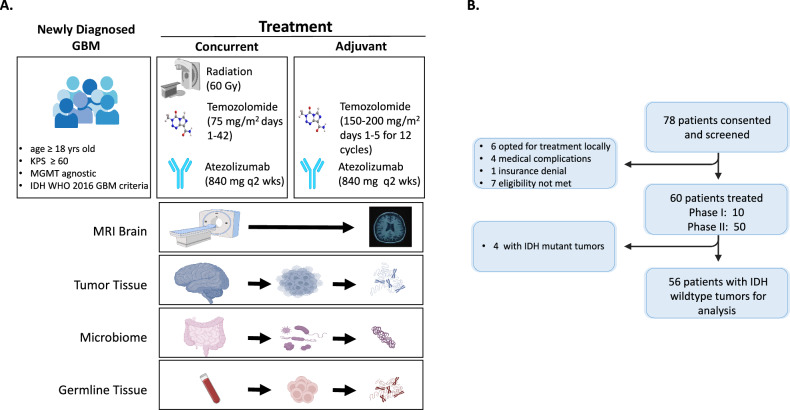
This phase I/II trial aims to evaluate the efficacy of concurrent atezolizumab with radiation therapy and temozolomide (TMZ) followed by adjuvant atezolizumab and TMZ in newly diagnosed glioblastoma (GBM) patients and to identify pre-treatment correlates with outcome (N = 60). Trial number: NCT03174197. The primary outcome was overall survival (OS) whereas secondary outcomes were retrospective global-omics analyses to identify pre-treatment immune and genetic tumor features that correlated with survival. Concurrent use of atezolizumab with radiation and TMZ demonstrated OS in line with published trials for newly diagnosed GBM. Tumor genomic (WES and/or targeted NGS panel), transcriptomic (RNAseq) and tissue microenvironment imaging, as well as fecal metagenomic sequencing were conducted. Gene set enrichment analysis of tumors identified multiple immune-based transcriptomic programs to distinguish patients with longer versus shorter survival (p ≤ 0.01). GBM immune enrichment was highly associated with the pre-treatment tumor mesenchymal subtype and patient gastrointestinal bacterial taxa profile.
这项I/II期试验旨在评估阿替利珠单抗与放射治疗和替莫唑胺(TMZ)联合使用,随后使用辅助性阿替利珠单抗和TMZ,对新诊断的胶质母细胞瘤(GBM)患者的疗效,并确定治疗前与预后相关的因素(N = 60)。试验编号:NCT03174197。主要结局为总生存期(OS),次要结局为回顾性全组学分析,以确定与生存相关的治疗前免疫和基因肿瘤特征。阿替利珠单抗与放疗和TMZ联合使用显示的总生存期与新诊断GBM的已发表试验一致。进行了肿瘤基因组(全外显子测序和/或靶向NGS panel)、转录组(RNA测序)和组织微环境成像以及粪便宏基因组测序。对肿瘤的基因集富集分析确定了多个基于免疫的转录组程序,以区分生存期较长和较短的患者(p≤0.01)。GBM免疫富集与治疗前肿瘤间充质亚型和患者胃肠道细菌分类群谱高度相关。