Marcos-Frutos Daniel, Leban Žiga, Li Zhaoqian, Zhang Xing, Lara Paula M, Alix-Fages Carlos, Jiménez-Martínez Pablo, Zebboudji Nadia, Caillet Annabelle, Redondo Beatriz, Vera Jesús, Janicijevic Danica, García-Ramos Amador
Department of Physical Education and Sport, Faculty of Sport Sciences, University of Granada, 18071 Granada, Spain.
Faculty of Health Sciences, University of Primorska, 6310 Izola, Slovenia.
Nutrients. 2025 Mar 7;17(6):940. doi: 10.3390/nu17060940.
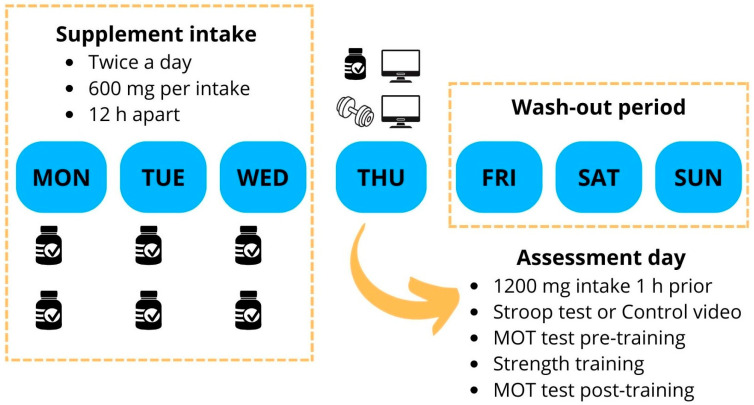
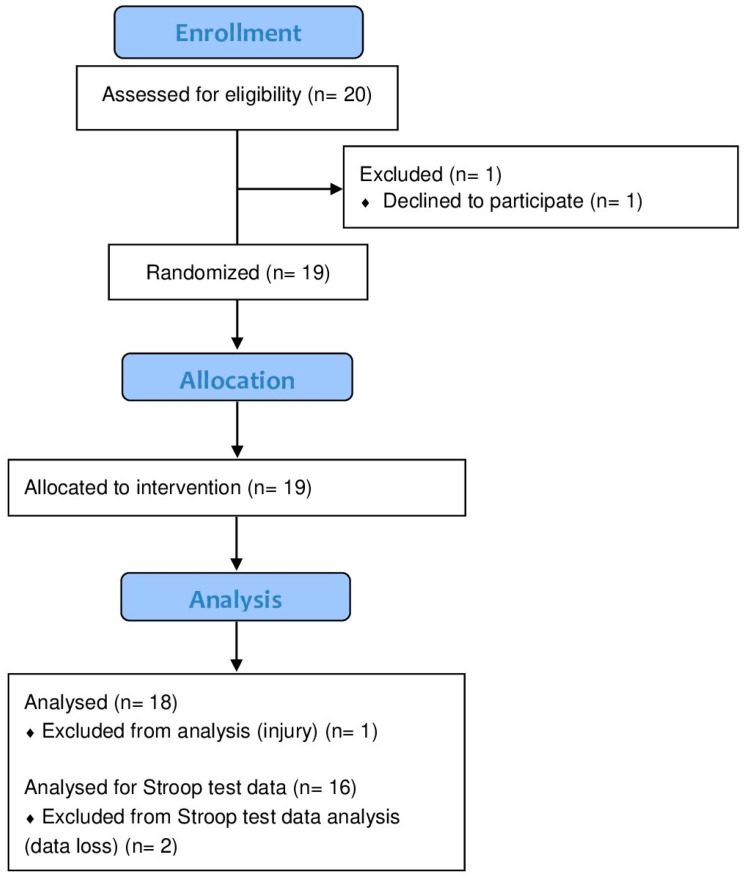
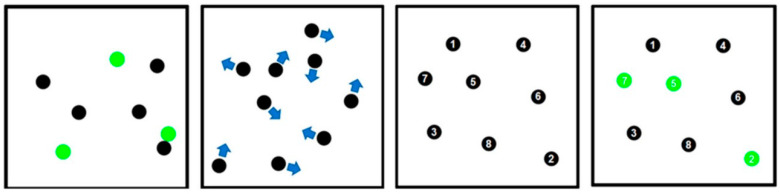
: This study aimed to explore the effects of four days of Rhodiola Rosea (RR) supplementation on bench-press and bench-pull exercises under resting or mental fatigue conditions in young healthy individuals. : Eighteen participants (seven women) visited the laboratory on five occasions separated by 7 days-one preliminary session and four experimental sessions. In the preliminary session, participants were familiarised with the Stroop and Multiple Object Tracking tests, after which their one-repetition maximum loads for bench presses and bench pulls were determined. The four experimental sessions had the same protocol, differing only in the supplement (RR or placebo) and mental task conditions (Stroop test or control video). Participants were assigned randomly and counterbalanced to each experimental condition: (I) RR and Stroop test, (II) RR and control video, (III) placebo and Stroop test, and (IV) placebo and control video. : The main findings indicate that RR supplementation has trivial-to-small effects in terms of mental fatigue, visuo-cognitive processing, or perceived exertion. However, RR was significantly superior to placebo on strength performance in the control video condition during some sets, as it increased the number of repetitions performed in the bench press and the fastest velocity in the bench pull. Out of 52 comparisons, 17 small effect sizes were observed, with 14 favouring RR and 3 favouring placebo, with the remaining differences being trivial. : These results suggest that short-term RR supplementation is safe and provides its main ergogenic effects on physical performance rather than in visuo-cognitive or mental outcomes.
本研究旨在探讨连续四天补充红景天(RR)对年轻健康个体在静息或精神疲劳状态下卧推和坐姿划船运动的影响。18名参与者(7名女性)分五次到访实验室,每次间隔7天,包括一次初步测试和四次实验测试。在初步测试中,参与者熟悉了斯特鲁普测试和多目标追踪测试,之后确定了他们的卧推和坐姿划船的单次最大负荷。四次实验测试的流程相同,仅在补充剂(RR或安慰剂)和精神任务条件(斯特鲁普测试或对照视频)上有所不同。参与者被随机分配并均衡到每个实验条件:(I)RR和斯特鲁普测试,(II)RR和对照视频,(III)安慰剂和斯特鲁普测试,以及(IV)安慰剂和对照视频。主要研究结果表明,补充RR在精神疲劳、视觉认知加工或主观用力程度方面的影响微不足道至较小。然而,在对照视频条件下的某些组中,RR在力量表现上显著优于安慰剂,因为它增加了卧推的重复次数和坐姿划船的最快速度。在52次比较中,观察到17个小效应量,其中14个有利于RR,3个有利于安慰剂,其余差异微不足道。这些结果表明,短期补充RR是安全的,并且其主要的促力作用体现在身体表现上,而非视觉认知或精神方面的结果。