Yang Haining, Dong Yali
School of Biological Engineering, Xinxiang University, Xinxiang 453003, P.R China.
National Engineering Laboratory for Cereal Fermentation Technology (NELCF), Jiangnan University, 1800 Lihu Road, Wuxi, Jiangsu 214122, P.R China.
J Microbiol Biotechnol. 2025 Apr 23;35:e2412041. doi: 10.4014/jmb.2412.12041.
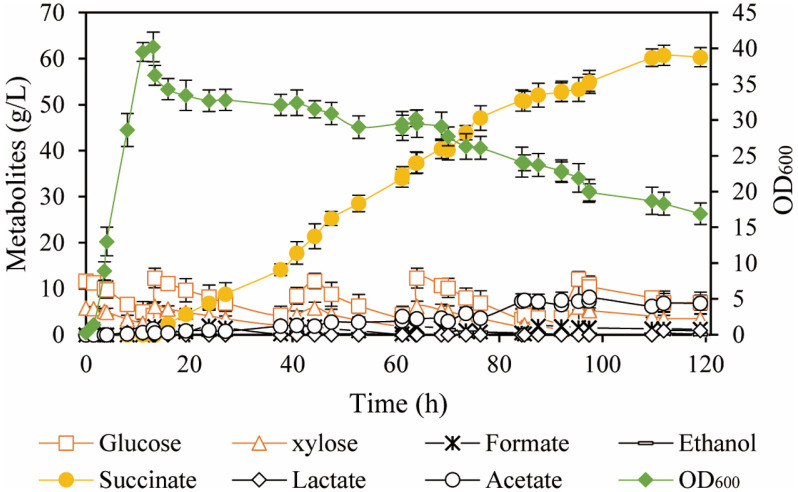
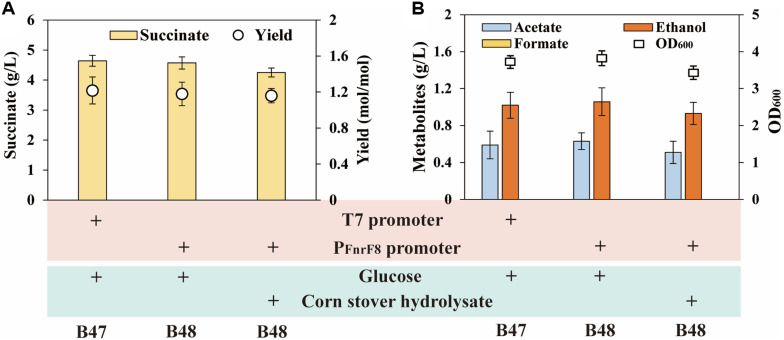
Succinic acid is regarded as one of the most important platform chemicals used in materials science, chemistry, and food industrial applications. Currently, the main bottlenecks in the microbial succinate synthesis lie in the low titer, cofactor imbalance, and high production costs. To overcome these challenges, the reductive tricarboxylic acid cycle (TCA) and glucose uptake pathway were enhanced, increasing the titer of succinate to 4.31 g/l, 2.06-fold of the original strain. Furthermore, formate dehydrogenase from was simultaneously overexpressed to increase the regeneration of NADH which was deficient in succinate synthesis under anaerobic condition. On this basis, the oxygen-responsive biosensor was used to replace the isopropyl-β-d-thiogalactoside (IPTG)-induction system, enabling strain to avoid the utilization of IPTG for succinate production. Using corn stover hydrolysate as the substrate, the optimum strain produced 60.74 g/l succinate in 5 L bioreactor. The engineered strain exhibited high succinate titer using biomass hydrolysate as substrate, significantly reduced the fermentation cost.
琥珀酸被认为是材料科学、化学和食品工业应用中最重要的平台化学品之一。目前,微生物琥珀酸合成的主要瓶颈在于产量低、辅因子失衡和生产成本高。为了克服这些挑战,增强了还原性三羧酸循环(TCA)和葡萄糖摄取途径,使琥珀酸产量提高到4.31 g/l,是原始菌株的2.06倍。此外,同时过表达来自[具体来源未明确]的甲酸脱氢酶,以增加厌氧条件下琥珀酸合成中缺乏的NADH的再生。在此基础上,使用氧响应生物传感器替代异丙基-β-D-硫代半乳糖苷(IPTG)诱导系统,使菌株在琥珀酸生产中无需使用IPTG。以玉米秸秆水解液为底物,最佳菌株在5 L生物反应器中产生了60.74 g/l琥珀酸。该工程菌株以生物质水解液为底物时表现出高琥珀酸产量,显著降低了发酵成本。