Yasmeen Sania, Waris Asim, Amin Faisal, Iqbal Javaid, Gilani Syed Omer, Khan Muhammad Jawad, Hazzazi Fawwaz, Imran Ahmed, Shah Umer Hameed, Ijaz Muhammad Adeel
Department of Biomedical Engineering and Sciences, School of Mechanical and Manufacturing Engineering, National University of Sciences and Technology (NUST), Islamabad, Pakistan.
Department of Electrical, Computer, and Biomedical Engineering, Abu Dhabi University, Abu Dhabi, UAE.
Sci Rep. 2025 Apr 28;15(1):14847. doi: 10.1038/s41598-025-96334-7.
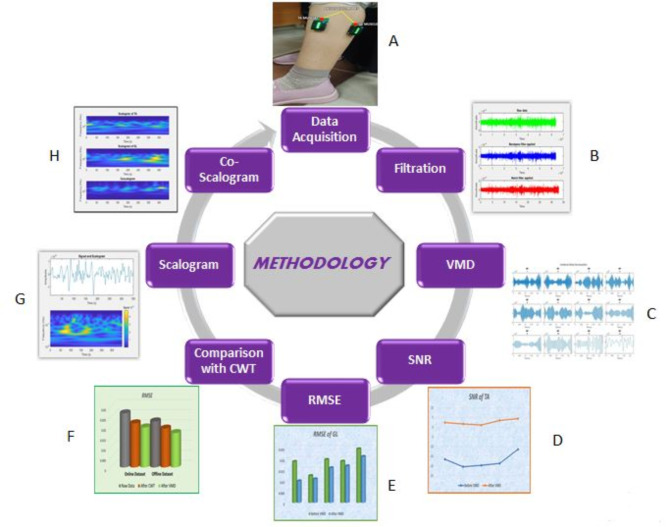
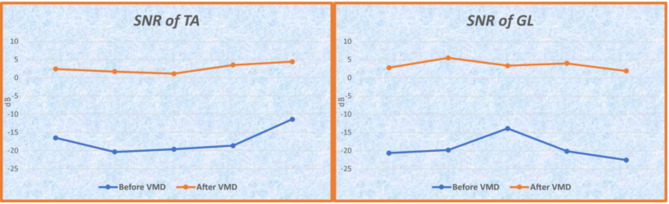
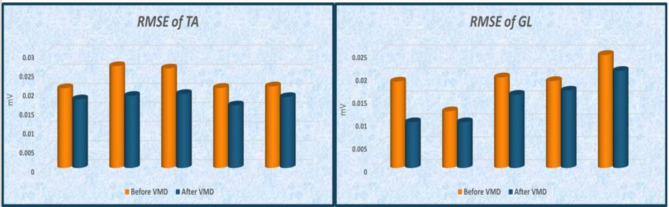
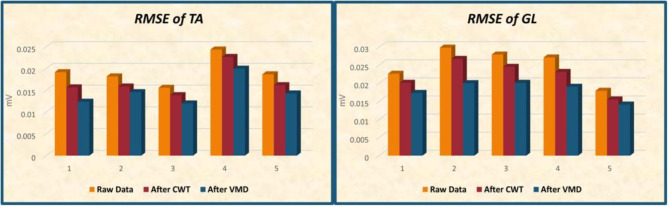
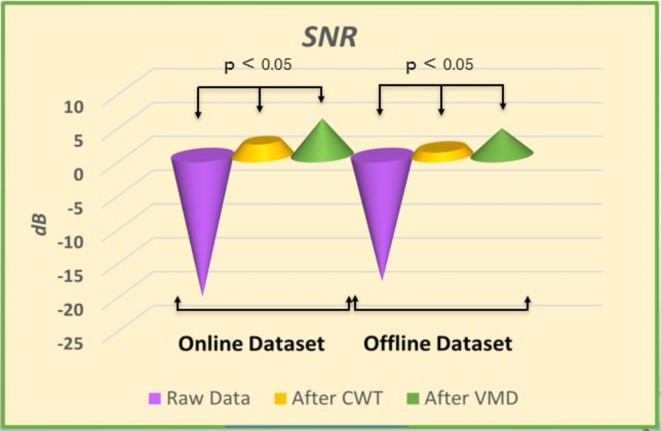
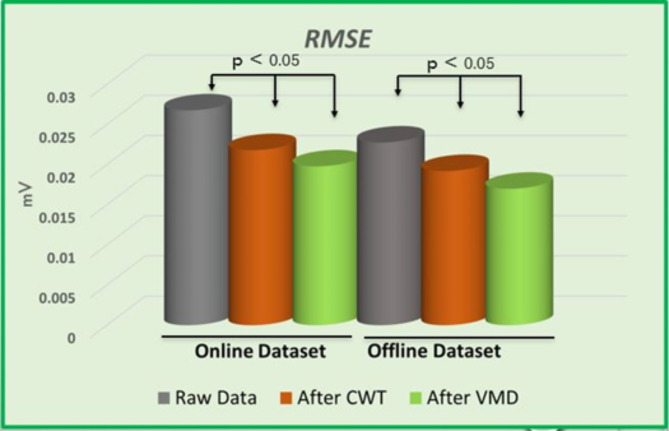
The ankle joint plays important role in performing fundamental activities such as walking and other essential daily tasks. Ankle stabilization and muscle co-contraction are crucial for rehabilitating gait abnormalities, as impaired ankle function disrupts gait, causes pain and inflammation, and hampers recovery. Accurate assessment of muscle co-contraction is crucial for developing effective non-pharmacological interventions. This paper introduces a novel approach using Variational Mode Decomposition (VMD) combined with scalogram visualization technique to analyze surface electromyographic (sEMG) signals from antagonist muscles of the lower limb and assesses muscular co-contraction using the coscalogram function. The present study compares VMD with the Continuous Wavelet Transform (CWT) approach and shows that VMD outperforms CWT in terms of both SNR and RMSE. On average, the increase in SNR in case of VMD (-17.65 ± 8.1dB to 2.98 ± 2.2dB) was greater than that of CWT (-17.65 ± 3.7dB to 1.34 ± 1.5dB). Similarly, the reduction in RMSE with VMD (0.023 ± 0.0029 to 0.017 ± 0.0015) surpassed that achieved with CWT (0.023 ± 0.0027 to 0.020 ± 0.0025). This enhanced accuracy in identifying co-contraction events has the potential to significantly improve clinical assessment and rehabilitation strategies for patients with ankle joint pathologies. To further validate VMD's effectiveness, we quantitatively assessed co-contraction events by comparing mean peak amplitudes identified using VMD and CWT. Our analysis, which revealed that VMD consistently captured stronger co-contraction events (higher mean peak amplitudes), supports VMD's superiority in accurately identifying and quantifying ankle muscle co-contraction. These results have significant implications for clinical practice, offering the potential for more precise assessments of ankle joint function and the development of more targeted and effective rehabilitation interventions.
踝关节在执行诸如行走和其他基本日常任务等基本活动中发挥着重要作用。踝关节稳定和肌肉协同收缩对于恢复步态异常至关重要,因为踝关节功能受损会扰乱步态、导致疼痛和炎症,并阻碍恢复。准确评估肌肉协同收缩对于开发有效的非药物干预措施至关重要。本文介绍了一种使用变分模态分解(VMD)结合小波尺度图可视化技术的新方法,以分析来自下肢拮抗肌的表面肌电图(sEMG)信号,并使用共尺度图函数评估肌肉协同收缩。本研究将VMD与连续小波变换(CWT)方法进行了比较,结果表明,在信噪比(SNR)和均方根误差(RMSE)方面,VMD均优于CWT。平均而言,VMD情况下的SNR增加幅度(从-17.65±8.1dB到2.98±2.2dB)大于CWT(从-17.65±3.7dB到1.34±1.5dB)。同样,VMD使RMSE的降低幅度(从0.023±0.0029到0.017±0.0015)超过了CWT(从0.023±0.0027到0.020±0.0025)。这种在识别协同收缩事件方面提高的准确性有可能显著改善踝关节病变患者的临床评估和康复策略。为了进一步验证VMD的有效性,我们通过比较使用VMD和CWT识别的平均峰值幅度来定量评估协同收缩事件。我们的分析表明,VMD始终能捕捉到更强的协同收缩事件(更高的平均峰值幅度),这支持了VMD在准确识别和量化踝关节肌肉协同收缩方面的优越性。这些结果对临床实践具有重要意义,为更精确地评估踝关节功能以及开发更有针对性和有效的康复干预措施提供了可能性。