Department of Biomedical Engineering & Sciences, School of Mechanical & Manufacturing Engineering, National University of Sciences and Technology (NUST), Islamabad 44000, Pakistan.
Department of Health Science and Technology, Aalborg University, 9220 Aalborg Øst, Denmark.
Sensors (Basel). 2021 Feb 24;21(5):1575. doi: 10.3390/s21051575.
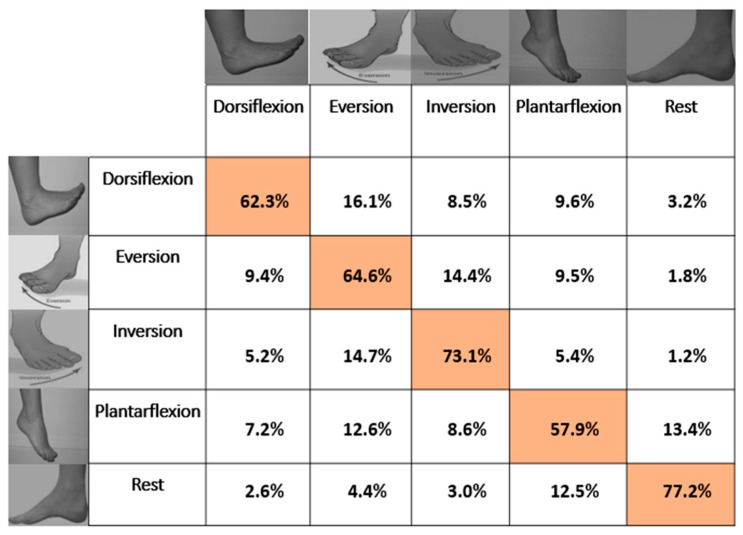
Stroke is a cerebrovascular disease (CVD), which results in hemiplegia, paralysis, or death. Conventionally, a stroke patient requires prolonged sessions with physical therapists for the recovery of motor function. Various home-based rehabilitative devices are also available for upper limbs and require minimal or no assistance from a physiotherapist. However, there is no clinically proven device available for functional recovery of a lower limb. In this study, we explored the potential use of surface electromyography (sEMG) as a controlling mechanism for the development of a home-based lower limb rehabilitative device for stroke patients. In this experiment, three channels of sEMG were used to record data from 11 stroke patients while performing ankle joint movements. The movements were then decoded from the sEMG data and their correlation with the level of motor impairment was investigated. The impairment level was quantified using the Fugl-Meyer Assessment (FMA) scale. During the analysis, Hudgins time-domain features were extracted and classified using linear discriminant analysis (LDA) and artificial neural network (ANN). On average, 63.86% ± 4.3% and 67.1% ± 7.9% of the movements were accurately classified in an offline analysis by LDA and ANN, respectively. We found that in both classifiers, some motions outperformed others ( < 0.001 for LDA and = 0.014 for ANN). The Spearman correlation (ρ) was calculated between the FMA scores and classification accuracies. The results indicate that there is a moderately positive correlation (ρ = 0.75 for LDA and ρ = 0.55 for ANN) between the two of them. The findings of this study suggest that a home-based EMG system can be developed to provide customized therapy for the improvement of functional lower limb motion in stroke patients.
中风是一种脑血管疾病(CVD),可导致偏瘫、瘫痪或死亡。传统上,中风患者需要长时间接受物理治疗师的治疗以恢复运动功能。也有各种基于家庭的上肢康复设备,它们需要理疗师的最小或无需协助。然而,目前还没有临床证明可用于下肢功能恢复的设备。在这项研究中,我们探讨了表面肌电图(sEMG)作为一种控制机制,用于开发用于中风患者的基于家庭的下肢康复设备的潜力。在该实验中,使用三个通道的 sEMG 记录 11 名中风患者进行踝关节运动时的数据。然后,从 sEMG 数据中解码运动,并研究其与运动障碍程度的相关性。使用 Fugl-Meyer 评估(FMA)量表来量化损伤程度。在分析过程中,提取了 Hudgins 时域特征,并使用线性判别分析(LDA)和人工神经网络(ANN)进行分类。平均而言,LDA 和 ANN 离线分析的分类准确率分别为 63.86%±4.3%和 67.1%±7.9%。我们发现,在这两种分类器中,某些运动的表现优于其他运动(LDA 的 <0.001,ANN 的 = 0.014)。计算 FMA 评分和分类准确率之间的斯皮尔曼相关系数(ρ)。结果表明,两者之间存在中度正相关(LDA 的 ρ=0.75,ANN 的 ρ=0.55)。这项研究的结果表明,可以开发基于家庭的 EMG 系统,为中风患者改善功能性下肢运动提供个性化治疗。