Wen Yan, Wang Qing
Department of Endocrinology, China-Japan Union Hospital of Jilin University, 126 Xian-tai street, 130033, Changchun, JiLin, China.
Biol Res. 2025 Apr 28;58(1):23. doi: 10.1186/s40659-025-00602-9.
We aimed to explore the heterogeneities and communication properties of cardiac CMs and ECs in diabetes.
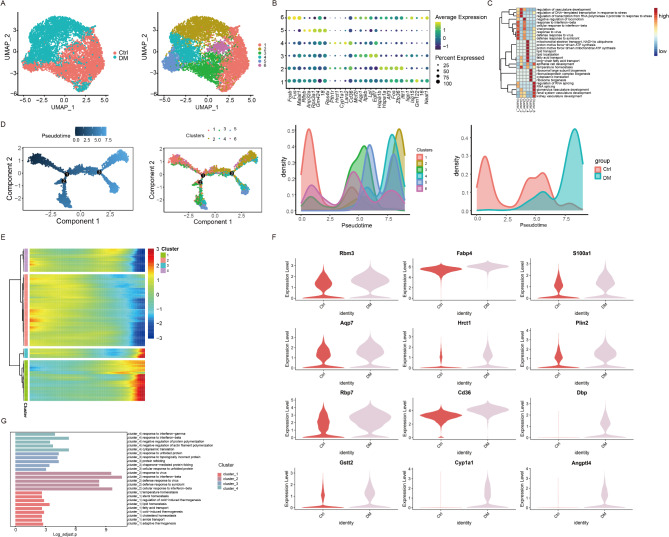
GSE213337 dataset was retrieved from NCBI Gene Expression Omnibus, containing the single-cell RNA sequencing data of hearts from the control and streptozotocin-induced diabetic mice. Cell cluster analysis was performed to identify the cell atlas. Data of CMs and ECs were extracted individually for re-cluster analysis, functional enrichment analysis and trajectory analysis. Cell communication analysis was conducted to explore the altered signals and significant ligand-receptor interactions.
Eleven cell types were identified in the heart tissue. CMs were re-clustered into four subclusters, and cluster 4 was dominant in diabetic condition and enriched in cellular energy metabolism processes. ECs were re-clustered into six subclusters, and clusters 2, 4 and 5 were dominant in the diabetic condition and mainly enriched in cellular energy metabolism and lipid transport processes. The cellular communication network was altered in the diabetic heart. ECs dominated the overall signaling and notably increased the ANGPTL and SEMA4 signals in the diabetic heart. Four significant ligand-receptor pairs implicating the two signals contributed to the communication between ECs and other cell types, including Angptl1-(Itga1 + Itgb1), Angptl4-Cdh5, Angptl4-Sdc3, and Sema4a-(Nrp + Plxna2). The ligand Angptl4 engaged in ECs-CMs communication in a paracrine manner.
Single-cell sequencing analysis revealed heterogeneities of ECs and CMs in diabetes, Angptl4-Cdh5 and Angptl4-Sdc3 were involved in the communication between ECs and CMs in diabetes.
我们旨在探究糖尿病状态下心脏心肌细胞(CMs)和内皮细胞(ECs)的异质性及通讯特性。
从NCBI基因表达综合数据库中检索GSE213337数据集,其包含来自对照小鼠和链脲佐菌素诱导的糖尿病小鼠心脏的单细胞RNA测序数据。进行细胞聚类分析以识别细胞图谱。分别提取CMs和ECs的数据进行再聚类分析、功能富集分析和轨迹分析。开展细胞通讯分析以探究改变的信号及显著的配体 - 受体相互作用。
在心脏组织中鉴定出11种细胞类型。CMs被重新聚类为四个亚群,亚群4在糖尿病状态下占主导且富集于细胞能量代谢过程。ECs被重新聚类为六个亚群,亚群2、4和5在糖尿病状态下占主导且主要富集于细胞能量代谢和脂质转运过程。糖尿病心脏中的细胞通讯网络发生了改变。ECs主导整体信号传导,并且在糖尿病心脏中显著增加了血管生成素样蛋白(ANGPTL)和信号素4(SEMA4)信号。涉及这两种信号的四个显著配体 - 受体对促成了ECs与其他细胞类型之间的通讯,包括血管生成素样蛋白1 - (整合素α1 + 整合素β1)、血管生成素样蛋白4 - 钙黏蛋白5、血管生成素样蛋白4 - 多功能聚糖蛋白3,以及信号素4A - (神经纤毛蛋白 + 血小板膜糖蛋白受体α2)。配体血管生成素样蛋白4以旁分泌方式参与ECs - CMs通讯。
单细胞测序分析揭示了糖尿病状态下ECs和CMs的异质性,血管生成素样蛋白4 - 钙黏蛋白5和血管生成素样蛋白4 - 多功能聚糖蛋白3参与了糖尿病状态下ECs与CMs之间的通讯。