Chen Long, Chen Xuemei, Huo Ran, Xu Songying, Xu Weiwei
Particle Physics Research Center, Shandong Institute of Advanced Technology, 1501 Panlong Road, Jinan, 250103, Shandong, China.
Institute for Advanced Technology, Shandong University, 17923 Jingshi Road, Jinan, 250061, Shandong, China.
Radiat Environ Biophys. 2025 Aug;64(3):391-407. doi: 10.1007/s00411-025-01126-2. Epub 2025 Apr 29.
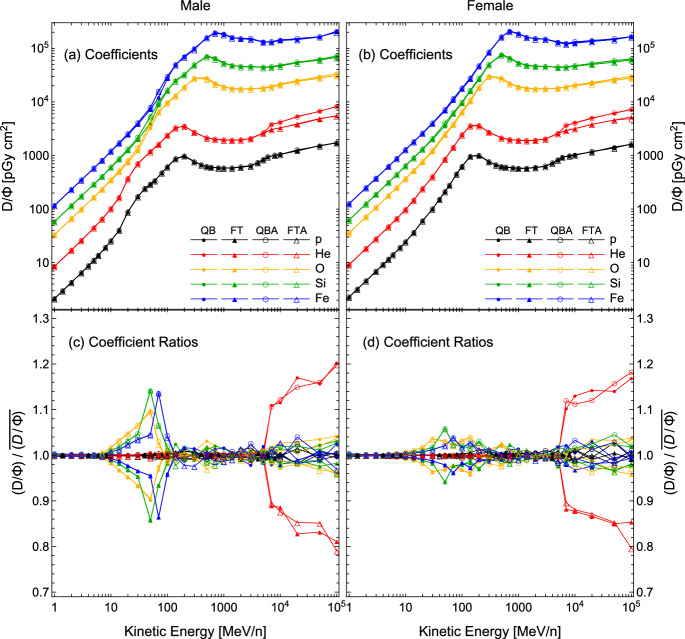
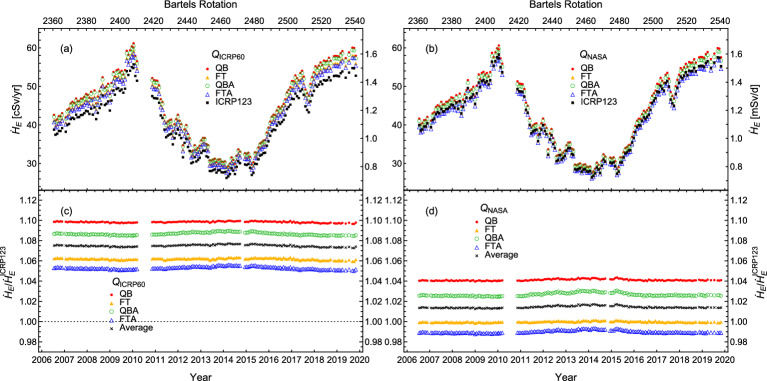
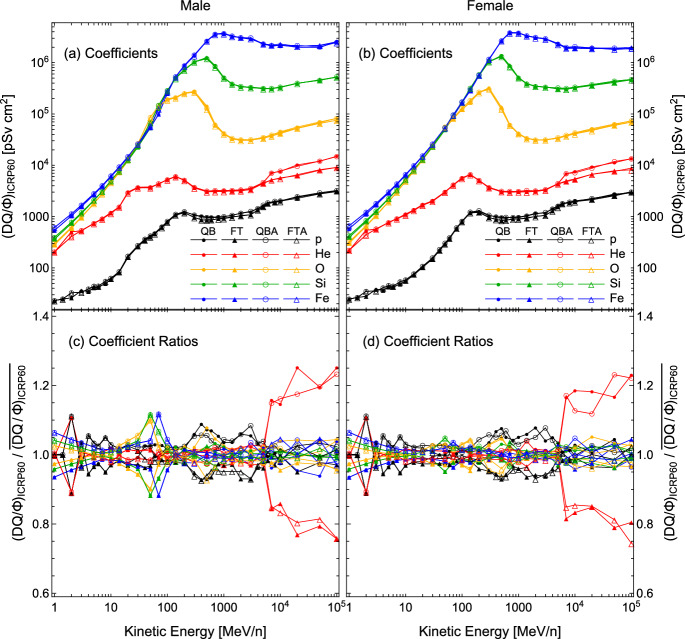
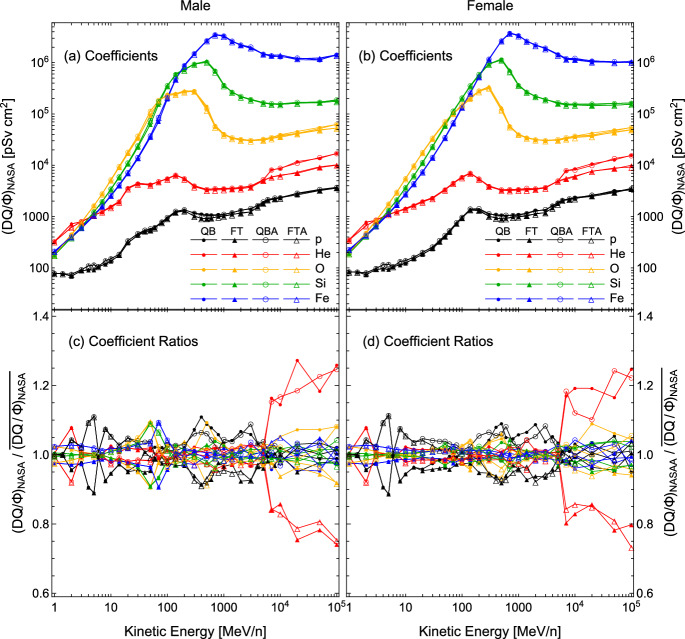
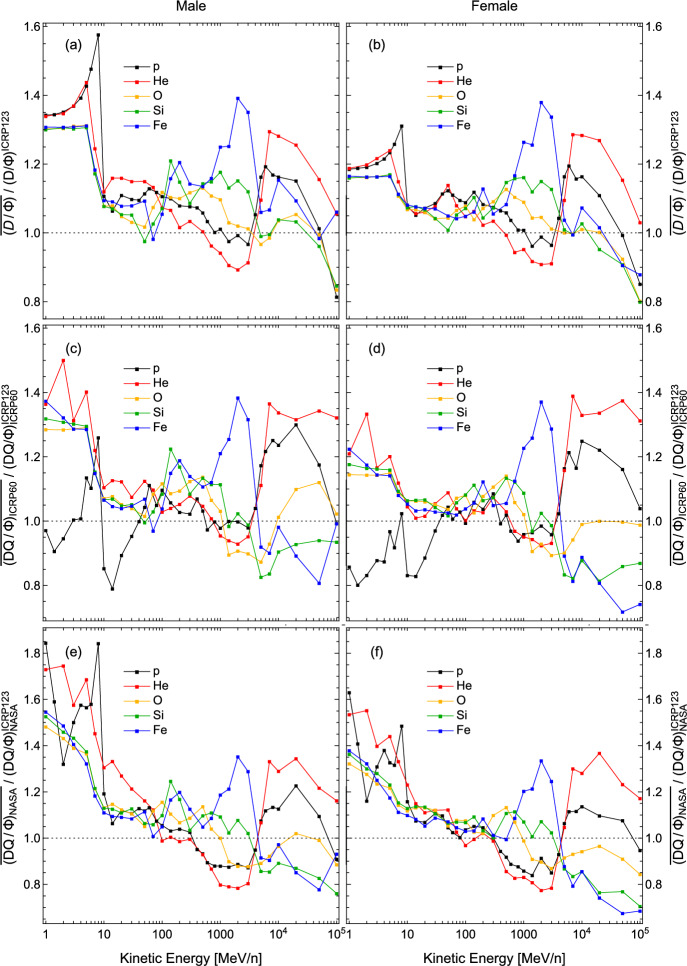
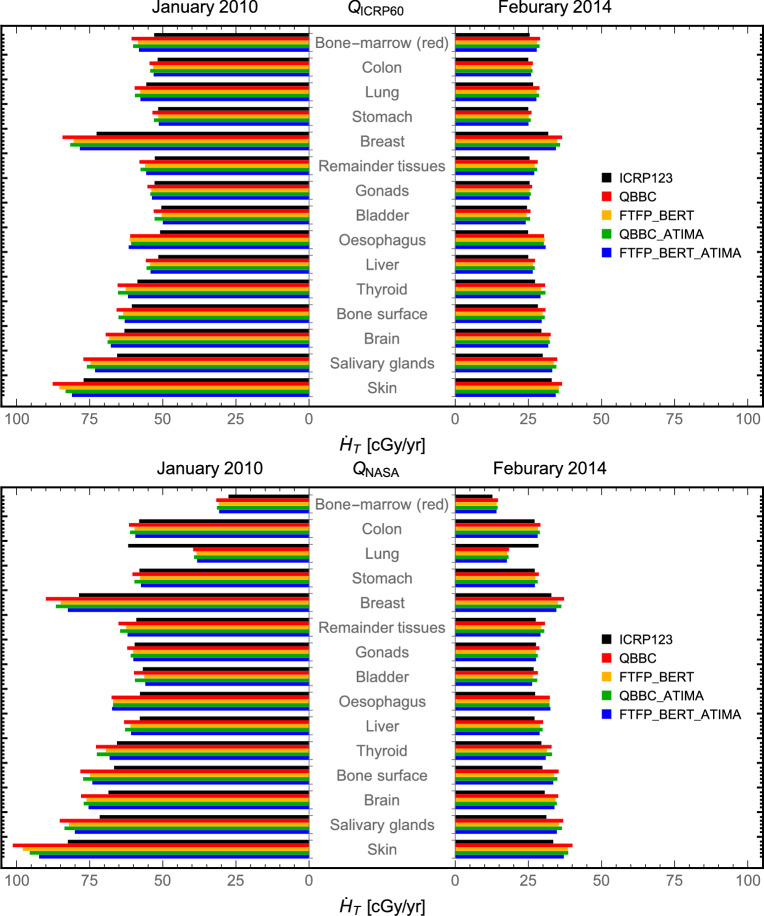
Fluence-to-dose conversion coefficients are fundamental ingredients to calculate astronaut radiation dose in space. For this purpose, the conversion coefficients for isotropic radiation provided by the International Commission on Radiological Protection in Publication 123 (ICRP123) are widely used. Understanding the uncertainties in these coefficients is important for a precise calculation of radiation dose. In this work, we present a systematic study of unshielded dose coefficients calculated by means of the GEANT4 Monte Carlo simulation toolkit and the human voxel phantoms defined in ICRP Publication 110. Four GEANT4 physics lists, featured with two variations of electromagnetic and two variations of hadronic interaction models, were used in the study. Absorbed dose and dose equivalent coefficients with both the ICRP60 and NASA quality factors were calculated, for individual cosmic nuclei with charge from Z 1 to Z 28 and a kinetic energy range from 1 MeV/n to 100 GeV/n. The effective dose equivalent rates in free space at 1 AU were then calculated for each set of dose coefficients. The four effective dose equivalent rates calculated with each physics list agreed within , and on average they were larger than the ICRP123 results by and using the ICRP60 and the NASA quality factor, respectively. These results shed light on the systematic uncertainty of astronaut radiation exposure calculation, particularly from the physics interaction models.
注量-剂量转换系数是计算太空宇航员辐射剂量的基本要素。为此,国际放射防护委员会第123号出版物(ICRP123)提供的各向同性辐射转换系数被广泛使用。了解这些系数的不确定性对于精确计算辐射剂量很重要。在这项工作中,我们对通过GEANT4蒙特卡罗模拟工具包和ICRP第110号出版物中定义的人体体素模型计算出的无屏蔽剂量系数进行了系统研究。研究中使用了四个GEANT4物理列表,其特点是电磁相互作用模型和强子相互作用模型各有两种变体。计算了电荷数从Z = 1到Z = 28、动能范围从1 MeV/n到100 GeV/n的单个宇宙核的吸收剂量和剂量当量系数,同时考虑了ICRP60和美国国家航空航天局(NASA)的品质因数。然后针对每组剂量系数计算了1天文单位(AU)自由空间中的有效剂量当量率。用每个物理列表计算出的四个有效剂量当量率在……范围内一致,平均而言,使用ICRP60和NASA品质因数时,它们分别比ICRP123的结果大……和……。这些结果揭示了宇航员辐射暴露计算中的系统不确定性,特别是来自物理相互作用模型的不确定性。 (注:原文中部分关键数据缺失,用省略号代替)