Cozza Mariagiovanna, Boccardi Virginia, Duka Ruslan, Vashist Yogesh, Marano Luigi
Department of Integration, Intermediate Care Programme, AUSL Bologna, 40100, Bologna, Italy.
Institute of Gerontology and Geriatrics, Department of Medicine and Surgery, University of Perugia, 06128, Perugia, Italy.
Aging Clin Exp Res. 2025 Apr 30;37(1):135. doi: 10.1007/s40520-025-03033-4.
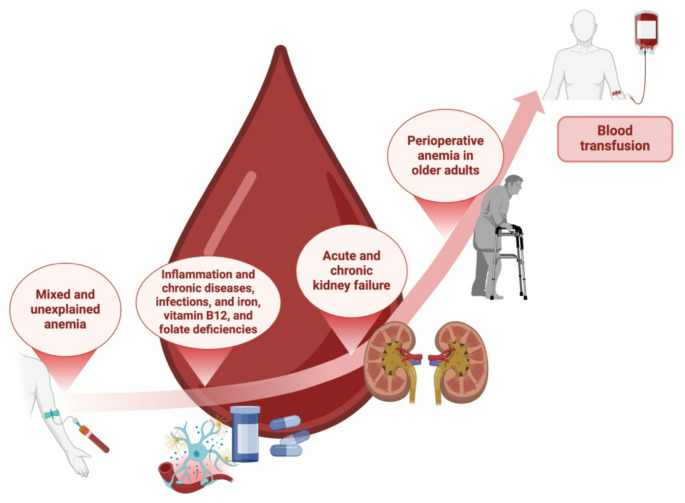
Anemia is a common clinical condition that can significantly affect patient outcomes, particularly in those undergoing surgery. In older adults, the presence of anemia combined with cardiovascular disease can increase surgical morbidity and mortality, influencing surgical decisions and creating a cascade of complications that may negatively impact recovery. Blood transfusion remains the primary response to anemia in the perioperative setting, despite evidence suggesting potential adverse effects on survival and recovery. However, older adults present unique challenges due to age-related physiological changes anda reduced tolerance to anemia and blood loss. The debate between restrictive and liberal blood transfusion strategies in this population remains unresolved. Patient Blood Management (PBM) protocols have been developed to systematically address perioperative anemia. This review emphasizes the need for a nuanced approach to transfusion in older adults, suggesting that while a restrictive strategy may not be universally applicable, decisions should be guided by thorough clinical evaluations. These assessments should prioritize not only hemoglobin levels but also patient-specific factors, including life expectancy, comorbidities, and patient preferences, with the involvement of a multidisciplinary team to tailor the best approach for everyone.
贫血是一种常见的临床病症,会显著影响患者的治疗结果,尤其是在接受手术的患者中。在老年人中,贫血与心血管疾病并存会增加手术的发病率和死亡率,影响手术决策,并引发一系列可能对康复产生负面影响的并发症。尽管有证据表明输血对生存和康复可能存在潜在不良影响,但在围手术期,输血仍是应对贫血的主要措施。然而,由于与年龄相关的生理变化以及对贫血和失血的耐受性降低,老年人面临着独特的挑战。在这一人群中,限制性输血策略和宽松输血策略之间的争论仍未解决。已经制定了患者血液管理(PBM)方案来系统地应对围手术期贫血。本综述强调,对于老年人输血需要采取细致入微的方法,表明虽然限制性策略可能并非普遍适用,但决策应以全面的临床评估为指导。这些评估不仅应优先考虑血红蛋白水平,还应考虑患者的特定因素,包括预期寿命、合并症和患者偏好,由多学科团队参与,为每个人量身定制最佳方案。