Korleski Jack, Sall Sophie, Luly Kathryn M, Johnson Maya K, Johnson Amanda L, Khela Harmon, Lal Bachchu, Taylor T C, Ashby Jean Micheal, Alonso Hector, Li Alice, Zhou Weiqiang, Smith-Connor Karen, Hughes Russell, Tzeng Stephany Y, Laterra John, Green Jordan J, Lopez-Bertoni Hernando
Hugo W. Moser Research Institute at Kennedy Krieger, Baltimore, USA.
Department of Internal Medicine, Mayo Clinic Rochester, Minnesota, USA.
Signal Transduct Target Ther. 2025 Apr 30;10(1):145. doi: 10.1038/s41392-025-02223-w.
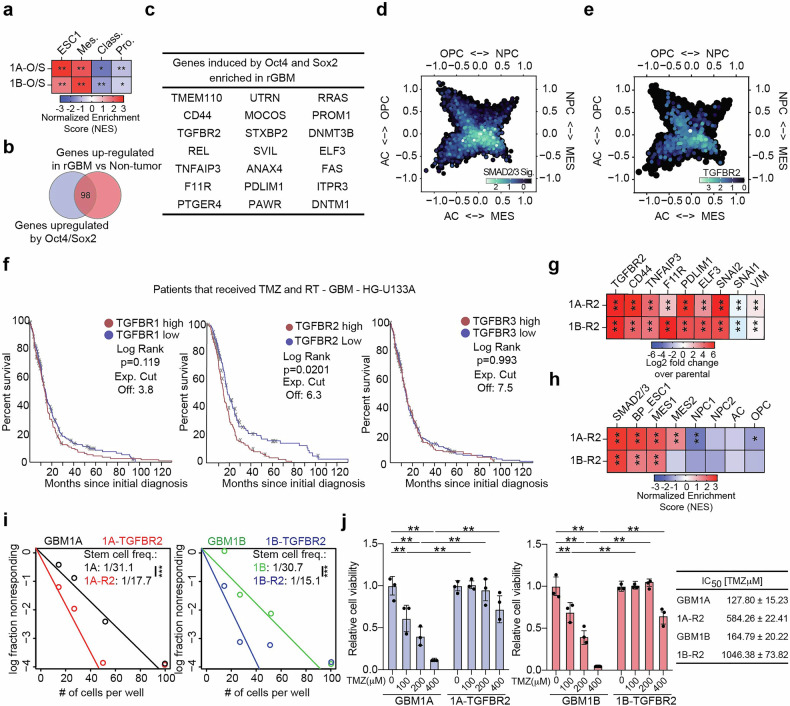
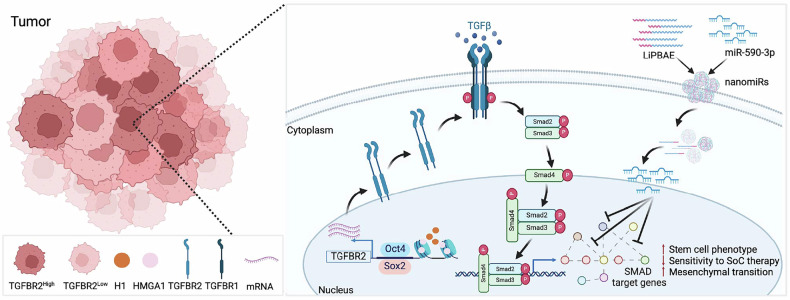
Despite aggressive therapy, glioblastoma (GBM) recurs in almost all patients and treatment options are very limited. Despite our growing understanding of how cellular transitions associate with relapse in GBM, critical gaps remain in our ability to block these molecular changes and treat recurrent disease. In this study we combine computational biology, forward-thinking understanding of miRNA biology and cutting-edge nucleic acid delivery vehicles to advance targeted therapeutics for GBM. Computational analysis of RNA sequencing from clinical GBM specimens identified TGFβ type II receptor (TGFBR2) as a key player in the mesenchymal transition associated with worse outcome in GBM. Mechanistically, we show that elevated levels of TGFBR2 is conducive to reduced temozolomide (TMZ) sensitivity. This effect is, at least partially, induced by stem-cell driving events coordinated by the reprogramming transcription factors Oct4 and Sox2 that lead to open chromatin states. We show that blocking TGFBR2 via molecular and pharmacological approaches decreases stem cell capacity and sensitivity of clinical recurrent GBM (rGBM) isolates to TMZ in vitro. Network analysis uncovered miR-590-3p as a tumor suppressor that simultaneously inhibits multiple oncogenic nodes downstream of TGFBR2. We also developed novel biodegradable lipophilic poly(β-amino ester) nanoparticles (LiPBAEs) for in vivo microRNA (miRNAs) delivery. Following direct intra-tumoral infusion, these nanomiRs efficiently distribute through the tumors. Importantly, miR-590-3p nanomiRs inhibited the growth and extended survival of mice bearing orthotopic human rGBM xenografts, with an apparent 30% cure rate. These results show that miRNA-based targeted therapeutics provide new opportunities to treat rGBM and bypass the resistance to standard of care therapy.
尽管进行了积极治疗,几乎所有胶质母细胞瘤(GBM)患者都会复发,且治疗选择非常有限。尽管我们对细胞转变如何与GBM复发相关联的理解不断加深,但在阻断这些分子变化和治疗复发性疾病的能力方面仍存在重大差距。在本研究中,我们结合计算生物学、对微小RNA(miRNA)生物学的前瞻性理解以及前沿的核酸递送载体,以推进GBM的靶向治疗。对临床GBM标本的RNA测序进行计算分析,确定转化生长因子βII型受体(TGFBR2)是与GBM预后较差相关的间充质转变中的关键因子。从机制上讲,我们表明TGFBR2水平升高会导致替莫唑胺(TMZ)敏感性降低。这种效应至少部分是由重编程转录因子Oct4和Sox2协调的干细胞驱动事件诱导的,这些事件导致染色质开放状态。我们表明,通过分子和药理学方法阻断TGFBR2可降低临床复发性GBM(rGBM)分离株的干细胞能力和对TMZ的敏感性。网络分析发现miR - 590 - 3p是一种肿瘤抑制因子,它同时抑制TGFBR2下游的多个致癌节点。我们还开发了新型可生物降解的亲脂性聚(β - 氨基酯)纳米颗粒(LiPBAEs)用于体内微小RNA(miRNAs)递送。直接瘤内注射后,这些纳米miR能有效分布于肿瘤中。重要的是,miR - 590 - 3p纳米miR抑制了原位人rGBM异种移植小鼠的肿瘤生长并延长了生存期,治愈率明显达到30%。这些结果表明,基于miRNA的靶向治疗为治疗rGBM提供了新机会,并绕过了对标准治疗的耐药性。