Gajewska Ewa, Surowińska Joanna, Chałupka Anna, Moczko Jerzy, Michalak Michał, Sobieska Magdalena
Chair and Clinic of the Developmental Neurology, Poznan University of Medical Sciences, Poznan, Poland.
Poznan University of Medical Sciences, Poznan, Poland.
Sci Rep. 2025 Apr 29;15(1):15035. doi: 10.1038/s41598-025-98118-5.
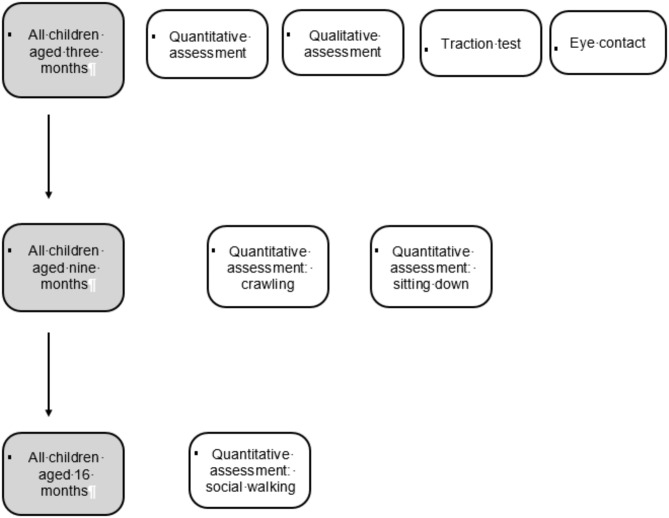
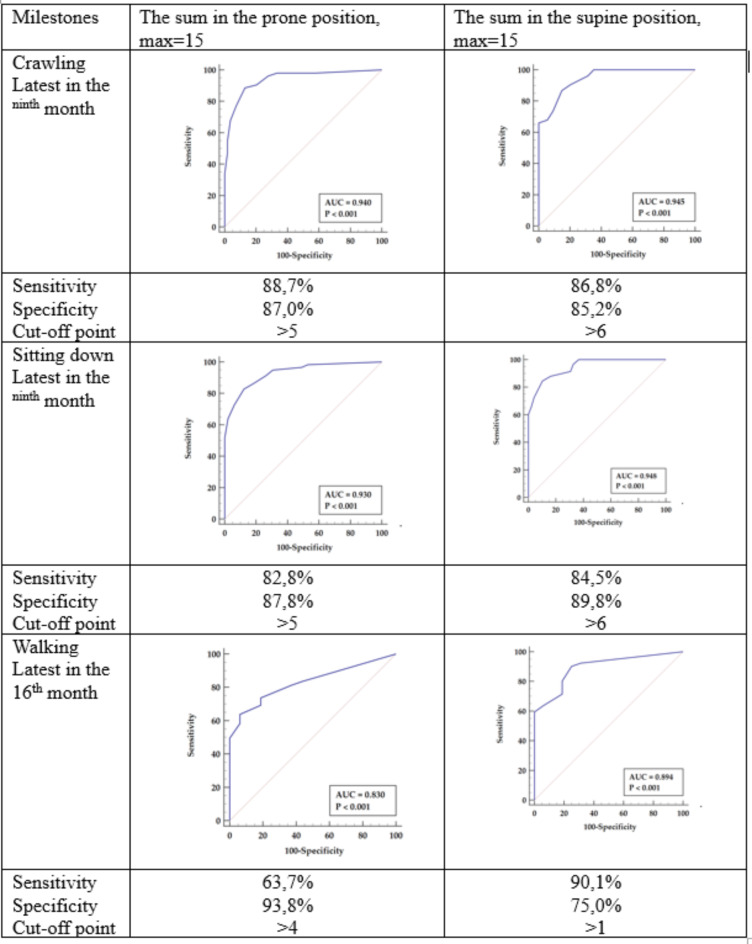
The study was conducted prospectively on 107 children (74 boys). Eighty-three children were born at term (39 ± 1), 24 were born prematurely (33 ± 4). The study included the qualitative assessment at three months of age, eye contact and traction response assessment, and the quantitative assessment at 3, 9, and 16 months of age. The timely achievement of crawling and sitting down depended on the same qualitative characteristics at three months of age: hands and lower limbs and on the segmentally extended spine and shoulder blades. Social walking was influenced by the qualitative assessment of the position of the lower limbs at three months of age. The eye contact substantially impacted walking; the correct traction test moderately impacted crawling and sitting down. The qualitative assessment at three months is highly predictive for crawling and sitting down at nine months and social walking at 16 months. The correct traction test appears to predict crawling and sitting down, while eye contact is essential for social walking.
该研究对107名儿童(74名男孩)进行了前瞻性研究。83名儿童足月出生(39±1周),24名儿童早产(33±4周)。该研究包括在三个月大时的定性评估、眼神交流和牵引反应评估,以及在3个月、9个月和16个月大时的定量评估。及时学会爬行和坐下取决于三个月大时相同的定性特征:手和下肢以及节段性伸展的脊柱和肩胛骨。社交行走受到三个月大时下肢位置定性评估的影响。眼神交流对行走有显著影响;正确的牵引测试对爬行和坐下有适度影响。三个月时的定性评估对九个月时的爬行和坐下以及16个月时的社交行走具有高度预测性。正确的牵引测试似乎可以预测爬行和坐下,而眼神交流对社交行走至关重要。