Zhao Yue, Gong Mingfu, Liu Xu, Xie Qian, Sun Tao, Zhou Chunyu, Shu Tongsheng, Wang Shuang, Zhang Liang, Zhang Dong
Department of Radiology, Xinqiao Hospital, Army Medical University, Chongqing 400037, China.
Theranostics. 2025 Apr 9;15(11):5106-5120. doi: 10.7150/thno.109826. eCollection 2025.
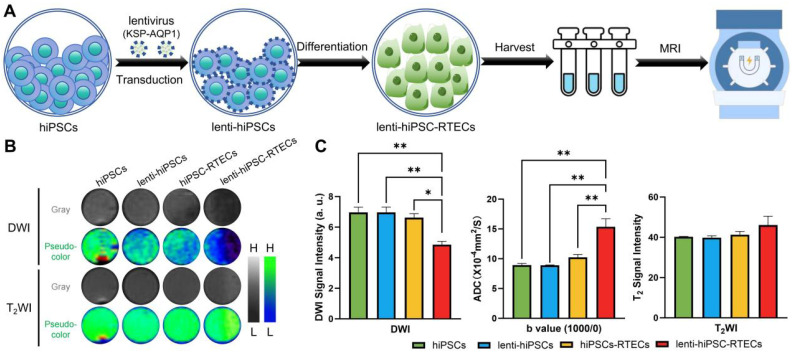
Human-induced pluripotent stem cells (hiPSCs) exhibit great potential in the treatment of acute kidney injury (AKI), and their targeted differentiation into renal tubular epithelial cells (RTECs) is directly involved in the repair of the injured tissue. However, their differentiation during treatment is difficult to evaluate noninvasively. Aquaporin 1 (AQP1) can alter the dispersion of water molecules at the cellular level and thus can be detected with high sensitivity by diffusion-weighted imaging (DWI). In this study, a kidney-specific promoter (KSP-cadherin)-driven AQP1 overexpression lentivirus (KSP-AQP1) was constructed and used for tracking the differentiation of hiPSCs . Then, two AKI animal models were used to identify the feasibility of KSP-AQP1 for tracking of the differentiation of hiPSCs into RTECs. We utilized KSP-positive and KSP-negative cells to examine the specificity of KSP-AQP1. It was found that only the KSP-positive cells showed a substantial expression of AQP1, accompanied by a significant variation in both the diffusion-weighted imaging (DWI) signal intensity (SI) and the apparent diffusion coefficient (ADC) values. whereas KSP-AQP1-transduced KSP-negative cells had no apparent SI and ADC changes. DWI results suggested that after the hiPSCs transplantation , the KSP-AQP1-pretransduced hiPSCs group exhibited a significantly decreased SI and increased ADC value when compared with the hiPSCs-treated and untreated AKI kidneys. In addition, the AQP1-mediated differences in DWI SI and ADC value between the KSP-AQP1-pretransduced hiPSCs group and hiPSCs group were confirmed by analysis of the KSP transcriptional activity using co-expressed exogenous flag gene mCherry. This study successfully developed a method for tracking the differentiation of hiPSCs into RTECs during the treatment of AKI using a KSP-regulated AQP1 overexpression strategy.
人诱导多能干细胞(hiPSC)在急性肾损伤(AKI)治疗中展现出巨大潜力,其定向分化为肾小管上皮细胞(RTEC)直接参与损伤组织的修复。然而,治疗过程中它们的分化难以通过非侵入性方法进行评估。水通道蛋白1(AQP1)可在细胞水平改变水分子的扩散,因此可通过扩散加权成像(DWI)进行高灵敏度检测。在本研究中,构建了一种由肾脏特异性启动子(KSP - 钙黏蛋白)驱动的AQP1过表达慢病毒(KSP - AQP1),用于追踪hiPSC的分化。然后,使用两种AKI动物模型来确定KSP - AQP1追踪hiPSC向RTEC分化的可行性。我们利用KSP阳性和KSP阴性细胞来检测KSP - AQP1的特异性。结果发现,只有KSP阳性细胞显示出AQP1的大量表达,同时扩散加权成像(DWI)信号强度(SI)和表观扩散系数(ADC)值均有显著变化。而转导KSP - AQP1的KSP阴性细胞则没有明显的SI和ADC变化。DWI结果表明,hiPSC移植后,与hiPSC治疗组和未治疗的AKI肾脏相比,预先转导KSP - AQP1的hiPSC组的SI显著降低,ADC值升高。此外,通过使用共表达的外源flag基因mCherry分析KSP转录活性,证实了预先转导KSP - AQP1的hiPSC组与hiPSC组之间在DWI SI和ADC值上由AQP1介导的差异。本研究成功开发了一种利用KSP调控的AQP1过表达策略追踪AKI治疗过程中hiPSC向RTEC分化的方法。