Taggart Caelan, Ferry Amy, Barker Stephanie, Williams Kelly, Souter Grace, Bularga Anda, Wereski Ryan, McDermott Michael J, Williams Michelle C, Boeddinghaus Jasper, White Christopher, Singh Jagdeep S, Boath Keith, Fujisawa Takeshi, Tuck Christopher, Briola Anny, Lewis Steff, Anand Atul, Dweck Marc R, Newby David E, Al-Shahi Salman Rustam, Mills Nicholas L, Chapman Andrew R
BHF Centre of Research Excellence, University of Edinburgh, Edinburgh, United Kingdom.
BHF Centre of Research Excellence, University of Edinburgh, Edinburgh, United Kingdom; Cardiovascular Research Institute, University Hospital Basel, University of Basel, Basel, Switzerland.
JACC Adv. 2025 May;4(5):101738. doi: 10.1016/j.jacadv.2025.101738. Epub 2025 Apr 4.
Type 2 myocardial infarction occurs in the absence of atherothrombosis, due to myocardial oxygen supply or demand imbalance, often during another acute illness. It is common and associated with poor clinical outcomes. No randomized controlled trials are available to guide investigation or treatment.
The authors assessed the feasibility of implementing a complex intervention of investigation and treatment for coronary and structural heart disease in patients with type 2 myocardial infarction.
A pilot phase of a prospective randomized controlled trial was conducted. Process outcomes included the proportion of eligible patients approached, consented, and randomized. Adherence was defined as the number of recommended investigations and treatments administered at 90 days. Qualitative interviews explored reasons for participation and patient experience.
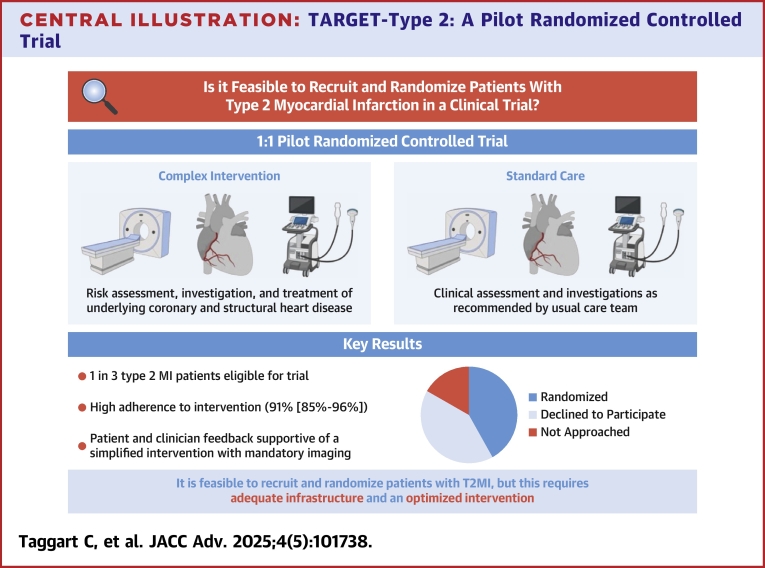
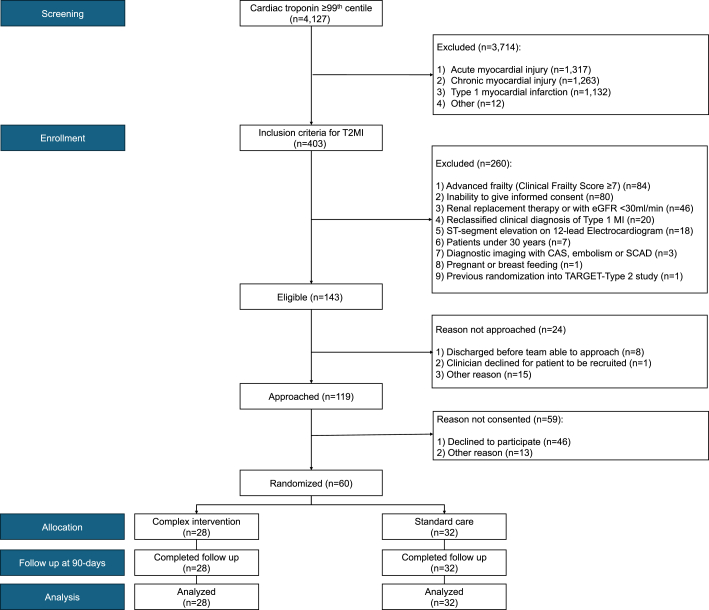
Between November 2022 and November 2023, 4,127 patients with increased cardiac troponin concentrations were screened across 3 sites, and 403 patients (10%) met inclusion criteria. One hundred and forty-three patients (35%) were eligible, 119 patients (83%) were approached, and 60 patients (42%, age 70 ± 10 years, 38% women) consented and randomized to the intervention (n = 28) or standard care (n = 32). Follow-up was complete in all participants. Adherence to recommendations was 90.7% (95% CI: 85.3%-96.1%). Patients highlighted variation in communication of the diagnosis and in trial investigation and management recommendations were potential barriers to participation.
It is feasible to recruit and randomize patients with type 2 myocardial infarction to a complex intervention targeting coronary or structural heart disease. A multicenter trial with an optimized intervention is now required to inform practice.
2型心肌梗死发生在无动脉粥样硬化血栓形成的情况下,由于心肌氧供或需求失衡,通常在另一种急性疾病期间发生。它很常见且与不良临床结局相关。尚无随机对照试验可指导调查或治疗。
作者评估了对2型心肌梗死患者实施针对冠状动脉和结构性心脏病的复杂调查和治疗干预措施的可行性。
进行了一项前瞻性随机对照试验的试点阶段。过程结果包括被接触、同意并随机分组的符合条件患者的比例。依从性定义为在90天时进行的推荐调查和治疗的数量。定性访谈探讨了参与原因和患者体验。
在2022年11月至2023年11月期间,在3个地点对4127名心肌肌钙蛋白浓度升高的患者进行了筛查,403名患者(10%)符合纳入标准。143名患者(35%)符合条件,119名患者(83%)被接触,60名患者(42%,年龄70±10岁,38%为女性)同意并随机分为干预组(n = 28)或标准治疗组(n = 32)。所有参与者均完成随访。对推荐的依从率为90.7%(95%CI:85.3%-96.1%)。患者强调诊断沟通以及试验调查和管理建议方面的差异是参与的潜在障碍。
将2型心肌梗死患者招募并随机分配到针对冠状动脉或结构性心脏病的复杂干预措施中是可行的。现在需要进行一项采用优化干预措施的多中心试验,为临床实践提供依据。