
2 型心肌梗死患者的冠状动脉和心脏疾病:一项前瞻性队列研究。
Coronary Artery and Cardiac Disease in Patients With Type 2 Myocardial Infarction: A Prospective Cohort Study.
机构信息
BHF Centre for Cardiovascular Science (A.B., J.H., M.D., S.S., C.T., R.W., T.S., M.N.M., T.F., A.V.F., J.C., W.S.J., F.E.S., M.W., C.T., A.H.B., D.E.N., M.R.D., N.L.M., A.R.C.), University of Edinburgh, United Kingdom.
Edinburgh Imaging (S.S., E.J.R.v.B., M.W.), University of Edinburgh, United Kingdom.
出版信息
Circulation. 2022 Apr 19;145(16):1188-1200. doi: 10.1161/CIRCULATIONAHA.121.058542. Epub 2022 Mar 28.
BACKGROUND
Type 2 myocardial infarction is caused by myocardial oxygen supply-demand imbalance, and its diagnosis is increasingly common with the advent of high-sensitivity cardiac troponin assays. Although this diagnosis is associated with poor outcomes, widespread uncertainty and confusion remain among clinicians as to how to investigate and manage this heterogeneous group of patients with type 2 myocardial infarction.
METHODS
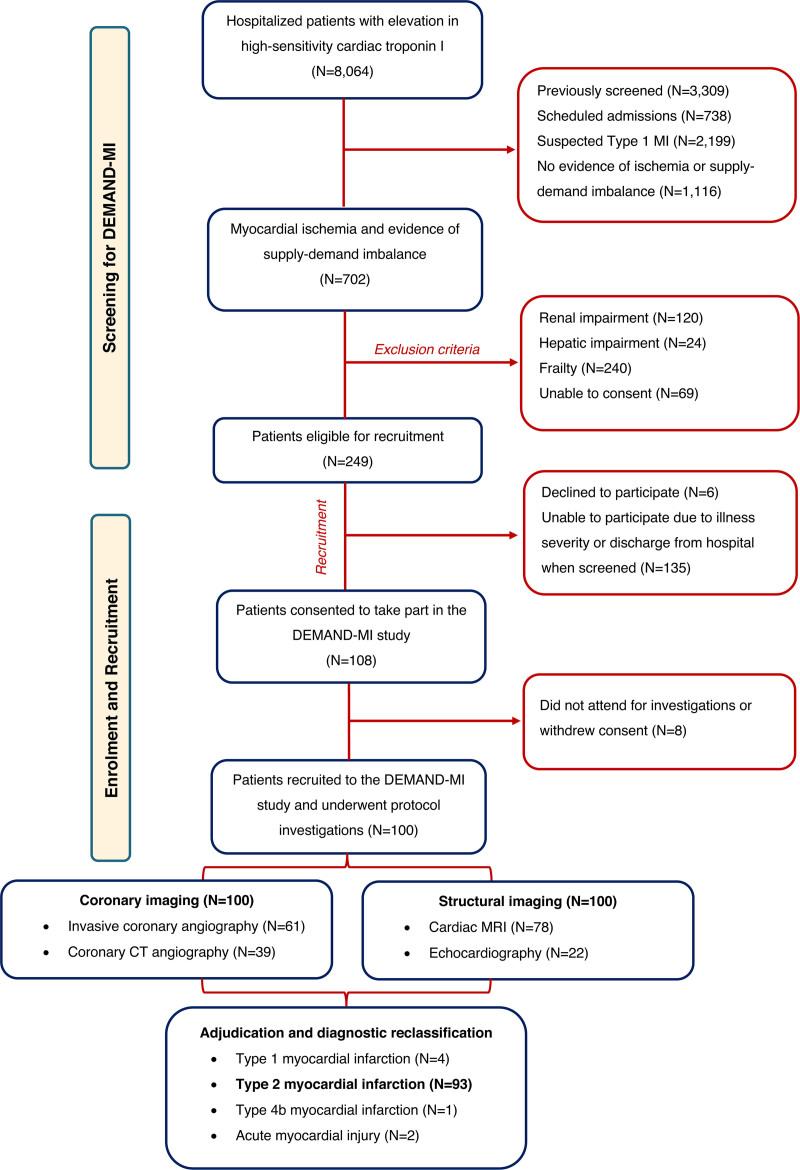
In a prospective cohort study, 8064 consecutive patients with increased cardiac troponin concentrations were screened to identify patients with type 2 myocardial infarction. We excluded patients with frailty or renal or hepatic failure. All study participants underwent coronary (invasive or computed tomography angiography) and cardiac (magnetic resonance or echocardiography) imaging, and the underlying causes of infarction were independently adjudicated. The primary outcome was the prevalence of coronary artery disease.
RESULTS
In 100 patients with a provisional diagnosis of type 2 myocardial infarction (median age, 65 years [interquartile range, 55-74 years]; 43% women), coronary and cardiac imaging reclassified the diagnosis in 7 patients: type 1 or 4b myocardial infarction in 5 and acute myocardial injury in 2 patients. In those with type 2 myocardial infarction, median cardiac troponin I concentrations were 195 ng/L (interquartile range, 62-760 ng/L) at presentation and 1165 ng/L (interquartile range, 277-3782 ng/L) on repeat testing. The prevalence of coronary artery disease was 68% (63 of 93), which was obstructive in 30% (28 of 93). Infarct-pattern late gadolinium enhancement or regional wall motion abnormalities were observed in 42% (39 of 93), and left ventricular systolic dysfunction was seen in 34% (32 of 93). Only 10 patients had both normal coronary and normal cardiac imaging. Coronary artery disease and left ventricular systolic dysfunction were previously unrecognized in 60% (38 of 63) and 84% (27 of 32), respectively, with only 33% (21 of 63) and 19% (6 of 32) on evidence-based treatments.
CONCLUSIONS
Systematic coronary and cardiac imaging of patients with type 2 myocardial infarction identified coronary artery disease in two-thirds and left ventricular systolic dysfunction in one-third of patients. Unrecognized and untreated coronary or cardiac disease is seen in most patients with type 2 myocardial infarction, presenting opportunities for initiation of evidence-based treatments with major potential to improve clinical outcomes.
REGISTRATION
URL: https://www.
CLINICALTRIALS
gov; Unique identifier: NCT03338504.
背景
2 型心肌梗死是由心肌供氧与需氧失衡引起的,随着高敏心肌肌钙蛋白检测的出现,其诊断越来越常见。尽管这种诊断与不良预后相关,但临床医生在如何调查和管理这种 2 型心肌梗死的异质患者群体方面仍存在广泛的不确定性和困惑。
方法
在一项前瞻性队列研究中,对 8064 例连续升高的心肌肌钙蛋白浓度患者进行了筛选,以确定 2 型心肌梗死患者。我们排除了虚弱或肾功能或肝功能衰竭的患者。所有研究参与者均接受了冠状动脉(侵入性或计算机断层血管造影)和心脏(磁共振或超声心动图)成像检查,并对梗死的潜在原因进行了独立裁决。主要结局是冠状动脉疾病的患病率。
结果
在 100 例暂定诊断为 2 型心肌梗死的患者中(中位年龄 65 岁[四分位距 55-74 岁];43%为女性),冠状动脉和心脏成像在 7 例患者中重新分类了诊断:5 例为 1 型或 4b 型心肌梗死,2 例为急性心肌损伤。在 2 型心肌梗死患者中,中位肌钙蛋白 I 浓度在就诊时为 195ng/L(四分位距 62-760ng/L),在重复检测时为 1165ng/L(四分位距 277-3782ng/L)。冠状动脉疾病的患病率为 68%(93 例中有 63 例),其中 30%(93 例中有 28 例)为阻塞性。在 42%(93 例中有 39 例)中观察到梗死模式延迟钆增强或区域性壁运动异常,在 34%(93 例中有 32 例)中观察到左心室收缩功能障碍。仅有 10 例患者同时具有正常的冠状动脉和正常的心脏成像。在 60%(63 例中有 38 例)和 84%(32 例中有 27 例)中分别以前未被识别出冠状动脉疾病和左心室收缩功能障碍,仅在 33%(63 例中有 21 例)和 19%(32 例中有 6 例)中进行了基于证据的治疗。
结论
对 2 型心肌梗死患者进行系统的冠状动脉和心脏成像,确定了三分之二的患者存在冠状动脉疾病,三分之一的患者存在左心室收缩功能障碍。大多数 2 型心肌梗死患者存在未被识别和未经治疗的冠状动脉或心脏疾病,为启动基于证据的治疗提供了机会,这些治疗可能会显著改善临床结局。
注册
网址:https://www.clinicaltrials.gov;独特标识符:NCT03338504。



 Zotero 插件