Moisa Ramona Celia, Negrut Nicoleta, Macovei Iulia Codruta, Aur Cristina, Botea Mihai Octavian, Maghiar Paula Bianca, Moisa Cezar Cristian Mihai, John Harrie Toms, Marian Paula
Clinic of Anaesthesia and Intensive Care, Pelican Clinic, Medicover Hospital, 4104869 Oradea, Romania.
Doctoral School of Biomedical Sciences, Faculty of Medicine and Pharmacy, University of Oradea, 410087 Oradea, Romania.
Children (Basel). 2025 Mar 31;12(4):450. doi: 10.3390/children12040450.
BACKGROUND/OBJECTIVES: Spinal anesthesia, frequently used in cesarean deliveries, can have a significant impact on newborns. This study aims to evaluate the effects of spinal anesthesia with morphine or fentanyl as adjuvants on neonatal outcomes.
A retrospective study was conducted over a specific period on 170 newborns delivered via cesarean section at the Pelican Clinic, Medicover Hospital, Romania. The neonatal parameters assessed included Apgar scores at 1 and 5 min, oxygen saturation, respiratory rate, and heart rate in two groups of newborns whose mothers underwent spinal anesthesia with bupivacaine combined with either morphine or fentanyl (group M_n and group F_n). Statistical analysis was performed using IBM SPSS Statistics (version 29.0.2.0 (20)).
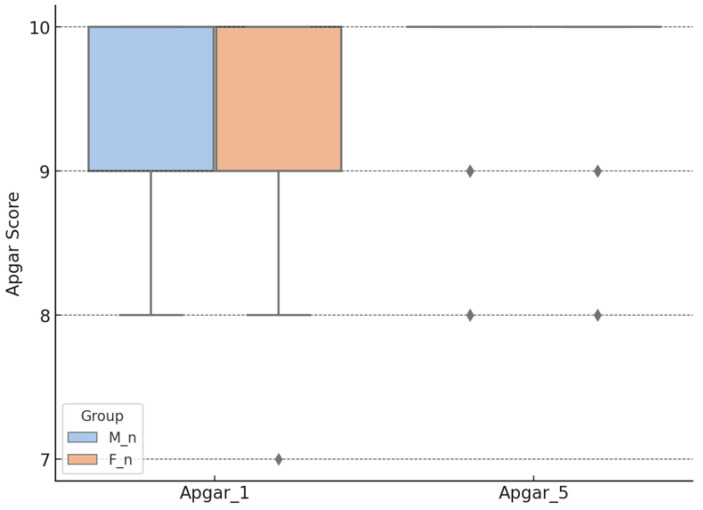
Newborns in the M_n group had significantly higher Apgar scores at 1 min compared to those in the F_n group (9.63 ± 0.57 vs 9.40 ± 0.65, = 0.010); however, at 5 min, the scores were comparable between groups. Regarding oxygen saturation, male neonates born to mothers who received morphine had significantly higher values than those in the fentanyl group (96.08 ± 4.14% vs. 94.50 ± 4.36%, = 0.026), whereas no significant differences were observed in female neonates.
The use of morphine in maternal spinal anesthesia may improve immediate neonatal adaptation, particularly in male newborns.
背景/目的:剖宫产中常用的脊髓麻醉会对新生儿产生重大影响。本研究旨在评估以吗啡或芬太尼作为佐剂的脊髓麻醉对新生儿结局的影响。
对罗马尼亚梅迪科弗医院鹈鹕诊所170例剖宫产分娩的新生儿进行了为期特定时间段的回顾性研究。评估的新生儿参数包括两组新生儿的1分钟和5分钟阿氏评分、血氧饱和度、呼吸频率和心率,这两组新生儿的母亲接受了布比卡因联合吗啡或芬太尼的脊髓麻醉(M_n组和F_n组)。使用IBM SPSS Statistics(版本29.0.2.0(20))进行统计分析。
M_n组新生儿1分钟时的阿氏评分显著高于F_n组(9.63±0.57 vs 9.40±0.65,P = 0.010);然而,5分钟时,两组评分相当。关于血氧饱和度,接受吗啡的母亲所生的男婴的值显著高于芬太尼组(96.08±4.14% vs. 94.50±4.36%,P = 0.026),而女婴未观察到显著差异。
母亲脊髓麻醉中使用吗啡可能会改善新生儿的即刻适应性,尤其是男婴。