Park Dojoon, Choi Youn-Ho, Han Kyungdo, Koh Hae-Seok, Koh Hae Seok
Department of Orthopedic Surgery, College of Medicine, St. Vincent's Hospital, The Catholic University of Korea, 93, Jungbu-daero, Paldal-gu, Suwon-si, Gyeonggi-do, Republic of Korea.
Department of Statistics and Actuarial Science, Soongsil University, Seoul, Republic of Korea.
Sci Rep. 2025 May 1;15(1):15293. doi: 10.1038/s41598-025-92247-7.
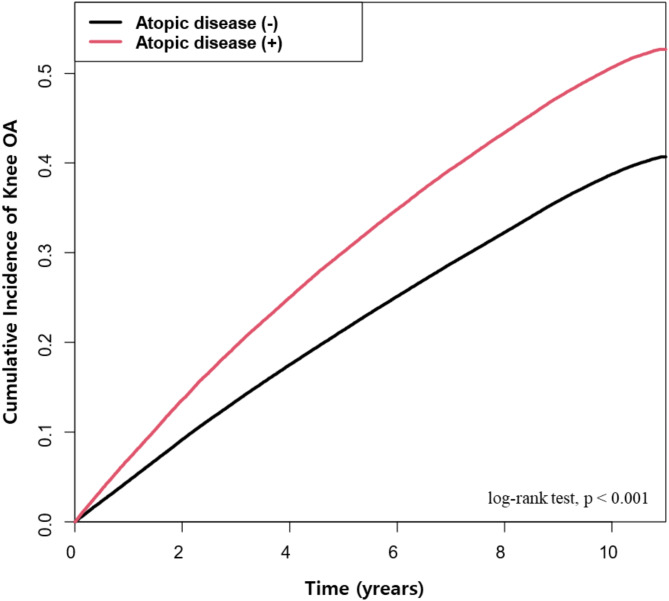
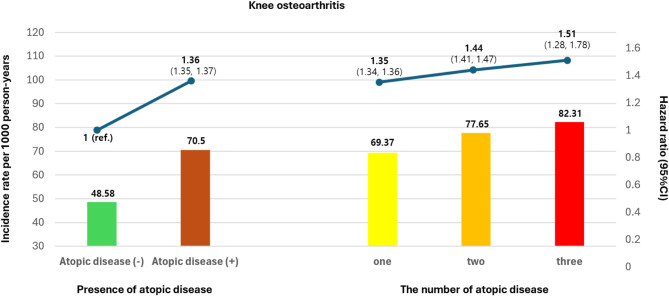
Knee osteoarthritis (OA) and atopic diseases are both characterized by chronic inflammation, yet their potential relationship remains unexplored. This study investigates whether atopic diseases are associated with an increased risk of knee OA in a large nationwide cohort. We conducted a nationwide cohort study using data from the Korean National Health Insurance Service (NHIS), including 880,300 individuals aged ≥ 50 years. Atopic disease was defined as ≥ 3 outpatient visits for asthma, allergic rhinitis, or atopic dermatitis. Knee OA incidence was identified using ICD-10 codes, and hazard ratios (HRs) were estimated using Cox proportional hazards models. Individuals with atopic diseases had a 36% higher risk of developing knee OA compared to those without (HR = 1.36, 95% CI: 1.35-1.37). A dose-response relationship was observed, with risk increasing progressively in individuals with multiple atopic conditions (HR = 1.44 for two conditions; HR = 1.51 for all three conditions). Subgroup analyses indicated that this association was strongest in younger individuals (50-59 years) and males. The results indicate a significant association between atopic diseases and an increased risk of knee OA, which was strongest in younger individuals. Further research is needed to understand the potential role of atopic-specific inflammation on OA development, and any potential implications for targeted therapies.
膝关节骨关节炎(OA)和特应性疾病均以慢性炎症为特征,但其潜在关系仍未得到探索。本研究调查在一个大型全国队列中特应性疾病是否与膝关节OA风险增加相关。我们利用韩国国民健康保险服务(NHIS)的数据进行了一项全国队列研究,纳入了880300名年龄≥50岁的个体。特应性疾病定义为因哮喘、过敏性鼻炎或特应性皮炎进行≥3次门诊就诊。使用国际疾病分类第十版(ICD - 10)编码确定膝关节OA发病率,并使用Cox比例风险模型估计风险比(HRs)。与没有特应性疾病的个体相比,患有特应性疾病的个体发生膝关节OA的风险高36%(HR = 1.36,95%置信区间:1.35 - 1.37)。观察到剂量反应关系,在患有多种特应性疾病的个体中风险逐渐增加(两种疾病的HR = 1.44;三种疾病的HR = 1.51)。亚组分析表明,这种关联在较年轻个体(50 - 59岁)和男性中最为明显。结果表明特应性疾病与膝关节OA风险增加之间存在显著关联,在较年轻个体中最为强烈。需要进一步研究以了解特应性特异性炎症在OA发展中的潜在作用以及对靶向治疗的任何潜在影响。