Chen Zhihao, Yang Hongxing, Qi Ming, Chen Wen, Liu Fei, Song Shaoli, Zhang Jianping
Department of Nuclear Medicine, Fudan University Shanghai Cancer Center, Shanghai, 200032, China.
Department of Oncology, Shanghai Medical College, Fudan University, Shanghai, 200032, China.
Cancer Imaging. 2025 May 1;25(1):58. doi: 10.1186/s40644-025-00877-x.
As body mass index (BMI) increases, the quality of 2-deoxy-2-[fluorine-18]fluoro-D-glucose (F-FDG) positron emission tomography (PET) images reconstructed with ordered subset expectation maximization (OSEM) declines, negatively impacting lesion diagnostics. It is crucial to identify methods that ensure consistent diagnostic accuracy and maintain image quality. Deep progressive learning (DPL) algorithm, an Artificial Intelligence(AI)-based PET reconstruction technique, offers a promising solution.
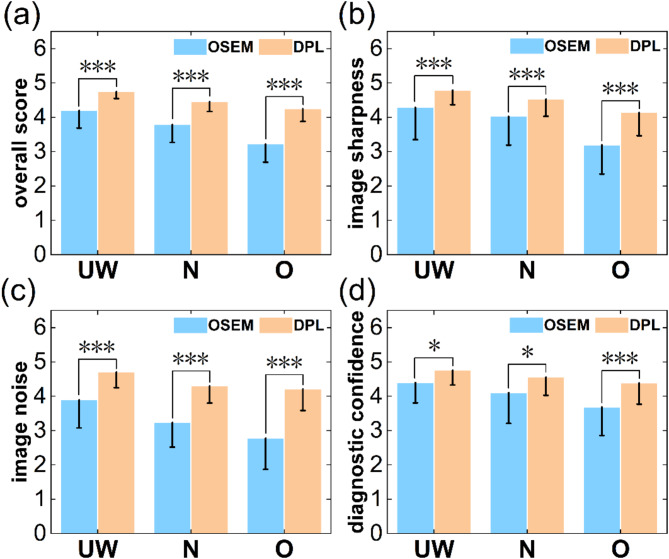
150 patients underwent F-FDG PET/CT scans and were categorized by BMI into underweight, normal, and overweight groups. PET images were reconstructed using both OSEM and DPL and their image quality was assessed both visually and quantitatively. Visual assessment employed a 5-point Likert scale to evaluate overall score, image sharpness, image noise, and diagnostic confidence. Quantitative assessment parameters included the background liver image-uniformity-index ([Formula: see text]) and signal-to-noise ratio ([Formula: see text]). Additionally, 466 identifiable lesions were categorized by size: sub-centimeter and larger. We compared maximum standard uptake value ([Formula: see text]), signal-to-background ratio ([Formula: see text]), [Formula: see text], contrast-to-background ratio ([Formula: see text]), and contrast-to-noise ratio ([Formula: see text]) of these lesions to evaluate the diagnostic performance of the DPL and OSEM algorithms across different lesion sizes and BMI categories.
DPL produced superior PET image quality compared to OSEM across all BMI groups. The visual quality of DPL showed a slight decline with increasing BMI, while OSEM exhibited a more significant decline. DPL maintained a stable [Formula: see text] across BMI increases, whereas OSEM exhibited increased noise. In the DPL group, quantitative image quality for overweight patients matched that of normal patients with minimal variance from underweight patients. In contrast, OSEM demonstrated significant declines in quantitative image quality with rising BMI. DPL yielded significantly higher contrast ([Formula: see text], [Formula: see text],[Formula: see text]) and [Formula: see text] than OSEM for all lesions across all BMI categories.
DPL consistently provided superior image quality and lesion diagnostic performance compared to OSEM across all BMI categories in F-FDG PET/CT scans. Therefore, we recommend using the DPL algorithm for F-FDG PET/CT image reconstruction in all BMI patients.
随着体重指数(BMI)的增加,采用有序子集期望最大化(OSEM)算法重建的2-脱氧-2-[氟-18]氟-D-葡萄糖(F-FDG)正电子发射断层扫描(PET)图像质量下降,对病变诊断产生负面影响。确定能确保一致诊断准确性并维持图像质量的方法至关重要。深度渐进学习(DPL)算法是一种基于人工智能(AI)的PET重建技术,提供了一个有前景的解决方案。
150例患者接受了F-FDG PET/CT扫描,并根据BMI分为体重过轻、正常和超重组。使用OSEM和DPL两种方法重建PET图像,并通过视觉和定量方式评估其图像质量。视觉评估采用5分李克特量表来评估总体评分、图像清晰度、图像噪声和诊断置信度。定量评估参数包括背景肝脏图像均匀性指数([公式:见原文])和信噪比([公式:见原文])。此外,466个可识别病变按大小分类为:亚厘米及更大。我们比较了这些病变的最大标准摄取值([公式:见原文])、信号与背景比([公式:见原文])、[公式:见原文]、对比与背景比([公式:见原文])和对比与噪声比([公式:见原文]),以评估DPL和OSEM算法在不同病变大小和BMI类别中的诊断性能。
在所有BMI组中,DPL生成的PET图像质量均优于OSEM。DPL的视觉质量随BMI增加略有下降,而OSEM下降更为显著。随着BMI增加,DPL的[公式:见原文]保持稳定,而OSEM的噪声增加。在DPL组中,超重患者的定量图像质量与正常患者相当,与体重过轻患者的差异最小。相比之下,随着BMI升高,OSEM的定量图像质量显著下降。在所有BMI类别中,对于所有病变,DPL产生的对比度([公式:见原文]、[公式:见原文]、[公式:见原文])和[公式:见原文]均显著高于OSEM。
在F-FDG PET/CT扫描中,与OSEM相比,DPL在所有BMI类别中始终提供更高的图像质量和病变诊断性能。因此,我们建议在所有BMI患者的F-FDG PET/CT图像重建中使用DPL算法。