Al-Tayyem Ban H, Müscher-Polzin Philipp, Pande Kanupriya, Yefanov Oleksandr, Mariani Valerio, Burkhardt Anja, Chapman Henry N, Näther Christian, Braun Michael, Radke Marvin, Waitschat Steve, Beyerlein Kenneth R, Terraschke Huayna
Institut für Anorganische Chemie, Christian-Albrechts-Universität zu Kiel, Kiel, Germany.
Center for Free-Electron Laser Science CFEL, Deutsches Elektronen-Synchrotron DESY, Hamburg, Germany.
Front Chem. 2025 Apr 17;13:1536383. doi: 10.3389/fchem.2025.1536383. eCollection 2025.
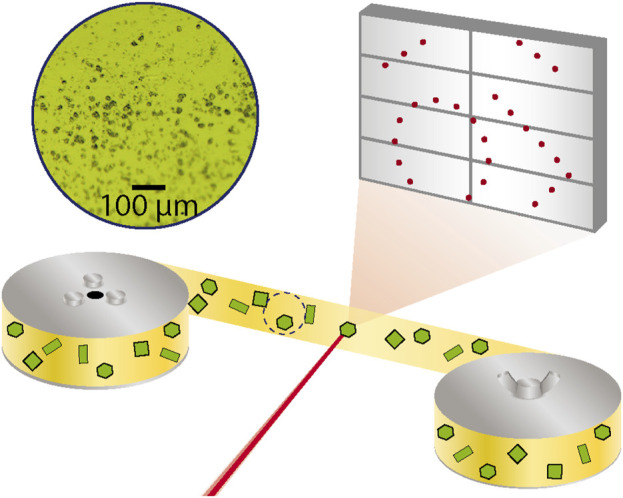
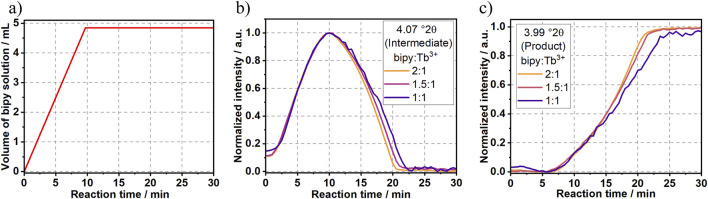
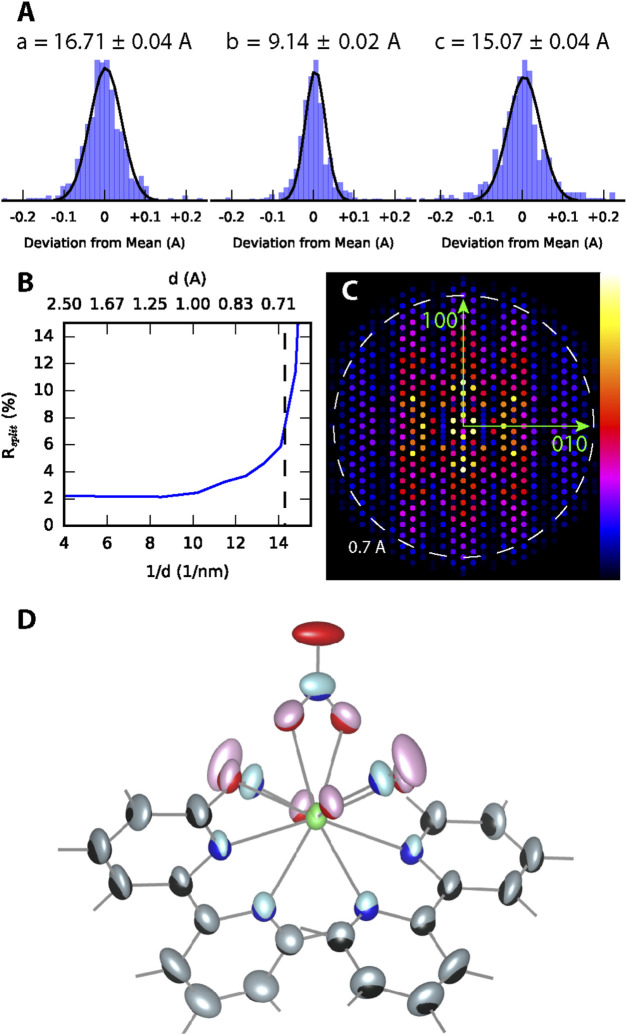
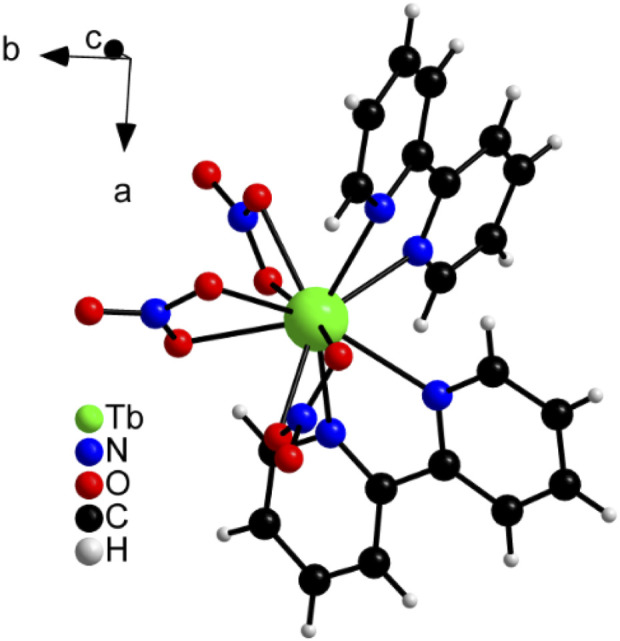
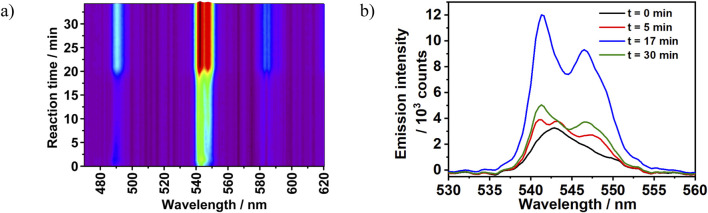
Despite wide application of lanthanide complexes in solar cells, light-emitting diodes and sensors, their crystallization mechanisms have not been studied in detail. Further investigations of this kind can lead to the development of targeted synthesis protocols and tailoring of their structure-related physical properties. In this work, the structural evolution during the synthesis of the luminescent [Tb (bipy)(NO)] (bipy = 2,2'-bipyridine) complex is studied by monitoring the ligand-to-metal energy transfer through luminescence measurements combined with synchrotron-based X-ray diffraction (XRD) analysis. These experiments reveal an interesting crystallization pathway involving the formation of a reaction intermediate that is dependent on parameters such as ligand-to-metal molar ratios. In addition, the structure of [Tb (bipy)(NO)] is solved from serial crystallography data collected at a microfocused synchrotron X-ray beamline. This is an emerging technique that can be used to interrogate individual crystallites and overcome beam damage effects. The resulting structure is found to correspond to that determined by classical single crystal XRD, and a perspective on realizing future measurements of this type is given. This work therefore describes multiple advancements combining crystallite-specific diffraction probes and techniques to track the synthesis kinetics of luminescent materials.
尽管镧系元素配合物在太阳能电池、发光二极管和传感器中得到了广泛应用,但其结晶机制尚未得到详细研究。对此类问题的进一步研究可能会促成有针对性的合成方案的开发,并对其与结构相关的物理性质进行定制。在这项工作中,通过结合基于同步加速器的X射线衍射(XRD)分析的发光测量来监测配体到金属的能量转移,研究了发光的[Tb (bipy)(NO)](bipy = 2,2'-联吡啶)配合物合成过程中的结构演变。这些实验揭示了一条有趣的结晶途径,该途径涉及一种反应中间体的形成,该中间体取决于配体与金属的摩尔比等参数。此外,[Tb (bipy)(NO)]的结构是根据在微聚焦同步加速器X射线束线上收集的串行晶体学数据解析得到的。这是一种新兴技术,可用于研究单个微晶并克服束流损伤效应。所得结构与通过经典单晶XRD确定的结构一致,并给出了实现此类未来测量的展望。因此,这项工作描述了结合微晶特异性衍射探针和技术来跟踪发光材料合成动力学的多项进展。