Chen Hu, Yuan Xiao
Department of Emergency Surgery, The First Affiliated Hospital of Anhui Medical University North District, Anhui Public Health Clinical Center, Hefei, Anhui, 230011, China.
Department of General Surgery, The First Affiliated Hospital of Anhui Medical University North District /Anhui Public Health Clinical Center, Hefei, Anhui, 230011, China.
BMC Surg. 2025 May 2;25(1):195. doi: 10.1186/s12893-025-02929-2.
To investigate the predictive efficacy of dynamic level changes of plasma endothelial microparticles (EMP) and plasma soluble thrombomodulin (sTM) on the prognosis of severe acute pancreatitis (SAP).
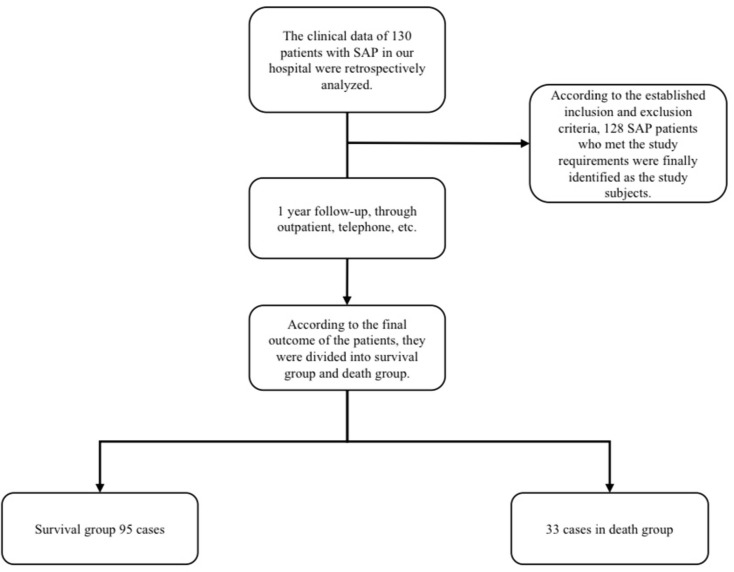
This study retrospectively selected 128 eligible SAP patients admitted to our hospital from May 2021 to April 2023. According to the final outcome, the patients were grouped as the survival group (n = 95) and death group (n = 33). The EMP, sTM and microcirculation related indexes (lactic acid level, central venous pressure (CVP), mean arterial pressure (MAP)) of SAP patients were monitored at admission, 24 h, 48 h and 72 h after admission. Pearson was adopted to analyze the correlation between EMP and sTM levels with microcirculation disorder related indicators. The levels of EMP and sTM were compared between the survival group and the death group. The EMP high level group was ≥ 150.00 ng / mL, and the EMP low level group was < 150.00 ng / mL. The sTM high-level group was ≥ 300.00 ng / mL, and the low-level group was < 300.00 ng / mL. The differences in survival curves between different groups were compared by Kaplan-Meier. AUC was used to analyze the prognostic value of EMP and sTM levels alone and in combination in SAP patients.
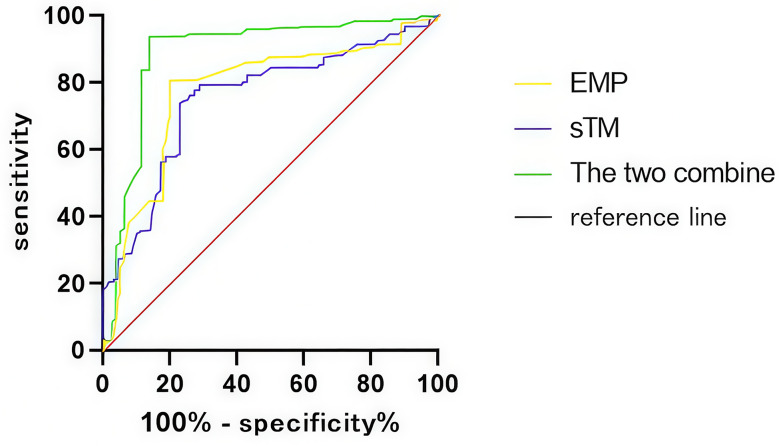
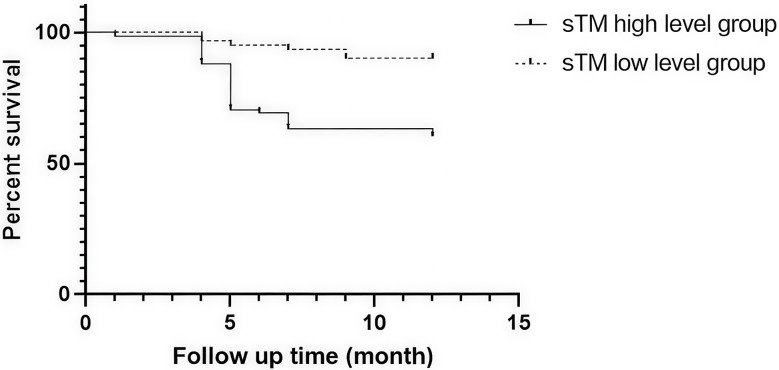
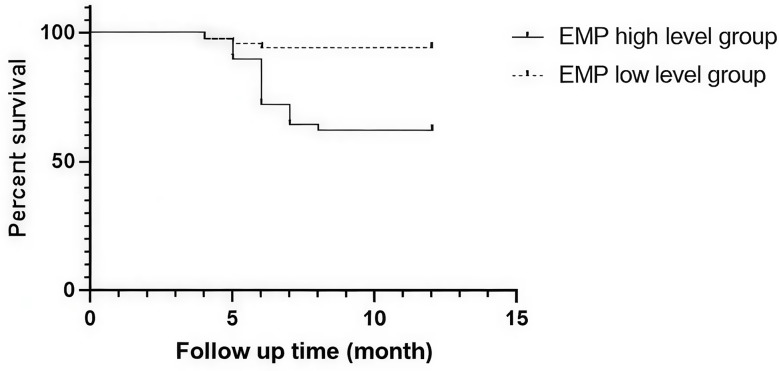
Compared with admission, the levels of EMP, sTM, lactic acid and CVP in 128 SAP patients were all significantly increased at 24 h, 48 h and 72 h after admission, but the MAP was largely decreased (p < 0.05). EMP and sTM were positively correlated with lactic acid and CVP respectively, but negatively correlated with MAP (p < 0.05). The death group had much higher levels of EMP and sTM than the survival group (p < 0.05). From the perspective of 1-year survival rate, the high-level group of EMP was lower than the low-level group (p < 0.05) and the high-level group of sTM was lower than the low-level group (p < 0.05). ROC curve analysis confirmed that the sensitivity and specificity of combined detection were 92.39% and 90.54%, respectively, with the AUC of 0.903 (95%CI:0.863-0.928), which was significantly higher than that of single detection (p < 0.05).
The levels of EMP and sTM were significantly increased in SAP patients, which were closely related to microcirculation disorders and poor prognosis. The combined detection of EMP and sTM has significant prognostic value in SAP.
探讨血浆内皮微粒(EMP)和血浆可溶性血栓调节蛋白(sTM)动态水平变化对重症急性胰腺炎(SAP)预后的预测效能。
本研究回顾性选取2021年5月至2023年4月我院收治的128例符合条件的SAP患者。根据最终结局,将患者分为生存组(n = 95)和死亡组(n = 33)。在入院时、入院后24小时、48小时和72小时监测SAP患者的EMP、sTM及微循环相关指标(乳酸水平、中心静脉压(CVP)、平均动脉压(MAP))。采用Pearson分析EMP和sTM水平与微循环障碍相关指标之间的相关性。比较生存组和死亡组之间EMP和sTM的水平。EMP高水平组≥150.00 ng/mL,EMP低水平组<150.00 ng/mL。sTM高水平组≥300.00 ng/mL,低水平组<300.00 ng/mL。采用Kaplan-Meier比较不同组之间生存曲线的差异。采用AUC分析EMP和sTM水平单独及联合对SAP患者的预后价值。
与入院时相比,128例SAP患者入院后24小时、48小时和72小时的EMP、sTM、乳酸和CVP水平均显著升高,但MAP大幅下降(p < 0.05)。EMP和sTM分别与乳酸和CVP呈正相关,但与MAP呈负相关(p < 0.05)。死亡组的EMP和sTM水平远高于生存组(p < 0.05)。从1年生存率来看,EMP高水平组低于低水平组(p < 0.05),sTM高水平组低于低水平组(p < 0.05)。ROC曲线分析证实,联合检测的敏感性和特异性分别为92.39%和90.54%,AUC为0.903(95%CI:0.863 - 0.928),显著高于单项检测(p < 0.05)。
SAP患者EMP和sTM水平显著升高,与微循环障碍及预后不良密切相关。EMP和sTM联合检测对SAP具有显著的预后价值。