Mori Sara, Montobbio Noemi, Sormani Maria Pia, Campi Cristina, Mazzoni Carlotta, Argirò Alessia, Mandoli Giulia Elena, Ginetti Francesca Rubina, Zanoletti Margherita, Vianello Pier Filippo, Rella Valeria, Crotti Lia, Piana Michele, Cameli Matteo, Cappelli Francesco, Porto Italo, Badano Luigi Paolo, Canepa Marco
Department of Internal Medicine, University of Genoa, Genova, Italy.
Biostatistics Unit, Department of Health Sciences, University of Genoa, Genoa, Italy.
JACC Adv. 2025 May 3;4(6 Pt 1):101755. doi: 10.1016/j.jacadv.2025.101755.
Transthyretin-related cardiac amyloidosis (ATTR-CA) is often diagnosed at an advanced stage. Emerging evidence suggests that radiomics applied to echocardiographic images (ie, ultrasonomics) can detect early myocardial texture changes in ATTR-CA.
This study aimed to develop a radiomic model for characterizing ATTR-infiltrated myocardium via echocardiography.
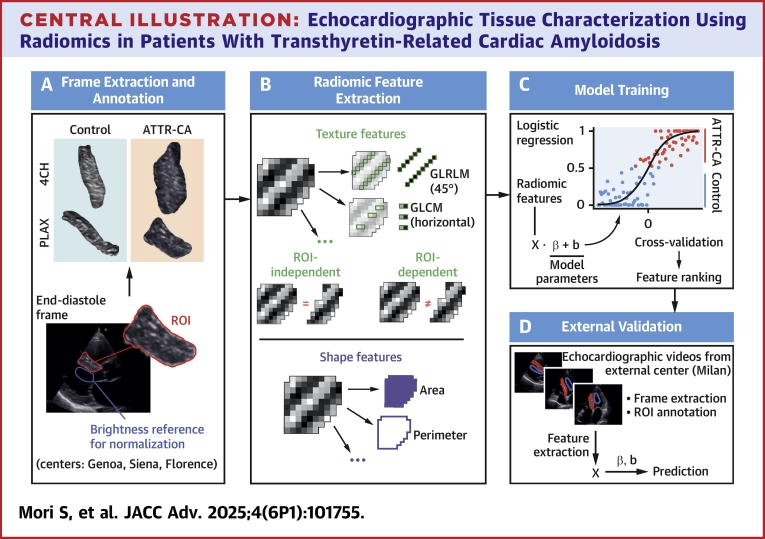
Echocardiographic images in parasternal long-axis and apical 4-chamber views from ATTR-CA and control patients were collected across 4 Italian centers. A region of interest (ROI) within the interventricular septum was delineated. Ninety-four radiomic features were extracted and classified into 2 categories for analysis, based on whether they were ROI-dependent or independent. Five logistic regression models analyzed data from 3 centers (229 ATTR-CA, 224 controls) to assess diagnostic accuracy and area under the curve (AUC) of different sets of radiomic features, with external validation conducted on patients from a fourth center (32 ATTR-CA, 32 controls).
Models analyzing the entire ROI using both ROI-dependent and ROI-independent features demonstrated high cross-validated accuracies (93%-95%) and AUC values (0.97-0.99). Using a fixed-size 0.5 × 0.5 cm ROI, these values decreased to 85% and 0.91, respectively, highlighting previous models' dependence on ROI size. The fifth model used 73 ROI-independent features on the entire ROI and demonstrated significantly better accuracy and AUC (92% and 0.97, respectively, P < 0.001), confirmed in the external validation cohort (87% and 0.95, respectively). Removing the least informative features slightly improved the model, achieving 90% accuracy and 0.95 precision.
This study showcases ultrasonomics potential to differentiate ATTR-CA and control patients by capturing disease-specific textural features independent of ROI dimensions.
转甲状腺素蛋白相关的心脏淀粉样变性(ATTR-CA)常于疾病晚期被诊断出来。新出现的证据表明,应用于超声心动图图像的放射组学(即超声组学)能够检测出ATTR-CA早期的心肌纹理变化。
本研究旨在通过超声心动图开发一种用于表征ATTR浸润心肌的放射组学模型。
在意大利的4个中心收集了ATTR-CA患者和对照患者的胸骨旁长轴和心尖四腔心切面的超声心动图图像。在室间隔内划定了一个感兴趣区域(ROI)。提取了94个放射组学特征,并根据其是否依赖于ROI分为2类进行分析。五个逻辑回归模型分析了来自3个中心的数据(229例ATTR-CA患者,224例对照),以评估不同放射组学特征集的诊断准确性和曲线下面积(AUC),并在第四个中心的患者(32例ATTR-CA患者,32例对照)中进行了外部验证。
使用依赖于ROI和不依赖于ROI的特征分析整个ROI的模型显示出较高的交叉验证准确性(93%-95%)和AUC值(0.97-0.99)。使用固定大小为0.5×0.5 cm的ROI时,这些值分别降至85%和0.91,突出了先前模型对ROI大小的依赖性。第五个模型在整个ROI上使用了73个不依赖于ROI的特征,显示出显著更高的准确性和AUC(分别为92%和0.97,P<0.001),在外部验证队列中得到证实(分别为87%和0.95)。去除信息量最少的特征后,模型略有改进,准确率达到90%,精确率达到0.95。
本研究展示了超声组学通过捕捉独立于ROI维度的疾病特异性纹理特征来区分ATTR-CA患者和对照患者的潜力。