Rangel-López Angélica, Mata-Rocha Minerva, Pérez-González Oscar Alberto, López-Romero Ricardo, López-Sánchez Dulce María, Juárez-Méndez Sergio, Villegas-Ruiz Vanessa, Méndez-Tenorio Alfonso, Mejía-Araguré Juan Manuel, Orihuela-Rodríguez Oscar, Álvarez-Aguilar Cleto, Majluf-Cruz Abraham, Amato Dante, Zavala-Vega Sergio, Melchor-Doncel de la Torre Silvia, Paniagua-Sierra Ramón, Arellano-Galindo José
Unidad de Investigación Médica en Enfermedades Nefrológicas, UMAE Hospital de Especialidades, Centro Médico Nacional (CMN) Siglo XXI (SXXI), Instituto Mexicano del Seguro Social (IMSS), Mexico City 06720, Mexico.
Laboratorio de Virología, Unidad de Investigación en Enfermedades Infecciosas, Hospital Infantil de México Federico Gómez-Secretaría de Salud (SS), Mexico City 06720, Mexico.
Int J Mol Sci. 2025 Apr 15;26(8):3732. doi: 10.3390/ijms26083732.
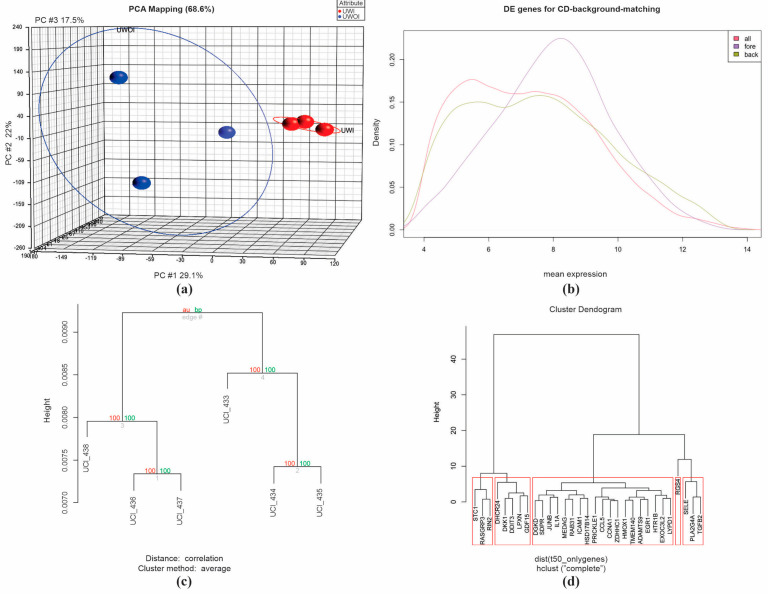
Patients with end-stage renal disease (ESRD) are at increased risk of cardiovascular disease (CVD), such as myocardial infarction (MI). Uremic toxins and endothelial dysfunction are central to this process. In this exploratory study, we used the Affymetrix GeneChip microarray to investigate the gene expression profile in uremic serum-induced human coronary arterial endothelial cells (HCAECs) from ESRD patients with and without MI (UWI and UWOI groups) as an approach to its underlying mechanism. We also explored which pathways are involved in this process. We found 100 differentially expressed genes (DEGs) among the conditions of interest by supervised principal component analysis and hierarchical cluster analysis. The expressions of four major DEGs were validated by quantitative RT-PCR. Pathway analysis and molecular network were used to analyze the interaction and expression patterns. Ten pathways were identified as the main enriched metabolic pathways according to the transcriptome profiling analysis, which were, among others, positive regulation of inflammatory response, positive regulation of extracellular signal-regulated kinases 1 and 2 (ERK1/2) cascade, cardiac muscle cell development, highlighting positive regulation of mitogen-activated protein kinase (MAPK) activity ( = 0.00016). Up- and down-regulation of genes from HCAECs exposed to uremic serum could contribute to increased endothelial dysfunction and CVD in ESRD patients. Our study suggests that inflammation and the ERK-MAPK pathway are highly enriched in kidney disease patients with MI, suggesting their role in ESRD pathology. Further studies and approaches based on MAPK pathway interfering strategies are needed to confirm these data.
终末期肾病(ESRD)患者发生心血管疾病(CVD)如心肌梗死(MI)的风险增加。尿毒症毒素和内皮功能障碍是这一过程的核心。在这项探索性研究中,我们使用Affymetrix基因芯片微阵列来研究尿毒症血清诱导的来自患有和未患有MI的ESRD患者的人冠状动脉内皮细胞(HCAECs)(UWI和UWOI组)中的基因表达谱,以此作为探究其潜在机制的一种方法。我们还探究了哪些信号通路参与了这一过程。通过监督主成分分析和层次聚类分析,我们在感兴趣的条件中发现了100个差异表达基因(DEGs)。通过定量RT-PCR验证了四个主要DEGs的表达。使用信号通路分析和分子网络来分析相互作用和表达模式。根据转录组分析,确定了十条通路为主要富集的代谢通路,其中包括炎症反应的正调控、细胞外信号调节激酶1和2(ERK1/2)级联反应的正调控、心肌细胞发育,突出了丝裂原活化蛋白激酶(MAPK)活性的正调控( = 0.00016)。暴露于尿毒症血清的HCAECs中基因的上调和下调可能导致ESRD患者内皮功能障碍和CVD增加。我们的研究表明,炎症和ERK-MAPK信号通路在患有MI的肾病患者中高度富集,表明它们在ESRD病理学中的作用。需要基于MAPK信号通路干扰策略的进一步研究和方法来证实这些数据。