
爱尔兰大学生运动员的营养知识、补充剂使用情况及营养支持获取途径
Nutrition knowledge, supplementation practices and access to nutrition supports of collegiate student athletes in Ireland.
作者信息
Leen Smith Ben, Carey Conor C, O'Connell Karen, Twomey Shauna, McCarthy Elaine K
机构信息
School of Food and Nutritional Sciences, University College Cork, Cork, Ireland.
INFANT Research Centre, University College Cork, Cork, Ireland.
出版信息
Eur J Nutr. 2025 May 7;64(4):172. doi: 10.1007/s00394-025-03693-y.
PURPOSE
To provide a comprehensive assessment of nutrition knowledge, supplementation practices and access to nutrition supports in third-level/university student athletes in Ireland.
METHODS
Nutrition knowledge was assessed using the Abridged Nutrition for Sport Knowledge Questionnaire (ANSKQ), with additional questions on nutrition information sources, access to nutritional supports and supplement use.
RESULTS
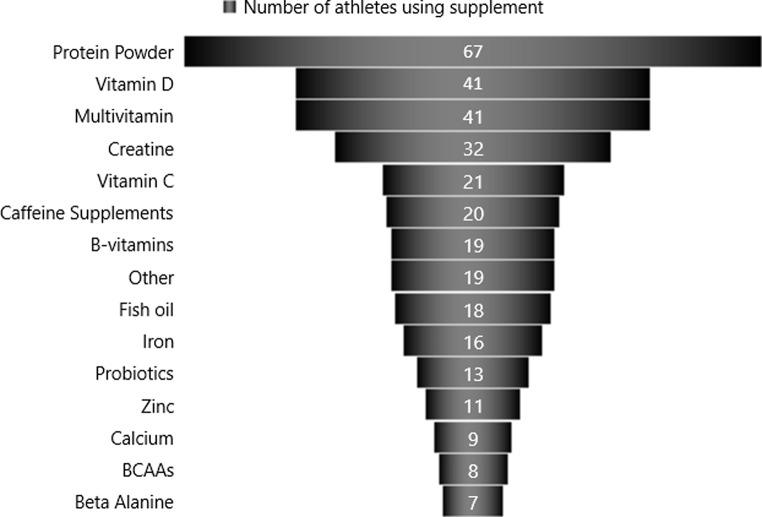
138 student athletes completed the online questionnaire. Participants had a mean (± SD) Total Nutrition Knowledge (TNK) score of 51.6 ± 13.7%, classed as "average". Scores were higher in the General Nutrition Knowledge (GNK) (61.4 ± 15.4%) sub-section, while Sports Nutrition Knowledge (SNK) scores (47.2 ± 15.5%) were considered "poor". Athletes that studied nutrition/dietetics at university level had higher GNK (69.9 ± 12.3% vs. 60.3 ± 15.5%), SNK (61.5 ± 13.7% vs. 45.3 ± 14.8%) and TNK (64.1 ± 11.8% vs. 50.0 ± 13.1%) scores than other students (all p < 0.05). Athletes with prior nutrition education/training also had significantly better TNK, GNK and SNK scores than those with no previous education/training (p < 0.001). Dietary supplements were used by 62.4% of participants, 64.0% of whom used 3 or more supplements. The most popular supplements were protein (77.9%), vitamin D (47.7%) and multivitamins (47.7%). Only 49.3% of participants had previous access to nutrition supports, but 80.4% of participants wanted more support.
CONCLUSIONS
Student athletes demonstrated inadequate levels of nutrition knowledge, particularly in the areas of sports nutrition, coupled with a high prevalence of nutritional supplement use. Athletes with higher education levels and prior nutrition education/training demonstrated greater nutrition knowledge, although a high desire for more nutrition supports was reported by the athletes in this cohort.
目的
对爱尔兰三级院校/大学生运动员的营养知识、补充剂使用情况及营养支持获取途径进行全面评估。
方法
使用简化的运动营养知识问卷(ANSKQ)评估营养知识,并附加关于营养信息来源、营养支持获取途径及补充剂使用的问题。
结果
138名学生运动员完成了在线问卷。参与者的总营养知识(TNK)平均得分(±标准差)为51.6±13.7%,属于“中等”水平。一般营养知识(GNK)子部分的得分较高(61.4±15.4%),而运动营养知识(SNK)得分(47.2±15.5%)被认为“较差”。在大学阶段学习营养/饮食学的运动员,其GNK(69.9±12.3%对60.3±15.5%)、SNK(61.5±13.7%对45.3±14.8%)和TNK(64.1±11.8%对50.0±13.1%)得分均高于其他学生(所有p<0.05)。有过营养教育/培训经历的运动员,其TNK、GNK和SNK得分也显著高于没有接受过此类教育/培训的运动员(p<0.001)。62.4%的参与者使用膳食补充剂,其中64.0%的人使用3种或更多补充剂。最受欢迎的补充剂是蛋白质(77.9%)、维生素D(47.7%)和多种维生素(47.7%)。只有49.3%的参与者此前获得过营养支持,但80.4%的参与者希望获得更多支持。
结论
学生运动员的营养知识水平不足,尤其是在运动营养领域,同时营养补充剂的使用较为普遍。受过高等教育且有过营养教育/培训经历的运动员营养知识更丰富,尽管该队列中的运动员普遍希望获得更多营养支持。

 Zotero 插件