Volčanšek Špela, Koceva Andrijana, Jensterle Mojca, Janež Andrej, Muzurović Emir
Department of Endocrinology, Diabetes and Metabolic Diseases, University Medical Center Ljubljana, Ljubljana, Slovenia.
Medical Faculty, University of Ljubljana, Ljubljana, Slovenia.
Diabetes Ther. 2025 Jun;16(6):1207-1227. doi: 10.1007/s13300-025-01733-8. Epub 2025 May 7.
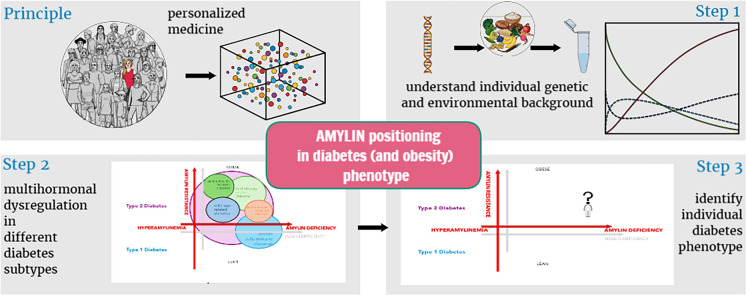
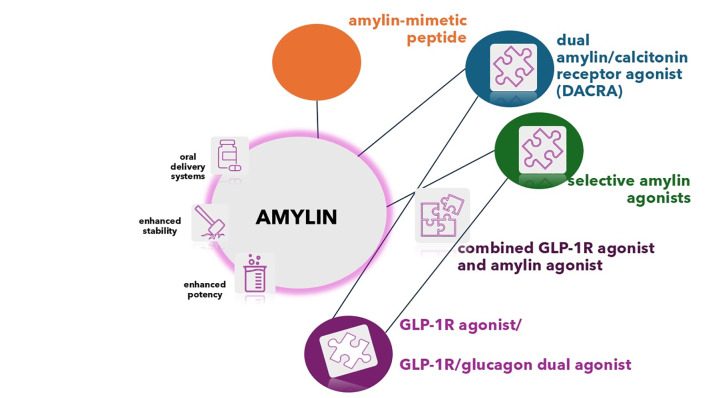
Precision diabetology is increasingly becoming diabetes phenotype-driven, whereby the specific hormonal imbalances involved are taken into consideration. Concomitantly, body weight-favorable therapeutic approaches are being dictated by the obesity pandemic, which extends to all diabetes subpopulations. Amylin, an anorexic neuroendocrine hormone co-secreted with insulin, is deficient in individuals with diabetes and plays an important role in postprandial glucose homeostasis, with additional potential cardiovascular and neuroprotective functions. Its actions include suppressing glucagon secretion, delaying gastric emptying, increasing energy expenditure and promoting satiety. While amylin holds promise as a therapeutic agent, its translation into clinical practice is hampered by complex receptor biology, the limitations of animal models, its amyloidogenic properties and pharmacokinetic challenges. In individuals with advanced β-cell dysfunction, supplementing insulin therapy with pramlintide, the first and currently only approved injectable short-acting selective analog of amylin, has demonstrated efficacy in enhancing both postprandial and overall glycemic control in both type 2 diabetes (T2D) and type 1 diabetes (T1D) without increasing the risk of hypoglycemia or weight gain. Current research focuses on several key strategies, from enhancing amylin stability by attaching polyethylene glycol or carbohydrate molecules to amylin, to developing oral amylin formulations to improve patients' convenience, as well as developing various combination therapies to enhance weight loss and glucose regulation by targeting multiple receptors in metabolic pathways. The novel synergistically acting glucagon-like peptide-1 (GLP-1) receptor agonist combined with the amylin agonist, CagriSema, shows promising results in both glucose regulation and weight management. As such, amylin agonists (combined with other members of the incretin class) could represent the elusive drug candidate to address the multi-hormonal dysregulations of diabetes subtypes and qualify as a precision medicine approach that surpasses the long overdue division into T1DM and T2DM. Further development of amylin-based therapies or delivery systems is crucial to fully unlock the therapeutic potential of this intriguing hormone.Graphical abstract available for this article.
精准糖尿病学越来越以糖尿病表型为驱动,其中会考虑到所涉及的特定激素失衡情况。与此同时,有利于体重控制的治疗方法正受到肥胖流行趋势的影响,这一趋势适用于所有糖尿病亚群。胰淀素是一种与胰岛素共同分泌的厌食性神经内分泌激素,糖尿病患者体内缺乏这种激素,它在餐后血糖稳态中发挥着重要作用,还具有潜在的心血管和神经保护功能。其作用包括抑制胰高血糖素分泌、延缓胃排空、增加能量消耗和促进饱腹感。虽然胰淀素有望成为一种治疗药物,但其转化为临床应用受到复杂的受体生物学特性、动物模型的局限性、其淀粉样变性特性以及药代动力学挑战的阻碍。在晚期β细胞功能障碍的个体中,用普兰林肽补充胰岛素治疗,普兰林肽是首个也是目前唯一获批的可注射短效胰淀素选择性类似物,已证明在2型糖尿病(T2D)和1型糖尿病(T1D)中增强餐后和总体血糖控制方面有效,且不会增加低血糖或体重增加的风险。当前的研究集中在几个关键策略上,从通过将聚乙二醇或碳水化合物分子连接到胰淀素上以增强其稳定性,到开发口服胰淀素制剂以提高患者的便利性,以及开发各种联合疗法以通过靶向代谢途径中的多种受体来增强体重减轻和血糖调节。新型协同作用的胰高血糖素样肽-1(GLP-1)受体激动剂与胰淀素激动剂CagriSema联合使用,在血糖调节和体重管理方面均显示出有前景的结果。因此,胰淀素激动剂(与肠促胰岛素类的其他成员联合使用)可能代表了难以捉摸的药物候选物,可解决糖尿病亚型的多激素失调问题,并符合一种超越早就应该将糖尿病分为1型糖尿病和2型糖尿病的精准医学方法。基于胰淀素的疗法或给药系统的进一步开发对于充分释放这种有趣激素的治疗潜力至关重要。本文提供图形摘要。