Bamtefa Iretioluwa Mary, Okunade Ibukunoluwa E, Babalola Oluranti, Ilori Temitope, Adeniji Folashayo I P, Fafiolu Akinbode S, Obembe Taiwo A
Department of Health Policy and Management, Faculty of Public Health, College of Medicine, University of Ibadan, Nigeria.
Department of Microbiology, College of Medicine, University College Hospital, Ibadan, Nigeria.
PLOS Glob Public Health. 2025 May 7;5(5):e0004545. doi: 10.1371/journal.pgph.0004545. eCollection 2025.
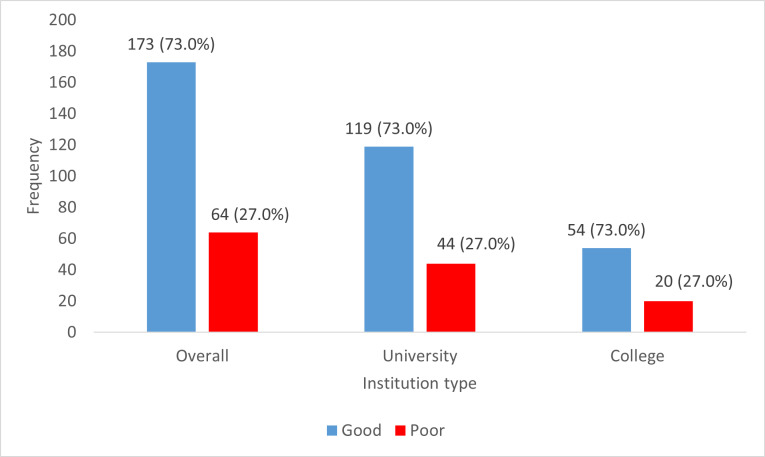
The Tertiary Institutions Social Health Insurance Program (TISHIP) was created by the National Health Insurance Authority (NHIA) to enhance health insurance coverage among students in tertiary institutions in Nigeria. Despite being in existence for many years, a significant number of eligible students remain uncovered by the program. It is unclear whether the intended users are sufficiently aware of the program's existence and benefits. Therefore, this study assessed the level of knowledge about the TISHIP program and related factors among students enrolled in selected tertiary institutions in Southwest Nigeria. Using a descriptive cross-sectional study design, 430 students were surveyed using a multi-stage random sampling technique from the University of Ibadan, Ibadan, Nigeria and the Federal College of Agriculture, Ibadan. Data were collected using a structured self-administered questionnaire of twenty-one questions using both a 4-point Likert scale questions and other questions not on a Likert scale to comprehensively assess the students' knowledge and perceptions. Responses to the Likert scale were reversed, so that "Strongly disagree" had a score of "1", and "Strongly agree" was assigned a score of "4". Overall, six questions were used to determine the knowledge of TISHIP, and the highest score was therefore "24". Persons with scores corresponding to the mean value and above (≥12 points) were categorized to have "Good knowledge of TISHIP", while those with lower score (<12) were said to have "Poor knowledge of TISHIP". One question "What is your view about TISHIP" was used to determine respondent's perception of TISHIP. Responses were arranged as follows: "Good", "Poor", and "Not sure". "Good" and "Not sure" were merged as "Poor". Chi-square tests were conducted to determine the association between knowledge and utilization of TISHIP with sociodemographic characteristics of the respondents. The level of significance was set at p < 0.05. The mean age of the respondents was 21.2 ± 2.9 years. More than half of the respondents (52.1%) were males, and 76.0% were university students. Overall, 46.0% of the students had good knowledge of TISHIP, and 173 (73.0%) had a good perception of the program. Being male (Chi-square = 0.043, p = 0.836) was associated with having a good knowledge of TISHIP. University students were approximately 3 times more likely to have good knowledge of TISHIP compared to college students (AOR = 2.616, 95%CI = 1.209 - 5.658, p = 0.015). Postgraduate students were three times more likely to have a good perception of TISHIP (AOR = 3.257, 95%CI = 0.622 - 17.051, p = 0.162) than undergraduate students. Knowledge of TISHIP was low while perception of the program was promising among students in tertiary institutions. Increased efforts to effectively communicate existence and benefits of TISHIP will be critical to the success of the program.
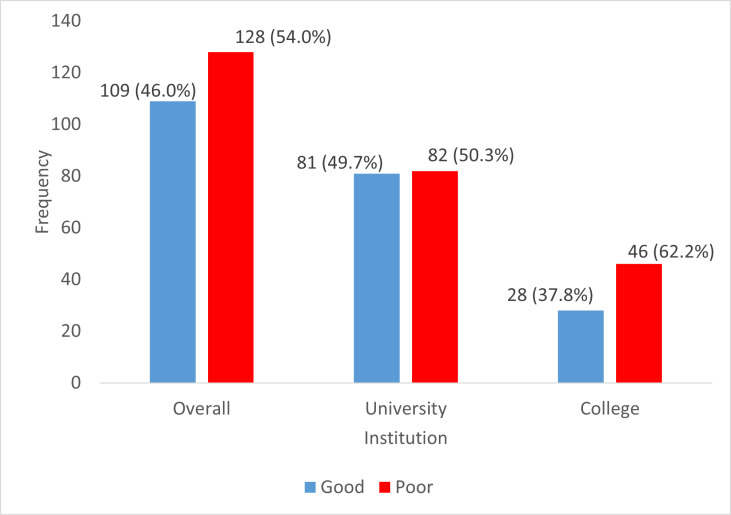
高等院校社会健康保险计划(TISHIP)由国家健康保险管理局(NHIA)设立,旨在提高尼日利亚高等院校学生的健康保险覆盖率。尽管该计划已实施多年,但仍有相当数量的符合条件的学生未被该计划覆盖。尚不清楚目标用户是否充分了解该计划的存在及其益处。因此,本研究评估了尼日利亚西南部选定高等院校的在校学生对TISHIP计划的了解程度及相关因素。采用描述性横断面研究设计,运用多阶段随机抽样技术,对来自尼日利亚伊巴丹大学、伊巴丹联邦农业学院的430名学生进行了调查。使用一份包含21个问题的结构化自填问卷收集数据,问卷既有采用4分李克特量表的问题,也有非李克特量表的问题,以全面评估学生的知识和认知。对李克特量表的回答进行了反向计分,即“强烈不同意”得分为“1”,“强烈同意”得分为“4”。总体而言,用6个问题来确定对TISHIP的了解程度,因此最高分是“24”分。得分等于或高于平均值(≥12分)的人被归类为“对TISHIP有良好了解”,而得分较低(<12分)的人则被认为“对TISHIP了解不足”。用一个问题“你对TISHIP的看法是什么”来确定受访者对TISHIP的认知。回答分为以下几类:“好”、“差”和“不确定”。“好”和“不确定”合并为“差”。进行卡方检验以确定TISHIP的知识和使用与受访者社会人口学特征之间的关联。显著性水平设定为p < 0.05。受访者的平均年龄为21.2±2.9岁。超过一半的受访者(52.1%)为男性,76.0%为大学生。总体而言,46.0%的学生对TISHIP有良好了解,173人(73.0%)对该计划有良好认知。男性(卡方 = 0.043,p = 0.836)与对TISHIP有良好了解相关。与大专学生相比,大学生对TISHIP有良好了解的可能性大约高出3倍(调整后比值比 = 2.616,95%置信区间 = 1.209 - 5.658,p = 0.015)。研究生对TISHIP有良好认知的可能性是本科生的3倍(调整后比值比 = 3.257,95%置信区间 = 0.622 - 17.051,p = 0.162)。高等院校学生对TISHIP的了解程度较低,而对该计划的认知情况较好。加大力度有效宣传TISHIP的存在及其益处对于该计划的成功至关重要。