School of Humanities, Arts and Education, Shandong Xiehe University, Jinan, China.
School of Public Administration, Xi'an University of Architecture and Technology, Xi'an, China.
Front Public Health. 2022 Apr 14;10:797272. doi: 10.3389/fpubh.2022.797272. eCollection 2022.
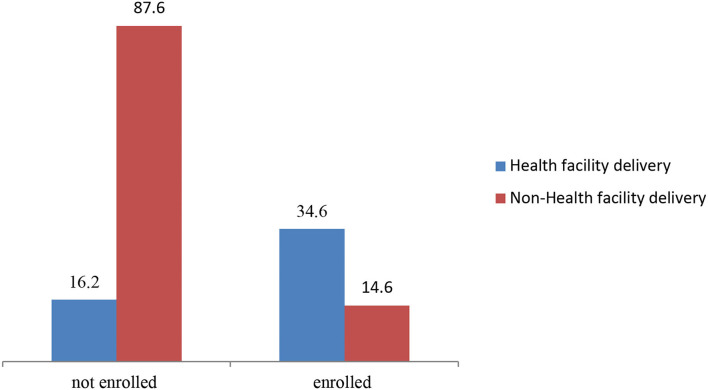
This study aims to compare determinants of health facility delivery for women under a health insurance scheme and those not under a health insurance scheme. Secondary data drawn from the National Demographic and Health Survey was used for the analysis. The characteristics of the women were presented with simple proportions. Binary multilevel logistic regression was used to examine the determinants of health facilities for women who enrolled in health insurance and those who did not. All statistical analyses were set at 5% level of significant level ( = 0.24). The result showed that 2.1% of the women were under a health insurance scheme. Disparity exists in health insurance ownership as a higher proportion of those enrolled in health insurance were those with higher education attainment, in urban parts of the country, and those situated on higher wealth quintiles. There is a significant difference between those with and those without health insurance. It implies that a higher proportion of women who enrolled in health insurance delivered in health facility delivery compared to those who do not. The unique determinants of health facility delivery for women under health insurance were parity and birth order, while unique determinants of health facility delivery for women not enrolled in health schemes were employment status, marriage type, and geopolitical zones. Uniform predictors of health facility delivery for both groups of women were maternal education, household wealth quintiles, autonomy on healthcare, number of antenatal contacts, residential status, community-level poverty, community-level media use, and community-level literacy. Intervention programs designed to improve health facility delivery should expand educational opportunities for women, improve household socioeconomic conditions, target rural women, and encourage women to undertake a minimum of four antenatal contacts.
这项研究旨在比较在医疗保险计划下和不在医疗保险计划下的妇女选择医疗设施分娩的决定因素。分析使用了来自国家人口与健康调查的二级数据。女性的特征以简单的比例呈现。使用二元多层逻辑回归来检验参加医疗保险和未参加医疗保险的妇女选择医疗设施分娩的决定因素。所有统计分析均设定在 5%的显著水平(=0.24)。结果显示,2.1%的妇女参加了医疗保险。医疗保险的拥有存在差异,因为参加医疗保险的人中有更高比例的人具有较高的教育程度、居住在该国的城市地区和处于较高的财富五分位数。有医疗保险和没有医疗保险的人之间存在显著差异。这意味着与没有医疗保险的人相比,参加医疗保险的人更有可能在医疗设施中分娩。参加医疗保险的妇女在医疗设施中分娩的独特决定因素是生育胎次和出生顺序,而没有参加医疗保险计划的妇女在医疗设施中分娩的独特决定因素是就业状况、婚姻类型和地缘政治区域。两组妇女在医疗设施中分娩的共同预测因素是母亲的教育程度、家庭财富五分位数、对医疗保健的自主权、产前检查次数、居住状况、社区贫困程度、社区媒体使用情况和社区识字率。旨在改善医疗设施分娩的干预计划应扩大妇女的教育机会,改善家庭的社会经济状况,针对农村妇女,并鼓励妇女进行至少四次产前检查。