Fan Ningbo, Wang Zhefang, Zhou Chenghui, Bludau Marc, Contino Gianmarco, Zhao Yue, Bruns Christiane
Department of General, Visceral, Cancer and Transplantation Surgery, University Hospital Cologne, 50937 Cologne, Germany.
Institute of Cancer and Genomic Sciences, College of Medical and Dental Sciences, University of Birmingham, Edgbaston, Birmingham, B15 2TT, United Kingdom.
EClinicalMedicine. 2021 Nov 6;42:101183. doi: 10.1016/j.eclinm.2021.101183. eCollection 2021 Dec.
Neoadjuvant chemoradiotherapy (NCRT) or neoadjuvant chemotherapy (NCT) followed by surgery are two standard strategies in treating locally advanced esophageal cancer (EC). We aim to compare NCRT and NCT in the management of locally advanced EC patients.
MEDLINE, Embase, CENTRAL, and conferences were systematically searched for clinical trials published up to September 2021. Pairwise comparisons and Bayesian network meta-analyses were conducted to compare overall survival (OS) and disease-free survival (DFS) by reporting the hazard ratio (HR) and 95% credible intervals (CrIs). The study was registered at PROSPERO (CRD42020170619).
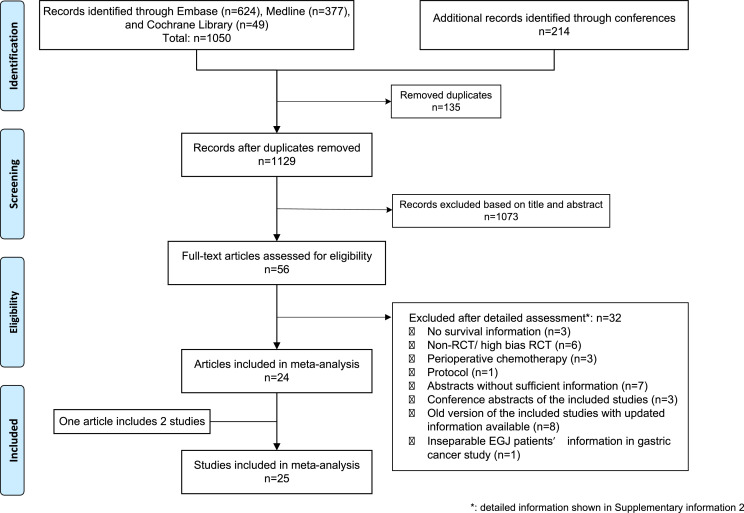
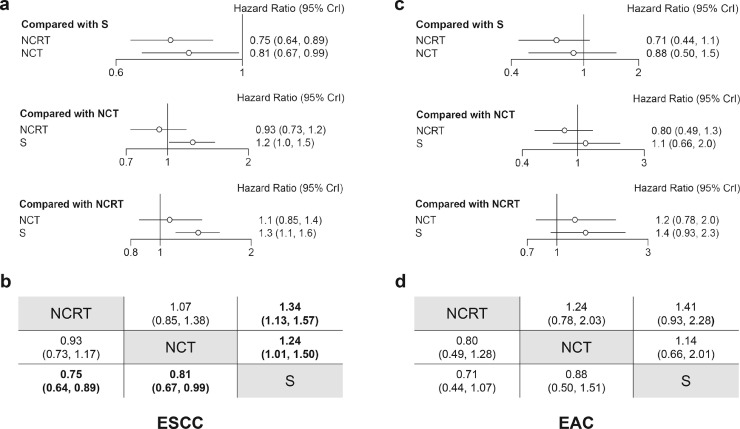
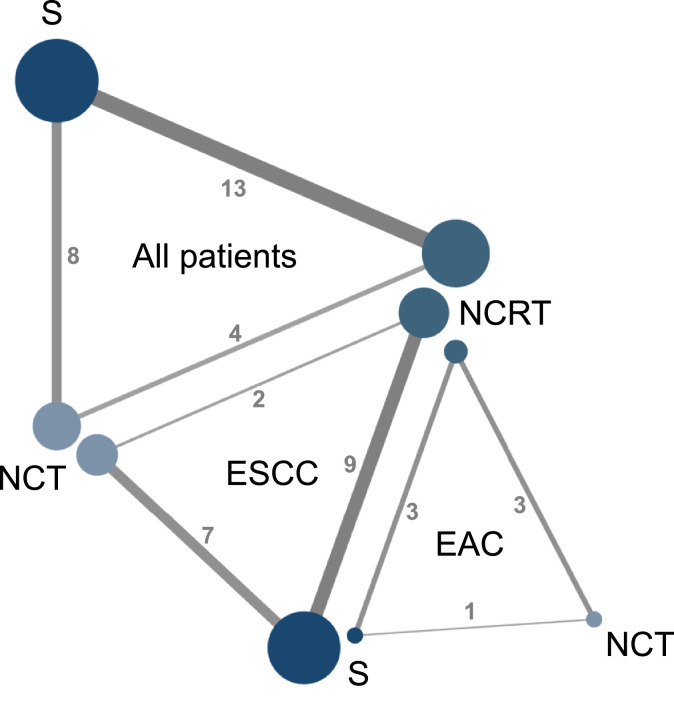
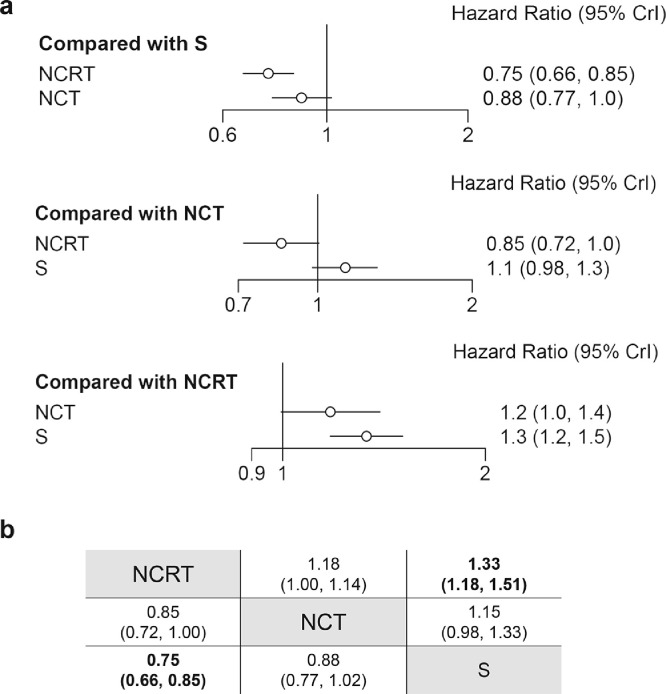
25 trials with 4563 EC patients met inclusion criteria. NCRT improved OS (HR: 0·72, 95%CrI: 0·63-0·82) and DFS (HR: 0·72, 95%CrI: 0·63-0·81) compared to surgery alone. NCRT improved OS (HR: 0·83, 95%CrI: 0·69-0·99) and DFS (HR: 0·83, 95%CI: 0·69-0·99) compared to NCT. Subgroup analysis demonstrated that both NCRT (HR: 0·77, 95%CrI: 0·65-0·90) and NCT (HR: 0·81, 95%CrI: 0·67-0·99) improved OS than surgery in esophageal squamous cell carcinoma (ESCC) patients. No significant differences were observed between NCRT and NCT regarding OS (HR: 0·95, 95%CrI: 0·75-1·19) and DFS (HR: 0·90, 95%CrI: 0·50-1·62) in ESCC. The short-term outcomes were similar between NCRT and NCT. The three treatment strategies were comparable in esophageal adenocarcinoma (EAC) subpopulations.
The study corroborated current guidelines in addressing the importance of analysing EC according to histopathological types. The analysis suggested that in locally advanced ESCC patients, both NCRT and NCT improved OS as compared to surgery alone, whereas no clear evidence supported the optimal strategies between NCRT and NCT. More RCTs comparing different therapeutic strategies in EAC patients are warranted.
Köln Fortune Program, University of Cologne.
新辅助放化疗(NCRT)或新辅助化疗(NCT)后行手术是治疗局部晚期食管癌(EC)的两种标准策略。我们旨在比较NCRT和NCT在局部晚期EC患者管理中的效果。
系统检索MEDLINE、Embase、CENTRAL及会议资料,查找截至2021年9月发表的临床试验。通过报告风险比(HR)和95%可信区间(CrI)进行成对比较和贝叶斯网络荟萃分析,以比较总生存期(OS)和无病生存期(DFS)。该研究已在国际前瞻性系统评价注册库(PROSPERO)注册(注册号:CRD42020170619)。
25项试验共纳入4563例EC患者,符合纳入标准。与单纯手术相比,NCRT改善了OS(HR:0.72,95%CrI:0.63 - 0.82)和DFS(HR:0.72,95%CrI:0.63 - 0.81)。与NCT相比,NCRT改善了OS(HR:0.83,95%CrI:0.69 - 0.99)和DFS(HR:0.83,95%CI:0.69 - 0.99)。亚组分析表明,在食管鳞状细胞癌(ESCC)患者中,NCRT(HR:0.77,95%CrI:0.65 - 0.90)和NCT(HR:0.81,95%CrI:0.67 - 0.99)均比手术改善了OS。在ESCC患者中,NCRT和NCT在OS(HR:0.95,95%CrI:0.75 - 1.19)和DFS(HR:0.90,95%CrI:0.50 - 1.62)方面未观察到显著差异。NCRT和NCT的短期结局相似。在食管腺癌(EAC)亚组中,三种治疗策略具有可比性。
该研究证实了当前指南中根据组织病理学类型分析EC的重要性。分析表明,在局部晚期ESCC患者中,与单纯手术相比,NCRT和NCT均改善了OS,但没有明确证据支持NCRT和NCT之间的最佳策略。需要更多比较EAC患者不同治疗策略的随机对照试验。
科隆财富计划,科隆大学。