Rowe Dylan, Rowe Mariam, Stubbs Dylan, Pontifex Chase, Melksham Phillip
School of Medicine, Griffith University, Brisbane, AUS.
Faculty of Medicine, The University of Queensland, Brisbane, AUS.
Cureus. 2025 Apr 7;17(4):e81846. doi: 10.7759/cureus.81846. eCollection 2025 Apr.
Accurate respiratory monitoring is crucial in post-anesthetic care settings due to increased risks of respiratory complications. This study evaluates the impact of a new breath-indicating device, ApnoLight (PEMDx Pty Ltd, Brisbane, Queensland, Australia), on medical staff's accuracy in recording respiratory rates and detecting apneic events, along with the device's acceptance among nurses.
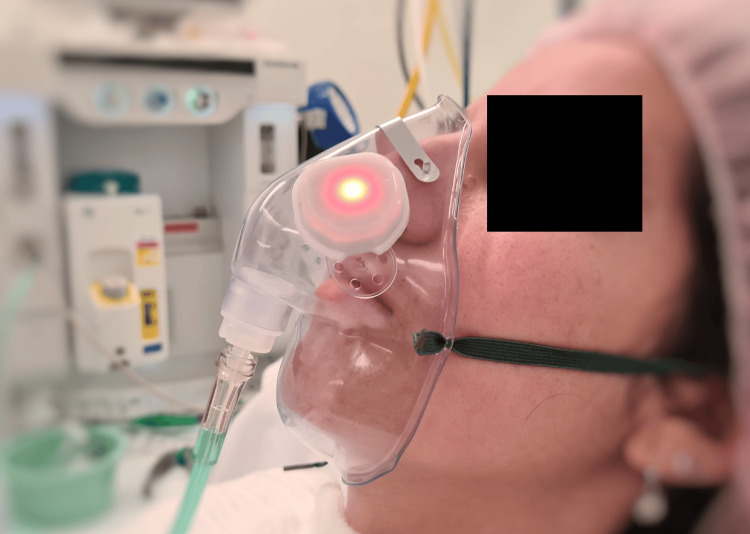
Twenty-five nurses from a hospital in Brisbane, Australia, participated. A simulated patient was fitted with the ApnoLight device on an oxygen mask. Nurses conducted six respiratory rate observations at varying distances (bedside, two meters, and five meters), both with and without the device. The patient's respiratory rates varied from eight to 25 breaths per minute. The accuracy of respiratory rate recordings and the time to identify apnea events were compared between simple observation and device-assisted observations.
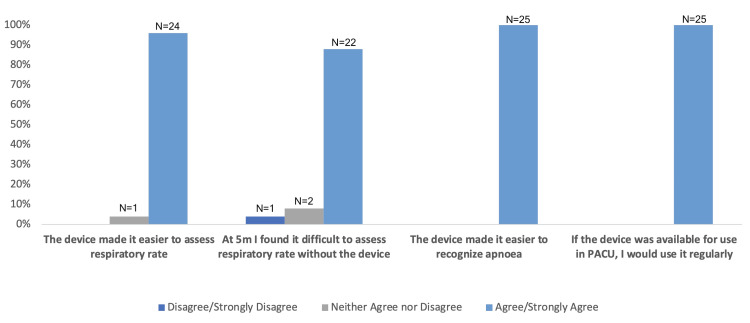
The ApnoLight significantly reduced error rates in respiratory rate recordings: 27.58% at the bedside (P = 0.09, t = 1.31), 90.99% at two meters (P = 0.02, t = 1.98), and 96.37% at five meters (P = 0.0002, t = 4.02). The mean time to identify apnea decreased from 12.96 ± 9.12 seconds (simple observation) to 7.42 ± 2.19 seconds (with ApnoLight device). All apnea events were identified with the device, whereas four were undetected without it. Feedback showed that 96% (N = 24) of nurses found the device improved respiratory rate accuracy, and 100% (N = 25) found it made apnea identification easier.
The ApnoLight device has the potential to enhance respiratory rate monitoring accuracy and apnea detection in postoperative settings. Its implementation could improve patient safety and streamline clinical workflows.
由于呼吸并发症风险增加,准确的呼吸监测在麻醉后护理环境中至关重要。本研究评估了一种新型呼吸指示设备ApnoLight(澳大利亚昆士兰州布里斯班的PEMDx私人有限公司)对医护人员记录呼吸频率和检测呼吸暂停事件准确性的影响,以及该设备在护士中的接受程度。
来自澳大利亚布里斯班一家医院的25名护士参与了研究。一名模拟患者在氧气面罩上佩戴了ApnoLight设备。护士在不同距离(床边、两米和五米)进行了六次呼吸频率观察,观察时既有设备辅助,也有单纯观察。患者的呼吸频率在每分钟8至25次之间变化。比较了单纯观察和设备辅助观察之间呼吸频率记录的准确性以及识别呼吸暂停事件的时间。
ApnoLight显著降低了呼吸频率记录的错误率:床边为27.58%(P = 0.09,t = 1.31),两米处为90.99%(P = 0.02,t = 1.98),五米处为96.37%(P = 0.0002,t = 4.02)。识别呼吸暂停的平均时间从12.96 ± 9.12秒(单纯观察)降至7.42 ± 2.19秒(使用ApnoLight设备)。使用该设备时所有呼吸暂停事件均被识别,而未使用时则有4例未被检测到。反馈显示,96%(N = 24)的护士发现该设备提高了呼吸频率的准确性,100%(N = 25)的护士发现它使呼吸暂停的识别更容易。
ApnoLight设备有可能提高术后环境中呼吸频率监测的准确性和呼吸暂停的检测能力。其应用可以提高患者安全性并简化临床工作流程。