Liu Guiming, Elsayed Ahmed Adham R, Kwantwi Louis Boafo, Gallardo-Macias Ricardo, Gurvich Vadim J, Basson Marc D
Department of Biomedical Sciences, Northeast Ohio Medical University College of Medicine, 4209 State Route 44, Rootstown, OH, USA.
Institute for Therapeutics Discovery and Development, Department of Medicinal Chemistry, College of Pharmacy, University of Minnesota, Minneapolis, MN, USA.
BMC Gastroenterol. 2025 May 8;25(1):347. doi: 10.1186/s12876-025-03937-5.
Intestinal mucosal injury may arise from various factors. While many drugs target the causative factors, none directly stimulate mucosal wound healing. We found that the specific focal adhesion kinase (FAK) activator, M64HCl, promotes intestinal mucosal healing in mice. This study aims to further validate the therapeutic impact of M64HCl on intestinal mucosal repair in rats as a second species.
Wistar rats were assigned to one of four groups: normal control, 1-day injury + vehicle, 4-day injury + vehicle, or 4-day injury + M64HCl. Intestinal injury was induced by serosally applying 75% acetic acid. Immediately after injury, rats received either a continuous infusion of M64HCl (25 mg/kg/day) or its vehicle (saline). Four days post-injury, blood was drawn to measure M64HCl levels and assess liver and kidney function. The intestines were removed and opened, ulcer areas were photographed for size quantification, and tissues were fixed for histological and immunohistochemical analysis.
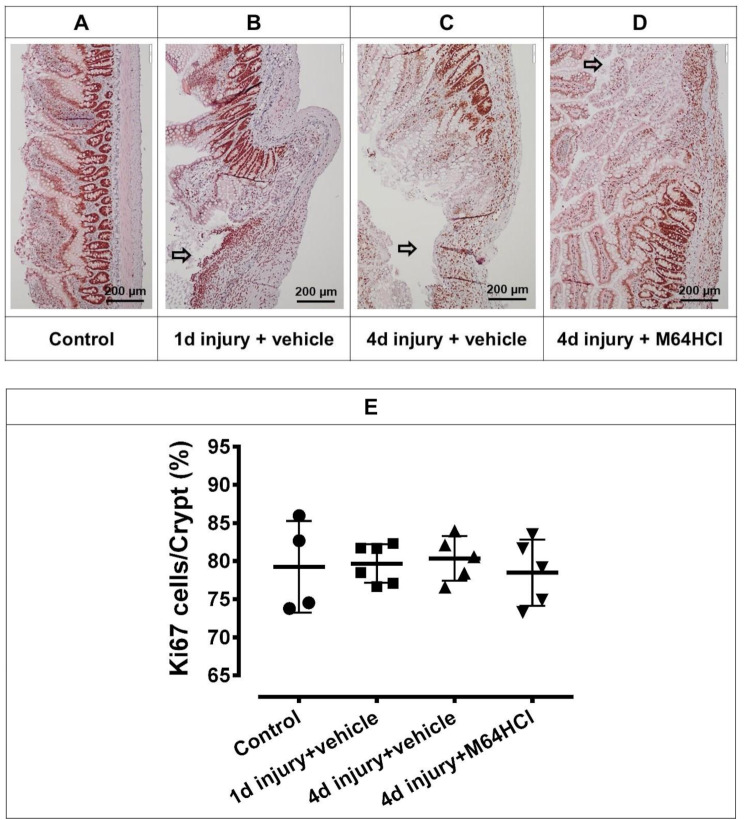
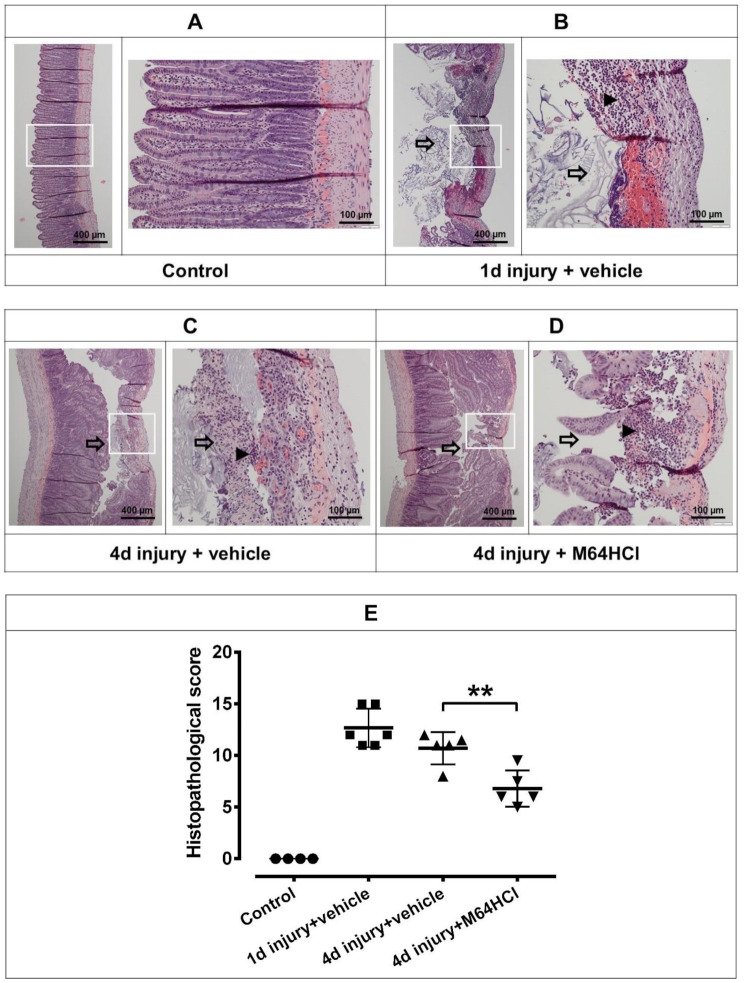
M64HCl substantially reduced ulcer area on gross examination, while histological analysis showed alleviation of pathological changes with M64HCl treatment. Immunohistochemical analysis confirmed increased immunoreactivity for phosphorylated FAK in the epithelium adjacent to the injury in M64HCl-treated rats. However, there was no change in the percentage of Ki67-positive cells in each crypt at the edge of the ulcer area. Serum creatinine, ALT, and AST levels did not differ between the 4-day injury groups with or without M64HCl treatment.
M64HCl, a water-soluble FAK activator, promotes acetic acid-induced ulcer healing in rats and may be useful in treating gastrointestinal mucosal injury.
肠道黏膜损伤可能由多种因素引起。虽然许多药物针对致病因素,但没有一种能直接刺激黏膜伤口愈合。我们发现,特异性粘着斑激酶(FAK)激活剂M64HCl可促进小鼠肠道黏膜愈合。本研究旨在进一步验证M64HCl对大鼠肠道黏膜修复的治疗作用,大鼠为第二种实验动物。
将Wistar大鼠分为四组之一:正常对照组、1天损伤+赋形剂组、4天损伤+赋形剂组或4天损伤+M64HCl组。通过浆膜面涂抹75%乙酸诱导肠道损伤。损伤后立即给大鼠持续输注M64HCl(25mg/kg/天)或其赋形剂(生理盐水)。损伤后4天,采集血液测量M64HCl水平并评估肝肾功能。取出肠道并打开,拍摄溃疡区域照片以进行大小定量,固定组织进行组织学和免疫组织化学分析。
大体检查显示M64HCl显著减小了溃疡面积,而组织学分析表明M64HCl治疗减轻了病理变化。免疫组织化学分析证实,M64HCl处理的大鼠损伤附近上皮中磷酸化FAK的免疫反应性增加。然而,溃疡区域边缘每个隐窝中Ki67阳性细胞的百分比没有变化。4天损伤组中,无论是否用M64HCl治疗,血清肌酐、谷丙转氨酶和谷草转氨酶水平均无差异。
水溶性FAK激活剂M64HCl可促进大鼠乙酸诱导的溃疡愈合,可能对治疗胃肠道黏膜损伤有用。