Sommer Katrin, Wiendl Maximilian, Müller Tanja M, Heidbreder Karin, Voskens Caroline, Neurath Markus F, Zundler Sebastian
Department of Medicine 1, University Hospital Erlangen, Friedrich-Alexander-Universität Erlangen-Nürnberg, Erlangen, Germany.
Department of Dermatology, University Hospital Erlangen, Friedrich-Alexander-Universität Erlangen-Nürnberg, Erlangen, Germany.
Front Med (Lausanne). 2021 Mar 23;8:643973. doi: 10.3389/fmed.2021.643973. eCollection 2021.
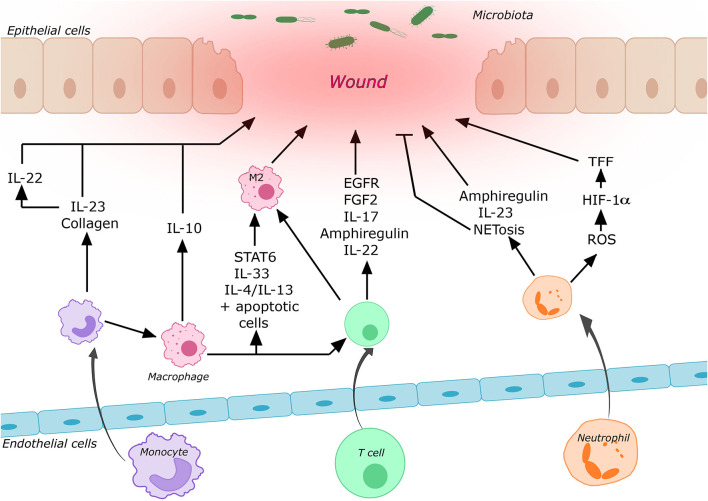
The intestinal epithelial barrier is carrying out two major functions: restricting the entry of potentially harmful substances while on the other hand allowing the selective passage of nutrients. Thus, an intact epithelial barrier is vital to preserve the integrity of the host and to prevent development of disease. Vice versa, an impaired intestinal epithelial barrier function is a hallmark in the development and perpetuation of inflammatory bowel disease (IBD). Besides a multitude of genetic, molecular and cellular alterations predisposing for or driving barrier dysintegrity in IBD, the appearance of intestinal mucosal wounds is a characteristic event of intestinal inflammation apparently inducing breakdown of the intestinal epithelial barrier. Upon injury, the intestinal mucosa undergoes a wound healing process counteracting this breakdown, which is controlled by complex mechanisms such as epithelial restitution, proliferation and differentiation, but also immune cells like macrophages, granulocytes and lymphocytes. Consequently, the repair of mucosal wounds is dependent on a series of events including coordinated trafficking of immune cells to dedicated sites and complex interactions among the cellular players and other mediators involved. Therefore, a better understanding of the crosstalk between epithelial and immune cells as well as cell trafficking during intestinal wound repair is necessary for the development of improved future therapies. In this review, we summarize current concepts on intestinal mucosal wound healing introducing the main cellular mediators and their interplay as well as their trafficking characteristics, before finally discussing the clinical relevance and translational approaches to therapeutically target this process in a clinical setting.
限制潜在有害物质的进入,另一方面允许营养物质选择性通过。因此,完整的上皮屏障对于维持宿主的完整性和预防疾病的发生至关重要。反之,肠道上皮屏障功能受损是炎症性肠病(IBD)发生和持续发展的一个标志。除了众多导致IBD屏障功能障碍或驱动其功能障碍的遗传、分子和细胞改变外,肠黏膜伤口的出现是肠道炎症的一个特征性事件,显然会导致肠道上皮屏障的破坏。损伤后,肠黏膜会经历一个伤口愈合过程来对抗这种破坏,这个过程由复杂的机制控制,如上皮修复、增殖和分化,也包括巨噬细胞、粒细胞和淋巴细胞等免疫细胞。因此,黏膜伤口的修复依赖于一系列事件,包括免疫细胞向特定部位的协调运输以及参与其中的细胞成分和其他介质之间的复杂相互作用。因此,更好地理解上皮细胞与免疫细胞之间的相互作用以及肠道伤口修复过程中的细胞运输,对于开发未来更好的治疗方法是必要的。在这篇综述中,我们总结了当前关于肠黏膜伤口愈合的概念,介绍了主要的细胞介质及其相互作用以及它们的运输特征,最后讨论了在临床环境中针对这一过程进行治疗的临床相关性和转化方法。