Silue Tenena, Agre Paterne Angelot, Olasanmi Bunmi, Adewumi Adeyinka Saburi, Adejumobi Idris Ishola, Abebe Abush Tesfaye
Pan African University Life and Earth Sciences Institute (including Health and Agriculture), University of Ibadan, Ibadan, Oyo State, Nigeria.
International Institute of Tropical Agriculture (IITA), Ibadan, Oyo State, Nigeria.
PLoS One. 2025 May 8;20(5):e0312079. doi: 10.1371/journal.pone.0312079. eCollection 2025.
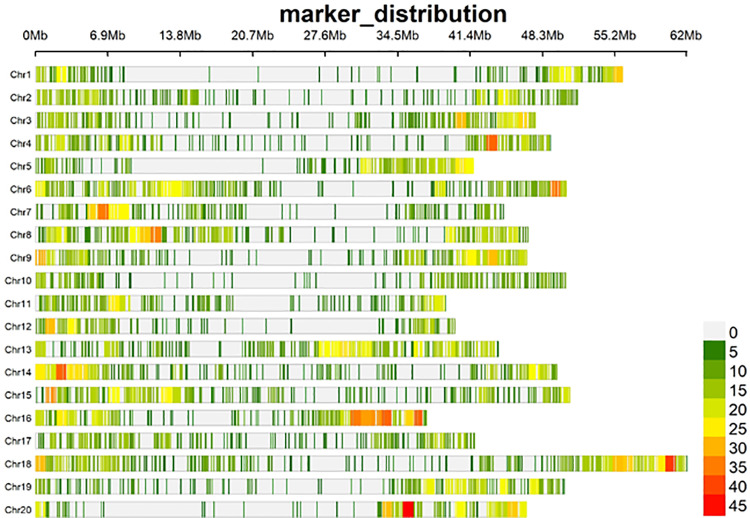
Soybean (Glycine max (L.) Merril) is a significant legume crop for oil and protein. However, its yield in Africa is less than half the global average resulting in low production, which is inadequate for satisfying the continent's needs. To address this disparity in productivity, it is crucial to develop new high-yielding cultivars by utilizing the genetic diversity of existing germplasms. Consequently, the genetic diversity and population structure of various soybean accessions were evaluated in this study. To achieve this objective, a collection of 147 soybean accessions was genotyped using the Diversity Array Technology Sequencing method, enabling high-throughput analysis of 7,083 high-quality single-nucleotide polymorphisms (SNPs) distributed across the soybean genome. The average values observed for polymorphism information content (PIC), minor allele frequency, expected heterozygosity and observed heterozygosity were 0.277, 0.254, 0.344, and 0.110, respectively. The soybean genotypes were categorized into four groups on the basis of model-based population structure, principal component analysis, and discriminant analysis of the principal component. Alternatively, hierarchical clustering was used to organize the accessions into three distinct clusters. Analysis of molecular variance indicated that the genetic variance (77%) within the populations exceeded the variance (23%) among them. The insights gained from this study will assist breeders in selecting parental lines for genetic recombination. The present study demonstrates that soybean improvement is viable within the IITA breeding program, and its outcome will help to optimize the genetic enhancement of soybeans.
大豆(Glycine max (L.) Merril)是一种重要的油料和蛋白质豆类作物。然而,其在非洲的产量不到全球平均水平的一半,导致产量较低,无法满足该大陆的需求。为了解决这种生产力差距,利用现有种质的遗传多样性开发新的高产栽培品种至关重要。因此,本研究评估了各种大豆种质的遗传多样性和群体结构。为实现这一目标,使用多样性阵列技术测序方法对147份大豆种质进行了基因分型,从而能够对分布在大豆基因组中的7083个高质量单核苷酸多态性(SNP)进行高通量分析。多态性信息含量(PIC)、次要等位基因频率、预期杂合度和观察到的杂合度的平均值分别为0.277、0.254、0.344和0.110。基于模型的群体结构、主成分分析和主成分判别分析,将大豆基因型分为四组。另外,使用层次聚类将种质组织成三个不同的聚类。分子方差分析表明,群体内的遗传方差(77%)超过了群体间的方差(23%)。本研究获得的见解将有助于育种者选择用于基因重组的亲本系。本研究表明,在国际热带农业研究所(IITA)的育种计划中,大豆改良是可行的,其结果将有助于优化大豆的遗传改良。