Zhang Lin, Liu Li Li, Zhu Zheng Bin, Xu Yan, Chen Kai, Duan Qing Qing, Li Yu Kai, Gao Jie, Song Meng, Shen Qiu Yu, Zhu Shao Jie, Jin Qing Qing, Wen Jian Ping, Feng Shuo, Lu Ying, Du Run, Ren Bin, Zhang Rui Yan
CAAC East China Aviation Personnel Medical Appraisal Center, Civil Aviation Shanghai Hospital, Shanghai, China.
Department of Cardiovascular Medicine, Rui Jin Hospital, Jiao Tong University School of Medicine, Shanghai, China.
Front Cardiovasc Med. 2025 Apr 24;12:1511358. doi: 10.3389/fcvm.2025.1511358. eCollection 2025.
The aim of the present study was to explore the value of coronary artery calcium score (CACS) using non-gated, non-contrast chest computed tomography (NCCT) to predict coronary artery disease (CAD) in airline pilots.
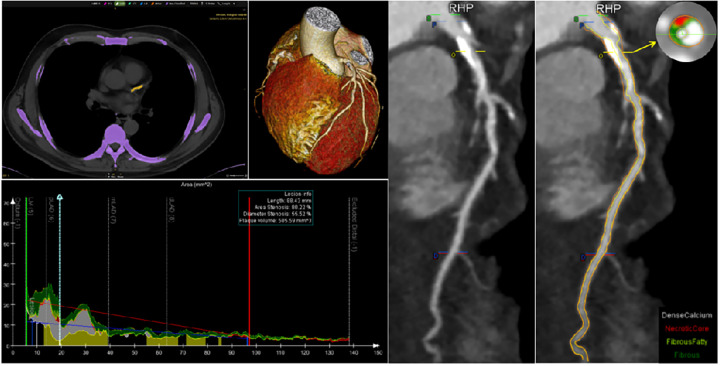
Pilots with coronary calcification found on NCCT were consecutively enrolled into this study. All received a coronary computed tomography angiography (CCTA) examination. The coronary artery calcium score (CACS) was evaluated on NCCT using the Agatston method. CCTA images were analyzed using a semi-automated software. Coronary Artery Disease Reporting and Data System (CAD-RADS) scoring categorized coronary stenosis.
A total of 217 male pilots were included, of which 49 were diagnosed with significant CAD (CAD-RADS category 3 or higher). Pilots with significant CAD had much higher CACS (324.28 ± 389.02 vs. 39.16 ± 68.88; < 0.001). Plaque volumetric measurements showed that total plaque volume (1,103.50 ± 285.51 mm vs. 913.18 ± 277.45 mm; < 0.001) and calcified plaque volume (149.77 ± 160.71 mm vs. 36.42 ± 26.86 mm; < 0.001) were more pronounced in individuals in the significant CAD group than those in the non-significant CAD group. A multivariate analysis demonstrated that CACS (odds ratio 1.01; 95% confidence interval 1.005-1.014; < 0.001) was the only independent risk factor of significant CAD but traditional cardiovascular risk factors, pre-existing medication regimens, or prolonged flight duration were not. CACS positively correlated with total plaque volume ( = 0.156; = 0.027) and calcified plaque volume ( = 0.434; < 0.001). Receiver operating characteristic curve analysis showed the area under the curve for the CACS in diagnosing significant CAD was 0.891 ( < 0.001).
CACS assessed using NCCT was significantly associated with CAD-RADS category 3 or higher, as confirmed by CCTA, which indicates that it may serve as a robust predictor for diagnosing significant CAD among airline pilots.
本研究的目的是探讨使用非门控、非增强胸部计算机断层扫描(NCCT)获得的冠状动脉钙化积分(CACS)预测航空公司飞行员冠状动脉疾病(CAD)的价值。
连续纳入在NCCT上发现冠状动脉钙化的飞行员进行本研究。所有受试者均接受了冠状动脉计算机断层扫描血管造影(CCTA)检查。使用阿加特斯顿方法在NCCT上评估冠状动脉钙化积分(CACS)。使用半自动软件分析CCTA图像。冠状动脉疾病报告和数据系统(CAD-RADS)评分对冠状动脉狭窄进行分类。
共纳入217名男性飞行员,其中49名被诊断为重度CAD(CAD-RADS分类为3级或更高)。重度CAD的飞行员CACS显著更高(324.28±389.02 vs. 39.16±68.88;P<0.001)。斑块体积测量显示,重度CAD组个体的总斑块体积(1103.50±285.51 mm vs. 913.18±277.45 mm;P<0.001)和钙化斑块体积(149.77±160.71 mm vs. 36.42±26.86 mm;P<0.001)比非重度CAD组更明显。多变量分析表明,CACS(比值比1.01;95%置信区间1.005-1.014;P<0.001)是重度CAD的唯一独立危险因素,而传统心血管危险因素、既往用药方案或飞行时间延长则不是。CACS与总斑块体积(r=0.156;P=0.027)和钙化斑块体积(r=0.434;P<0.001)呈正相关。受试者工作特征曲线分析显示,CACS诊断重度CAD的曲线下面积为0.891(P<0.001)。
经CCTA证实,使用NCCT评估的CACS与CAD-RADS分类为3级或更高显著相关,这表明它可能是诊断航空公司飞行员重度CAD的有力预测指标。