
股票市场波动与严重精神障碍之间的关联:一项多城市时间序列研究。
Association between stock market volatility and severe mental disorders: a multi-city time-series study.
作者信息
Hu Jiangli, Yin Yantao, Guo Ruiqing, Wang Yunqiong, Ji Shuming, Wang Jinyu, Feng Benying, Qian Jian, Zhou Bo, Li Hui, Liao Fang
机构信息
Sichuan Provincial Center for Mental Health, Sichuan Provincial People's Hospital, School of Medicine, University of Electronic Science and Technology of China, Chengdu, China.
Key Laboratory of psychosomatic medicine, Chinese Academy of Medical Sciences, Chengdu, China.
出版信息
SSM Popul Health. 2025 Apr 23;30:101807. doi: 10.1016/j.ssmph.2025.101807. eCollection 2025 Jun.
BACKGROUND
Stock market volatility was commonly considered as a psychological stressor. However, the association between stock market volatility and severe mental disorders (SMD) has not been investigated.
METHODS
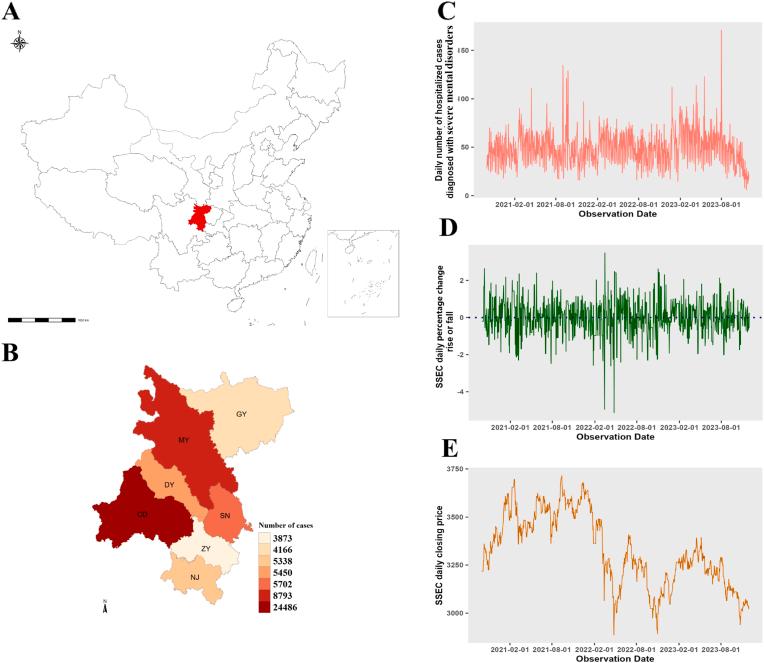
Daily numbers of SMD hospital admissions and Shanghai Stock Exchange Composite (SSEC) Index in 7 cities in southwestern China from 2020 to 2023 were collected. A two-stage time-series analysis was conducted to reveal the association between stock volatility and the risk of hospital admission for SMD. Stratified analyses were performed by age, gender, and ICD-10 codes to explore potential high-risk groups.
RESULTS
The association between the SSEC percentage change, SSEC closing price and SMD hospital admissions both exhibit a U-shaped curve. A 1 % decrease in SSEC is associated with a 7.2 % (95 %CI: 4.1 %-10.4 %) increase in the SMD admission, while a 1 % increase in SSEC is associated with a 2.6 % (95 %CI: 0.1 %-5.2 %) increase in the SMD admissions. With 3400 points as the dividing point, every 10-point increase in SSEC closing price is associated with a 9 % (95 %CI: 3.6 %-14.7 %) increase in the SMD hospital admissions, while each 10-point decrease is associated with a 4.4 % (95 %CI: 0.6 %-8.3 %) increase in the SMD hospital admissions. Furthermore, these associations tended to be stronger in the female and non-schizophrenia patients.
CONCLUSION
These associations indicate that both rise and fall in stock prices increase the risk of SMD. This finding suggests that it is an effective way to take the stock speculation behavior into consideration when managing and treating the SMD patients.
背景
股市波动通常被视为一种心理压力源。然而,股市波动与严重精神障碍(SMD)之间的关联尚未得到研究。
方法
收集了2020年至2023年中国西南部7个城市SMD住院患者的每日数量以及上海证券交易所综合指数(SSEC)。进行了两阶段时间序列分析,以揭示股市波动与SMD住院风险之间的关联。按年龄、性别和国际疾病分类第十版(ICD - 10)编码进行分层分析,以探索潜在的高危人群。
结果
SSEC百分比变化、SSEC收盘价与SMD住院人数之间的关联均呈现U形曲线。SSEC下降1%与SMD住院人数增加7.2%(95%置信区间:4.1% - 10.4%)相关,而SSEC上升1%与SMD住院人数增加2.6%(95%置信区间:0.1% - 5.2%)相关。以3400点为分界点,SSEC收盘价每上涨10点与SMD住院人数增加9%(95%置信区间:3.6% - 14.7%)相关,而每下跌10点与SMD住院人数增加4.4%(95%置信区间:0.6% - 8.3%)相关。此外,这些关联在女性和非精神分裂症患者中往往更强。
结论
这些关联表明股价的上涨和下跌都会增加SMD的风险。这一发现表明,在管理和治疗SMD患者时考虑股票投机行为是一种有效的方法。



 Zotero 插件